Israeli settler sanctions spark ambassador’s retaliation vow
Israeli settler sanctions: Israel's ambassador to Australia vows retaliation after Penny Wong blacklists seven targets over West Bank settlement activity.
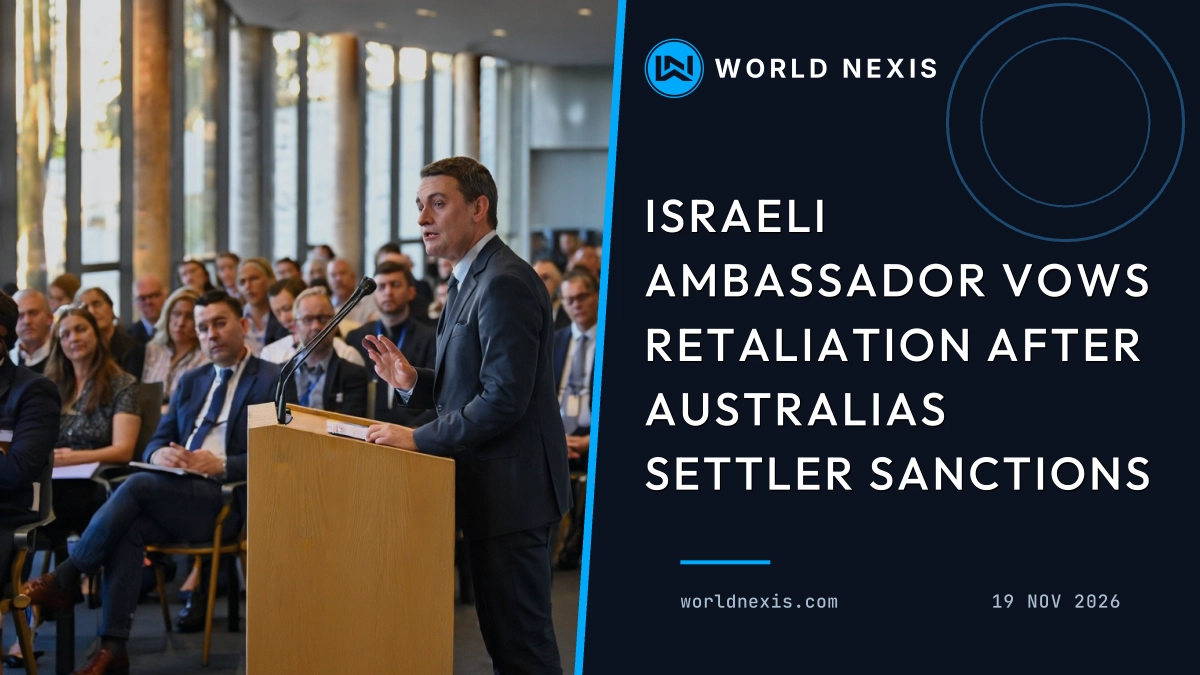
Australia’s Israeli settler sanctions have drawn an explicit retaliation warning from Israel’s ambassador, a day after Foreign Minister Penny Wong blacklisted three individuals and four organisations over illegal settlement activity in the West Bank. Ambassador Hillel Newman told a forum on Thursday afternoon that Israel “is going to respond”, accusing Canberra of “megaphone diplomacy”.
Key points
- Australia’s Israeli settler sanctions cover three individuals and four organisations linked to illegal settlement activity in the West Bank.
- Australians and Australian businesses are now barred from trading with the named people and entities, or providing them with financial support.
- Itamar Yehuda Levi and Eyal Hari Yehuda Company Ltd are the first construction firm and company owner to be targeted, with Australian businesses barred from bidding for tenders with the firm.
- Ambassador Hillel Newman said Israel would reciprocate, warning his country is “not going to be a mattress that everyone just walks over”.
What the Israeli settler sanctions cover
Senator Wong set out the designations on Wednesday, and they took effect under Australian law. Australians and Australian businesses can no longer trade with the three individuals and four organisations on the list, or channel financial support to them.
The Israeli settler sanctions mark the first time a construction company and its boss have been listed. Senator Wong named Itamar Yehuda Levi and Eyal Hari Yehuda Company Ltd, saying they were involved in building illegal settler developments in the Palestinian territory. The listing makes it unlawful for Australian businesses to bid for tenders with the firm.
The package also targets Daniela Weiss, 81, and her organisation Nachala. Weiss has been at the forefront of expanding Israeli settlements in the West Bank for decades and has for some time been subject to sanctions from the UK and the European Union.
The scope is deliberately narrow. Nothing in the announcement restricts trade with Israel itself; the prohibitions bite on dealings with the named people and entities rather than on Israeli companies at large.
A spokesperson for Australia’s Department of Foreign Affairs and Trade said the measures were taken with international partners: “Australia’s targeted action with international partners supports a two-state solution, the only viable path to enduring peace and security for Israelis and Palestinians alike.”
Ambassador warns of retaliation over ‘megaphone diplomacy’
Mr Newman used a combative forum address on Thursday afternoon to reject the decision and promise a response. He argued the two governments should settle their differences in “closed rooms” rather than through public announcements, and labelled the designations “megaphone diplomacy”.
He was careful to stress the value of the relationship even as he criticised the move, describing Australia as one of the most important international relationships for Israel and saying he has more discussions with the foreign minister’s office than many ambassadors around the world.
His warning about consequences was blunt. He said he wanted to tell his audience that Israel is going to respond, and that Israel is “not going to be a mattress that everyone just walks over”. “When sanctions are taken against Israel, doesn’t matter what aspect in Israel, Israel is going to reciprocate,” he said.
A government spokesman said: “The Israeli government is considering its response and will announce any decisions at the appropriate time.”
Why it matters
For Australian businesses, the Israeli settler sanctions create a hard legal line where previously there was only political pressure. Any firm that trades with the listed entities, funds them, or bids alongside Eyal Hari Yehuda Company Ltd now risks acting unlawfully.
The Israeli settler sanctions also align Australia with the UK and the European Union, which have already sanctioned Weiss. That coordination turns a national gesture into part of a wider pressure campaign over settlement expansion.
The framing matters too. Canberra presents the designations as support for a two-state solution, which keeps the argument on end goals rather than punishment, a distinction that will shape how the promised Israeli response is received.
For the wider alliance, the exchange is a test of how much friction a close partner can absorb, and whether public designations become a normal tool between friends.
Analysis
Having covered sanctions and alliance management for World Nexis News, I look first at how narrow a designation is, because breadth is what usually turns a listing into a diplomatic rupture. The Israeli settler sanctions are narrow by design: seven names, no embargo on Israel, and a package explicitly taken with international partners.
I think the facts support Senator Wong’s approach rather than the ambassador’s. The strongest counter-argument is that public designations do shrink the room for quiet bargaining, and that a friend as close as Australia is often more useful inside a closed room than outside one. But the closed-room method is the one that has been tried, and Weiss’s place on UK and EU lists shows where it leaves allies: converging on the same handful of names while construction continues.
What I will watch is whether Israel’s promised response is calibrated or theatrical. A reciprocal listing of Australian officials would be cheap and reversible; anything touching defence co-operation or trade would be a genuine rupture. Either way, the lesson is that targeted sanctions now carry a price, and Canberra should say plainly what it thinks that price is worth.
What happens next
The Israeli settler sanctions are already in force. Israel’s government says it is considering its response and will announce any decisions at the appropriate time, so the timing and the form of any countermeasure remain open.
What we don’t know yet
Three questions are unresolved. It is not yet known what Israel will do, whether any response will reach trade, travel or diplomatic access, or whether further partners will add the same names. No additional Australian designations have been announced.
Related coverage
- West Bank sanctions: UK names all eight firms hit by asset freezes
- Trump Xi Putin meeting: first trilateral, major stakes
- Trump Xi summit: historic first three-way talks with Putin
Further reading
- Retaliation for settler sanctions: Israeli ambassador
- Retaliation for settler sanctions: Israeli ambassador
About the author: Marcus Ellington is the International Correspondent at World Nexis News (WNN), covering world affairs. The analysis section reflects the writer’s view.

Marcus Ellington
Marcus Ellington is International Correspondent at World Nexis News, reporting on diplomacy, conflict and the political forces reshaping Europe, the Middle East, Asia and the Americas. Based in London, he focuses on explaining why events unfold as they do, using official statements, diplomatic documents and…



