Kemi Badenoch EU warning: Burnham dragging UK backwards
Kemi Badenoch EU warning: the Conservative leader says Andy Burnham's summit deals will drag Britain backwards. Here is what is on the table.
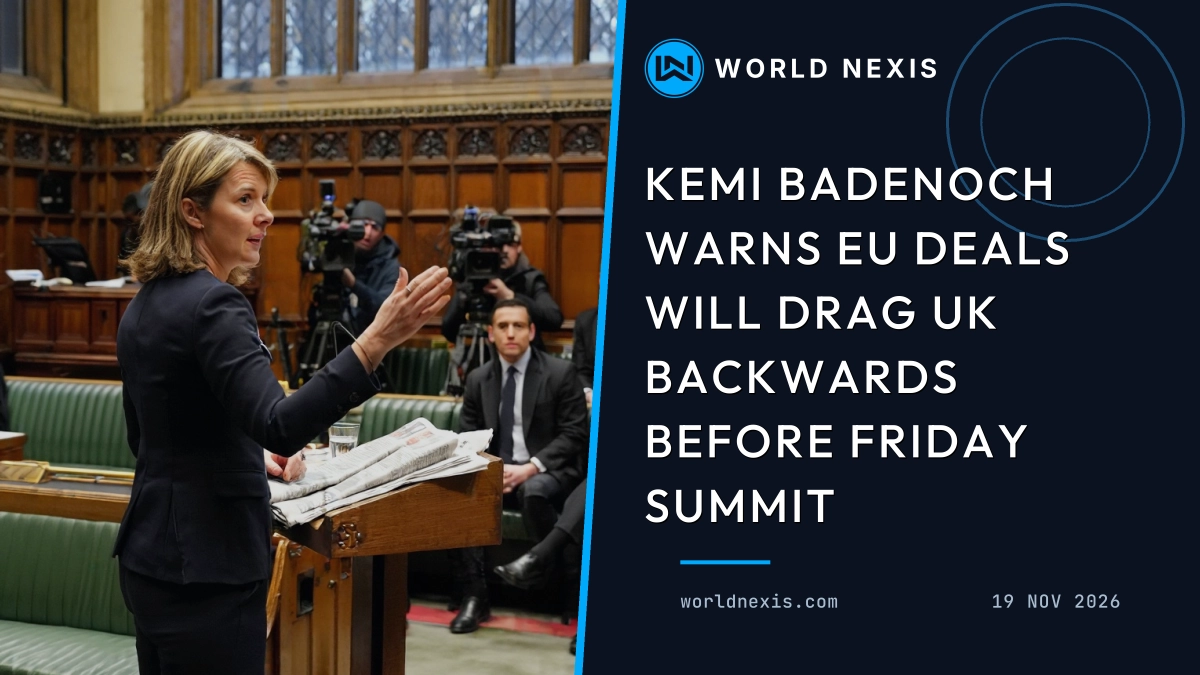
Kemi Badenoch EU criticism has framed a difficult week in Westminster, the day before the Prime Minister attends a European summit. The Conservative leader accused Andy Burnham of dragging Britain “backwards” by deepening ties with the bloc, arguing that easier trade does not justify what she calls a loss of sovereignty.
Key points
- Kemi Badenoch says closer EU ties will not deliver enough growth to justify the sovereignty she says is lost.
- Andy Burnham is due to sign agreements on food, energy and youth mobility at Friday’s summit.
- David Lammy, the former deputy prime minister, says Labour should campaign to rejoin the EU.
- A youth mobility scheme for under-30s is being negotiated, with the visa cap still unresolved.
The Kemi Badenoch EU intervention, in her own words
In a newspaper article published before the summit, the Conservative leader accepted that making trade easier is “a good thing”. She then drew a hard line between practical co-operation and what she describes as surrender.
“There is a world of difference between practical co-operation with our neighbours and giving up the freedoms Britain voted for in 2016.”
Her central charge is that the Prime Minister is retreating on the three tests she says defined the referendum. She listed control over money, laws and borders, then concluded that on every one of them Mr Burnham is moving the country the wrong way.
“The three central purposes of Brexit were control over our money, over our laws and over our borders. On each of those, Burnham is moving us backwards.”
Ms Badenoch also questioned the Prime Minister’s mandate. She said Keir Starmer led Labour into the last general election on a promise not to reopen the EU relationship. Mr Burnham, she wrote, is now pursuing “his own divisive agenda”.
“Andy Burnham stabbed him in the back and is now pursuing his own divisive agenda.”
She went on to argue that successive governments “haven’t made nearly enough” of the opportunities Brexit created. That framing is telling, because it blames ministers rather than the settlement itself for the trade friction businesses now face.
What the summit is expected to deliver
The Prime Minister is due to sign new agreements covering food, energy and youth mobility. He has said the current Brexit deal is not good enough, a judgment that places him closer to the critics than to the defenders of the status quo.
The youth mobility scheme would let people under 30 travel, work and study more easily between the UK and the EU, possibly from 2028. Negotiations are not finished. The cap on how many visas would be available is still being argued over, and the package may include reduced university fees for EU nationals.
Lammy pushes Labour the other way
David Lammy, the former deputy prime minister, used a Wednesday broadcast interview to argue that his party should go further than the government. He said Labour should campaign to rejoin the EU and put the question to voters.
“I have no doubt that we should campaign to go back in.”
He set out what he sees as the real choice, between a limited customs arrangement and full membership. He ruled out the single market on the grounds that Britain cannot be “a rule taker” while holding a seat on the security council.
“There are only really two choices: we either do a sort of mini-thing with the EU Customs Union or we go back in.”
Mr Lammy also tried to turn the argument on the two leaders who want distance from Brussels. He said voters should hear that Nigel Farage and Ms Badenoch would prefer a no-deal Brexit. In his account, leaving the European Convention on Human Rights would force the trade deal back to the table.
Why it matters
For households, the summit package is about prices and paperwork. Food and energy agreements could reduce checks on goods and cut costs that currently pass through to consumers, though the scale is still unclear.
For young people, mobility is the most concrete offer on the table: the chance to work or study on the continent without today’s visa obstacles. The unresolved cap on numbers will decide how real that offer turns out to be.
For politics, the Kemi Badenoch EU attack reframes the argument. Both the Conservative leader and a former Labour deputy prime minister now call the current deal inadequate, from opposite directions. That leaves the government defending a settlement nobody in the debate praises.
Analysis
Having covered Westminster and devolution for World Nexis News, I check the arithmetic before the volume. On the evidence here, Ms Badenoch’s case is weaker than her certainty suggests. She concedes that making trade easier is a good thing, then treats almost any agreement as a surrender of the 2016 vote. That is a test no government could ever pass. A country trading with its nearest market will always accept some shared rules.
The Kemi Badenoch EU argument is strongest on consent, and I will not dismiss it. She is right that the last election was fought on a promise not to reopen the EU relationship. Voters are entitled to ask who authorised a bigger package. But a mandate for a programme is not a veto on every later deal, and the honest verdict on food, energy and mobility will come from bills and queues, not from newspaper columns.
In my view the government’s practical approach is the better bet for readers in the short term. Mr Lammy’s rejoin pitch is the bigger long-term risk to it. The counter-argument is fair: if these deals are as modest as ministers suggest, they will not repair the trade damage either. Modest help is still help, and refusing it on principle costs households money now.
What happens next
The Prime Minister attends the European summit on Friday, when the food, energy and youth mobility agreements are expected to be signed. Officials will then try to settle the visa cap, with the scheme possibly opening in 2028.
What we don’t know yet
- How many visas the youth mobility scheme will offer, and whether the cap can be agreed at all.
- Whether reduced university fees for EU nationals survive the final text.
- Whether Mr Lammy’s call for a rejoin campaign wins support inside Labour or remains a personal view.
- How much the food and energy deals will actually change costs for households.
Related coverage
- Neet welfare reforms could extend to over-25s, Burnham says
- Met Office snow warning brings rush hour travel disruption
- Bayesian sinking report: crew never warned of wind risk
Further reading
- Prime Minister’s EU talks will drag the UK ‘backwards’, Kemi Badenoch says
- Prime Minister’s EU talks will drag the UK ‘backwards’, Kemi Badenoch says
About the author: Liam O’Connor is the UK Politics Reporter at World Nexis News (WNN), covering uk politics. The analysis section reflects the writer’s view.

Liam O'Connor
Liam O'Connor is UK Politics Reporter at World Nexis News, covering Westminster, devolved politics and the issues that matter to voters across England, Scotland, Wales and Northern Ireland. Based in London, he reports from primary sources — Hansard, official statements, published data — and explains…



