Neet welfare reforms could extend to over-25s, Burnham says
Andy Burnham says Neet welfare reforms for 16 to 24-year-olds could be applied to over-25s, as Alan Milburn urges action on older claimants.
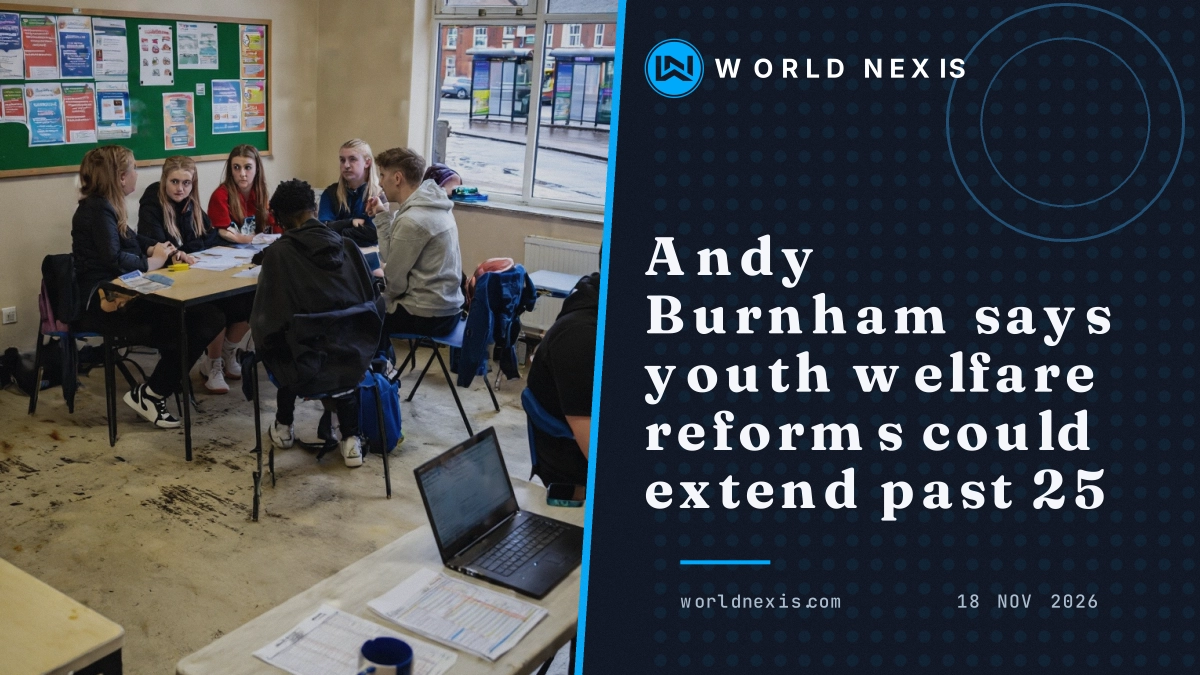
The government’s Neet welfare reforms could be widened to people over 25, Andy Burnham has said, after a review by Alan Milburn proposed an entirely new benefit system for young people. The prime minister told The Times that the “same philosophy” could apply “right through the age range”. The Alan Milburn report, published on Tuesday, sets a 10-year goal of cutting the Neet rate among 16 to 24-year-olds from around 13% to 5%.
Key points
- Alan Milburn’s review sets a 10-year plan to cut the number of 16 to 24-year-olds who are Neet from about 13% — roughly a million people — to 5%.
- It proposes a “youth allowance” replacing the health element of universal credit and Pip for that age group, redirecting £3.6 billion a year into jobs and training.
- Andy Burnham said the “same philosophy” behind the Neet welfare reforms could apply to over-25s.
- A white paper is expected early next year, after Sir Stephen Timms’s review of Pip.
What the Neet welfare reforms would change
Milburn, a former Labour cabinet minister, was commissioned by the government to examine why so many young people sit outside work and study. His answer is a substantial shake-up of working-age benefits: the Neet welfare reforms would move around £3.6 billion a year out of welfare payments and into measures designed to get 16 to 24-year-olds into jobs or training.
At the centre sits what the report calls an “entirely new benefit system for young people”. A so-called youth allowance would replace both the health element of universal credit and personal independence payment for 16 to 24-year-olds.
Roughly one million people in that age group are currently classed as Neet, and the review wants that share cut to 5% within a decade. The government has not immediately committed to every change, which would cost up to £5.8 billion a year.
Furthermore, the package is far less of a money-saver than the headline figures imply. With the £3.6 billion shift and a projected £2.4 billion of extra tax revenue from people moving into work, it would still deliver only £200 million of savings in 2036-37 once youth support, tax breaks and hiring bonuses are paid for.
Burnham hints Neet welfare reforms could reach older claimants
Milburn was careful to say that over-25s fall beyond the scope of his review. However, he argued that the “design features” of his model could be “applied to the older cohort of claimants”. He wrote that the government “should act with urgency to bring forward new proposals for a reformed welfare system for those aged 25 and over”.
The prime minister went further in an interview with The Times. “I think the same philosophy could apply right through the age range,” Burnham said. “What we are doing is creating an approach that is preventative, that supports people where they can prosper. The same applies up the age range.”
Sir Stephen Timms’s separate review of personal independence payment is running in parallel, and the white paper is expected after both pieces of work are published. That sequencing means any decision on older claimants will land only once the youth system has been redrawn.
Labour pressure and warnings over a two-tier system
Burnham said he was “confident” that Labour backbenchers would back the Neet welfare reforms, after they hampered previous government attempts to cut the welfare bill. A white paper is expected early next year, following Milburn’s report and the Timms review of Pip.
Not everyone is persuaded. In the Guardian, the columnist Frances Ryan wrote that the plan has positive aspects but will cause “huge anxiety” for young people with disabilities, and warned of a two-tier welfare state. Her objection goes to the heart of the design: entitlement would turn partly on age rather than on assessed need.
Alongside the benefit changes, the report announced locally led youth services from next year, bringing together employment, health, skills and wider support. It also committed the government to an “opportunity and support guarantee” so that every young person not earning or learning has a route into education, training, an apprenticeship, high-quality work experience or a job. A new youth opportunities unit, chaired by Milburn and reporting directly to the prime minister, will try to join up education, employment, health and local government.
Analysis
Having covered public services and devolution for WNN, I look first at how these Neet welfare reforms would be delivered — and at what the numbers say about scaling them. Burnham’s instinct is not unreasonable: the cliff edge at 25 is arbitrary, and nothing in the design of a preventative, work-focused allowance is inherently tied to a birthday.
Even so, I think the evidence in the report supports Milburn’s caution about extending the Neet welfare reforms rather than the prime minister’s broader hint. Milburn explicitly puts over-25s outside his remit, and the £200 million saving projected for 2036-37 shows this is not a package that pays for itself. Stretching a youth allowance over older claimants before the white paper and the Timms review have landed risks repeating the pattern where disability support gets swept up in a back-to-work drive. The strongest counter-argument is that the status quo — about a million young people Neet — is itself a failure, and that caution has not served them well.
What I would watch is what “design features” actually means in practice: a reformed assessment, or simply tougher conditionality applied to more people. I would also watch whether locally led youth services arrive with real funding or only a mandate, because the delivery end is where previous Neet welfare reforms have quietly come apart.
What happens next
The next stage of the Neet welfare reforms comes with the white paper on welfare reform, expected early next year after Milburn’s report and the Timms review of Pip. New locally led youth services are due to start next year, and the youth opportunities unit will report directly to the prime minister. The government has yet to commit to every recommendation, and no timetable has been set for proposals covering claimants aged 25 and over.
Related coverage
- Brexit reset: Burnham says major EU deal can lift GDP 0.4%
- Chinese automakers could fill Canada auto gap, Carney warns
- Stormont brake: DUP request rejected as 30 MLA test not met
Sources
- Hoping for Britain to rejoin the EU with Andy Burnham? You may be waiting a long time | Timothy Garton Ash (theguardian.com)
- Burnham suggests Neet welfare reforms could also be applied to over-25s (swindonadvertiser.co.uk)
- Burnham suggests Neet welfare reforms could also be applied to over-25s (eppingforestguardian.co.uk)
- Burnham suggests Neet welfare reforms could also be applied to over-25s (watfordobserver.co.uk)
- Burnham suggests Neet welfare reforms could also be applied to over-25s (stourbridgenews.co.uk)
About the author: Liam O’Connor is World Nexis News’s UK Politics Reporter, covering uk politics. The analysis section reflects the writer’s view.

Liam O'Connor
Liam O'Connor is UK Politics Reporter at World Nexis News, covering Westminster, devolved politics and the issues that matter to voters across England, Scotland, Wales and Northern Ireland. Based in London, he reports from primary sources — Hansard, official statements, published data — and explains…



