Stormont brake: DUP request rejected as 30 MLA test not met
Northern Ireland Secretary Sir Chris Bryant rejected a DUP-led request to use the Stormont brake against EU customs rules, saying the test was not met.
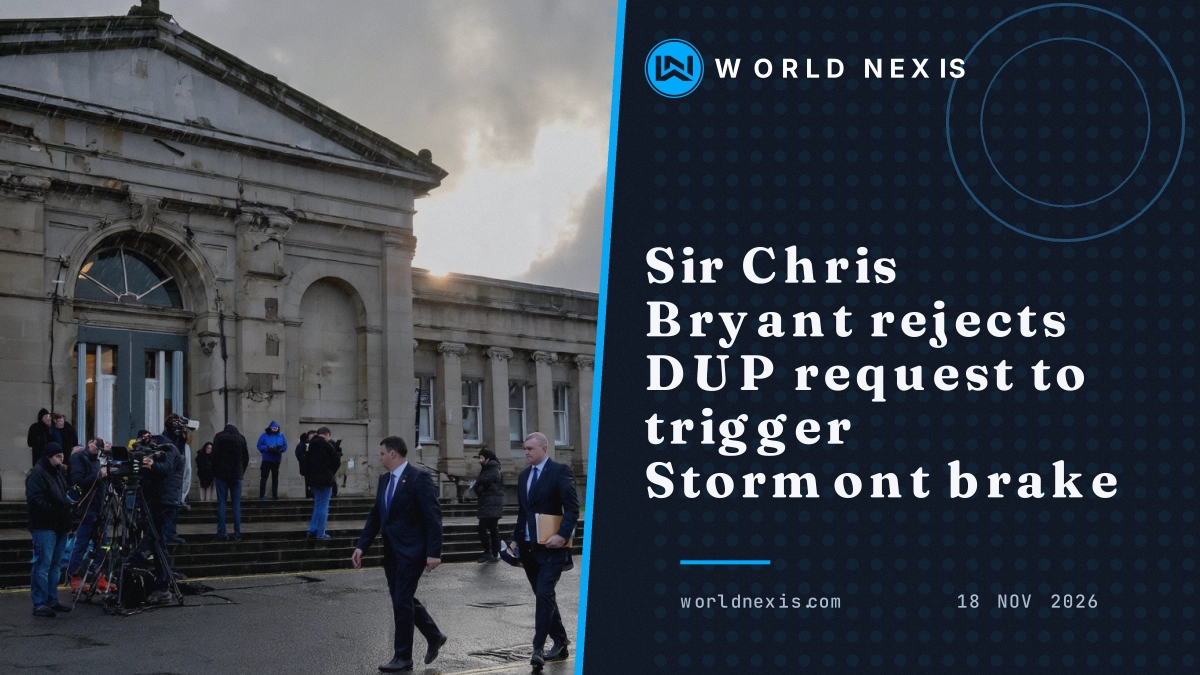
The Stormont brake was refused on Tuesday 17 November 2026, when Northern Ireland Secretary Sir Chris Bryant rejected a DUP-led request to block new EU customs legislation from applying in the region. The petition reached the UK Government on 6 November, signed by MLAs from more than one unionist party, but ministers ruled it did not clear the legal threshold.
The mechanism sits at the centre of the 2023 Windsor Framework, the post-Brexit agreement between London and Brussels. It was written to give Stormont a formal say when EU rules that apply in Northern Ireland are amended, answering unionist concerns about the region’s place in the UK internal market.
Key points
- Sir Chris Bryant rejected the DUP-led Stormont brake request on Tuesday 17 November.
- The petition was lodged on 6 November and targeted the EU’s revised Union Customs Code.
- Alliance deputy leader Eóin Tennyson called it an “attempted abuse” of the mechanism.
- DUP leader Gavin Robinson condemned the decision but welcomed unionist cooperation.
What the Stormont brake is and how it was used
Under the Windsor Framework and its predecessor, the Northern Ireland Protocol, goods moving from Great Britain into Northern Ireland face checks and customs paperwork. The arrangements were built to avoid a hardened land border with the Republic of Ireland, and they leave Northern Ireland following many EU trade and customs rules.
The Stormont brake allows a minimum of 30 MLAs, drawn from at least two parties, to refer a proposed EU law change to the UK Government. Ministers then assess the proposal and decide whether the objection is upheld.
This time the target was the Union Customs Code, which will replace national customs IT systems with a single, centralised online portal. The MLAs who signed the request argued the reforms would create complexity for business and push up costs and burdens, both inside Northern Ireland and on Great Britain to Northern Ireland movements.
Why the Stormont brake request failed the legal test
Sir Chris concluded that the test was not met. In his assessment, the reform is aimed at simplifying the customs rules and processes that apply in Northern Ireland rather than making them more complex.
He also noted that the change will be implemented over a period running to 2034, giving businesses time to adapt. That timetable weighed against any claim that traders face an immediate new burden.
Eóin Tennyson was blunt. “This stunt was always destined to fail,” the Alliance deputy leader said, describing the DUP’s intervention as “particularly counterproductive and unhelpful in the run-up to a major UK-EU summit”.
He argued that progress is being made towards an agreement that could significantly reduce checks in the Irish Sea, cut costs and provide much-needed certainty for businesses. “Rather than building on that momentum and grasping the opportunities afforded by dual market access, this ongoing war of attrition is fuelling uncertainty and instability,” he said.
Tennyson also pointed to a former DUP MP for Upper Bann, who he said had admitted the party “actively misled” its own supporters on Brexit. “Northern Ireland cannot afford to keep paying the price for the DUP’s disastrous Brexit strategy and internal wrangling,” he added.
Unionist reaction to the ruling
Gavin Robinson said he disagreed with the outcome while welcoming the joint approach taken by unionist parties. “Whilst we condemn the Secretary of State for this decision it was right for unionist MLAs to work co-operatively to raise our significant concerns,” the DUP leader said.
He aimed his fire at smaller unionist groupings that criticised the move. “Those small number of unionist representatives, who thrive on attacking the DUP, would be better served by recognising it was the Secretary of State who made this decision, and yet he would hold all power in Northern Ireland if we followed the course of action they advocated,” he said.
Analysis
Having covered devolution and Northern Ireland for WNN, I look first at what a mechanism was built to do before judging whether it has been used properly. The Stormont brake exists to catch EU amendments that would leave Northern Ireland diverging from Great Britain in a way that creates new and lasting burdens. A customs reform that consolidates national IT systems into one portal, phased in to 2034, is a poor fit for that test, so Sir Chris Bryant’s reading looks right to me and Eóin Tennyson is on the stronger ground.
The political cost, though, is real. The DUP has spent years telling its voters that the Stormont brake was the safeguard that made the Windsor Framework tolerable. Watching a Westminster secretary of state rule the request out on a technical assessment hands critics an easy answer: the lever exists, but someone else decides whether it works. That is the strongest counter-argument, and it reflects a genuine democratic deficit rather than a complaint to be waved away.
Still, the consequences for readers in Northern Ireland point one way. Businesses want fewer checks and a settled timetable before the next UK-EU summit, not another round of constitutional theatre. In my view, the Stormont brake should be kept for the cases it was written for, and unionist parties should spend their leverage on shaping the deal being negotiated now rather than relitigating 2023.
What happens next
The Union Customs Code changes will roll out over the period to 2034, with businesses expected to adapt as national systems are replaced by the central portal. Unionist MLAs have said they will keep pressing their concerns about cost and complexity for traders.
Tennyson’s remarks point to the next flashpoint: the major UK-EU summit, where an agreement that could reduce Irish Sea checks is under discussion. How that negotiation lands will matter far more to Northern Ireland firms than the fate of this Stormont brake request.
Related coverage
- NSMC meeting: DUP warned not to ‘punish’ NI public
- Omagh Bombing Inquiry: families formally request Irish public inquiry
- Met Office snow warning brings rush hour travel disruption
Sources
- DUP’s ‘attempted abuse’ of the Stormont brake was destined to fail – Alliance (dudleynews.co.uk)
- DUP’s ‘attempted abuse’ of the Stormont brake was destined to fail – Alliance (impartialreporter.com)
- DUP’s ‘attempted abuse’ of the Stormont brake was destined to fail – Alliance (thisisoxfordshire.co.uk)
- DUP’s ‘attempted abuse’ of the Stormont brake was destined to fail – Alliance (bournemouthecho.co.uk)
- DUP’s ‘attempted abuse’ of the Stormont brake was destined to fail – Alliance (salisburyjournal.co.uk)
About the author: Liam O’Connor is World Nexis News’s UK Politics Reporter, covering uk politics. The analysis section reflects the writer’s view.

Liam O'Connor
Liam O'Connor is UK Politics Reporter at World Nexis News, covering Westminster, devolved politics and the issues that matter to voters across England, Scotland, Wales and Northern Ireland. Based in London, he reports from primary sources — Hansard, official statements, published data — and explains…