Omagh Bombing Inquiry: families formally request Irish public inquiry
The Omagh Bombing Inquiry heard police chief Norman Baxter say Sinn Féin was content with 1998 bombings, as Michelle O'Neill rejected the claim.
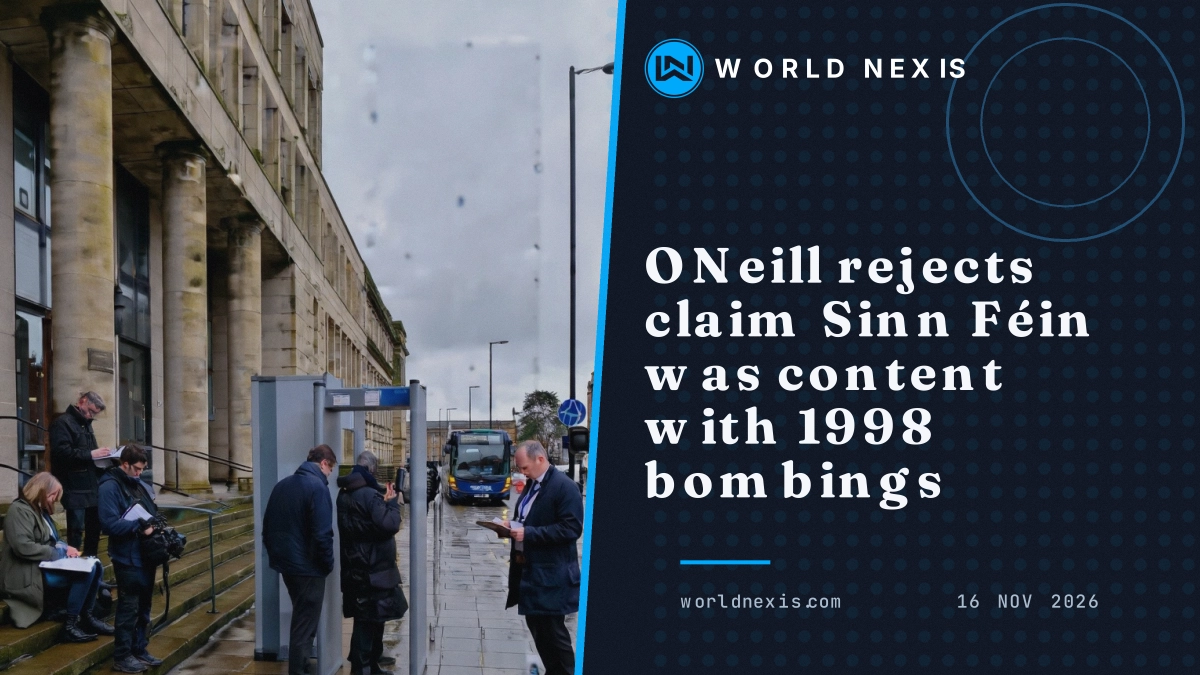
Updated 17 Nov 2026, 13:46 (UK time): Claire Hayes gave fuller remarks saying she is “fed up hearing words” after 28 years and wants to meet the Taoiseach directly, as reports detailed Norman Baxter’s claim that a “Garda-MI5 source” was involved in the Omagh attack.
The sister of a man killed in the Omagh bombing has said she is “fed up hearing words” after 28 years and wants to put her case for an Irish public inquiry to the Taoiseach in person. Claire Hayes, whose brother Alan Radford was among the 29 killed on 15 August 1998, told BBC Radio Ulster she would like to meet Micheál Martin, saying the British state is “clearly implicated here, and so is the Irish state”, the Standard reported. She said action, not more words, was needed.
Her remarks followed fuller reporting of Norman Baxter’s evidence to the Omagh Bombing Inquiry. The retired chief superintendent, who led the police investigation from 2002 until 2008, contended that a “Garda-MI5 source” had been involved in carrying out the attack, and said there were “strong indications” that gardaí and the Irish Republic had knowledge of dissident republican activity that was not shared with police north of the border before or after 15 August, according to the Standard.
Hayes thanked Baxter for giving his evidence “with respect and integrity”, which she said had given her clarity, while stressing that the blame would always belong to the perpetrators. The Irish government has committed to being “fully forthcoming” with information, documentation and evidence for the Belfast tribunal chaired by Lord Turnbull, but has not committed to a public inquiry of its own.
My take: the allegation of an Irish state-linked source is the most uncomfortable strand of Baxter’s evidence for Dublin, and it makes “fully forthcoming” look like a holding position rather than an answer.
Updated 17 Nov 2026, 11:35 (UK time): Families of 54 core participants formally wrote to the Taoiseach requesting an Irish public inquiry into the Omagh bombing, and Claire Hayes, whose brother Alan Radford was killed, said she wants to meet Micheál Martin to make the case directly.
The Omagh Bombing Inquiry story has moved beyond the witness box. On Monday evening solicitors for 54 core participants — the families of 16 of those murdered and 10 survivors — wrote to the Taoiseach formally asking the Irish government to commit to a public inquiry, the BBC reported. Fox Law said the time had come to “lift every stone” and uncover the “unvarnished truth”.
On Tuesday Claire Hayes, whose brother Alan Radford was killed in the 1998 attack, told BBC Radio Ulster she wants to meet Micheál Martin and put the case to him in person, saying both governments must be held accountable. She thanked Norman Baxter for giving his evidence “with respect and integrity”, while stressing the blame belongs with the perpetrators.
Asked about that demand, the Taoiseach indicated he is not contemplating a separate inquiry, according to reports. The Irish government has already committed to being “fully forthcoming” with information, documentation and evidence for the Belfast tribunal chaired by Lord Turnbull.
My take: the pressure has shifted from what Sinn Féin knew to what Dublin will do, and “fully forthcoming” is not the same answer as a public inquiry.
The Omagh Bombing Inquiry has heard the officer who led the Omagh bombing investigation from 2002 allege that Sinn Féin’s leadership was “content” with the dissident bombing campaign of early 1998, a claim First Minister Michelle O’Neill has rejected. Retired PSNI chief superintendent Norman Baxter told the Belfast hearing on Monday that the campaign was “beneficial” to the party’s negotiations with the British government. The inquiry, chaired by Lord Turnbull, is examining whether the attack of 15 August 1998 could have been prevented. Twenty-nine people died, including a woman pregnant with twins.
Key points
- Norman Baxter, senior investigating officer on the Omagh bombing investigation from 2002 until 2008, gave evidence for a third day.
- He said the Sinn Féin leadership were “content that there were bombs happening” so they could tell the British government not to push them too far.
- Michelle O’Neill said she “absolutely” did not agree and that Sinn Féin was “unequivocal” in condemning the bombing.
- Baxter also told the inquiry that UK security services colluded in the bombing and that he suspected obstruction of his investigation.
What the Omagh Bombing Inquiry was told
Baxter set out his reading of the political context in early 1998, as the peace process moved towards the Good Friday Agreement. “My reading of the material is that the Sinn Féin leadership were content that there were bombs happening so that they could say to the British Government you can’t push us too far,” he said.
He added that “certainly, the bombing campaign in early 1998 was beneficial for the political negotiations Sinn Féin had with the British government”. The Omagh Bombing Inquiry also heard his account of contacts between senior republicans and the head of the Real IRA.
“Even at a senior level of Sinn Féin there was a degree of contact with Michael McKevitt in terms of the bombing campaign,” Baxter told the hearing. He accepted that part of his evidence was “probably more for the closed hearing”, where sensitive material is heard without the public present.
Baxter was senior investigating officer on the Omagh bombing investigation from May 2002 until he retired in November 2008, and had earlier headed the PSNI’s serious crime branch.
O’Neill: our condemnation is ‘unequivocal’
The claim came on his third day in the witness box at the Omagh Bombing Inquiry. Responding to it, the First Minister said: “I can say that I absolutely do not agree with his commentary or his view of things.”
“Sinn Féin were unequivocal in our condemnation of the Omagh bombing. It was horrific,” O’Neill said. She added that “the scale of loss that was encountered by that whole community was still felt very much today”, pointing to the heartbreak of families attending the Omagh Bombing Inquiry.
She restated her party’s commitment to the Good Friday Agreement and its opposition to “dissident republicans, loyalist groups, or anybody else involved in criminality, or anybody that’s anti-peace process”.
Collusion questions at the Omagh Bombing Inquiry
Baxter also told the Omagh Bombing Inquiry that UK security services colluded in the bombing. Asked whether the “definition of collusion” extended to the security service, he replied “yes”.
He agreed that he suspected the security services of “obstruction” of the Omagh bombing investigation he led. He described a “firewall” between the bombing investigators and intelligence officers, and said lead responsibility for national security in Northern Ireland rested with police rather than MI5.
Intelligence was largely handled by special branch within the Royal Ulster Constabulary, he said, because it had “deep local knowledge and networks”.
Questioned about a warning the day before the bombing, Baxter recalled a meeting on 14 August 1998 interrupted by a senior special branch officer. The officer said gardaí had reported a bomb was planned for the next day, and police mounted a proactive operation in Newry.
“Truthfully I never thought about it until the bomb went off,” he said, adding that the Newry operation would have had a “huge deterrent effect”. Last week he told the inquiry that one of the men who took the bomb to Omagh was “a covert human intelligence source”.
Analysis
Having covered Northern Ireland politics for WNN, I look first at what a witness can actually prove. Baxter is no bystander: he ran the Omagh bombing investigation for six years and spent three days in the witness box. Yet he framed his central claim as “my reading of the material”, and he himself suggested some of it belonged in closed session. That makes it a serious allegation rather than a documented finding.
Even so, I think the evidence supports testing the claim rather than dismissing it. O’Neill’s answer restates her party’s position; it does not address the specific allegation of contact at a senior level with Michael McKevitt. Saying she disagrees with a witness’s “commentary” leaves the substance of what he says the material shows untouched. The families attending the Omagh Bombing Inquiry are entitled to see that distinction drawn under oath, in closed session if that is what the material requires.
The strongest counter-argument is that Baxter’s reading is an inference, drawn by an officer who says his own inquiry was obstructed, and that inference is not proof; O’Neill’s record of condemning the attack is also genuine. But an inference from the man who saw the files is still evidence, and this tribunal exists to weigh exactly that.
What happens next
Evidential hearings at the Omagh Bombing Inquiry continue in Belfast under Lord Turnbull, who will assess all the evidence before the tribunal concludes. Baxter has suggested that part of his account belongs in closed session, where intelligence material can be heard without the public present.
Taoiseach Micheál Martin said he had made it “very clear” to the Department of Justice and government colleagues that they must be “fully forthcoming in respect of information and documentation and evidence to that inquiry”. Asked about coverage of last week’s evidence, he cautioned that there was a “need to be very careful”, saying the chairperson should assess all the evidence at the conclusion.
Related coverage
- NSMC meeting: DUP warned not to ‘punish’ NI public
- Russell Brand prison message sparks urgent MoJ investigation
- Age of consent change discussed after Russell Brand case
Sources
- Omagh Bombing Inquiry: Sinn Féin were ‘content’ with 1998 bombing campaign inquiry told (bbc.co.uk)
- O’Neill rejects claim Sinn Fein ‘content’ with bombing campaign in 1998 (southwalesguardian.co.uk)
- O’Neill rejects claim Sinn Fein ‘content’ with bombing campaign in 1998 (stroudnewsandjournal.co.uk)
- O’Neill rejects claim Sinn Fein ‘content’ with bombing campaign in 1998 (thecomet.net)
- O’Neill rejects claim Sinn Fein ‘content’ with bombing campaign in 1998 (richmondandtwickenhamtimes.co.uk)
About the author: Liam O’Connor is World Nexis News’s UK Politics Reporter, covering uk politics. The analysis section reflects the writer’s view.

Liam O'Connor
Liam O'Connor is UK Politics Reporter at World Nexis News, covering Westminster, devolved politics and the issues that matter to voters across England, Scotland, Wales and Northern Ireland. Based in London, he reports from primary sources — Hansard, official statements, published data — and explains…



