Troubles Bill: victims commissioner warns over fresh delay
Joe McVey, the victims commissioner, warns a fresh Lords consultation on the Troubles Bill would delay justice, as peers consider replacing the Legacy Act.
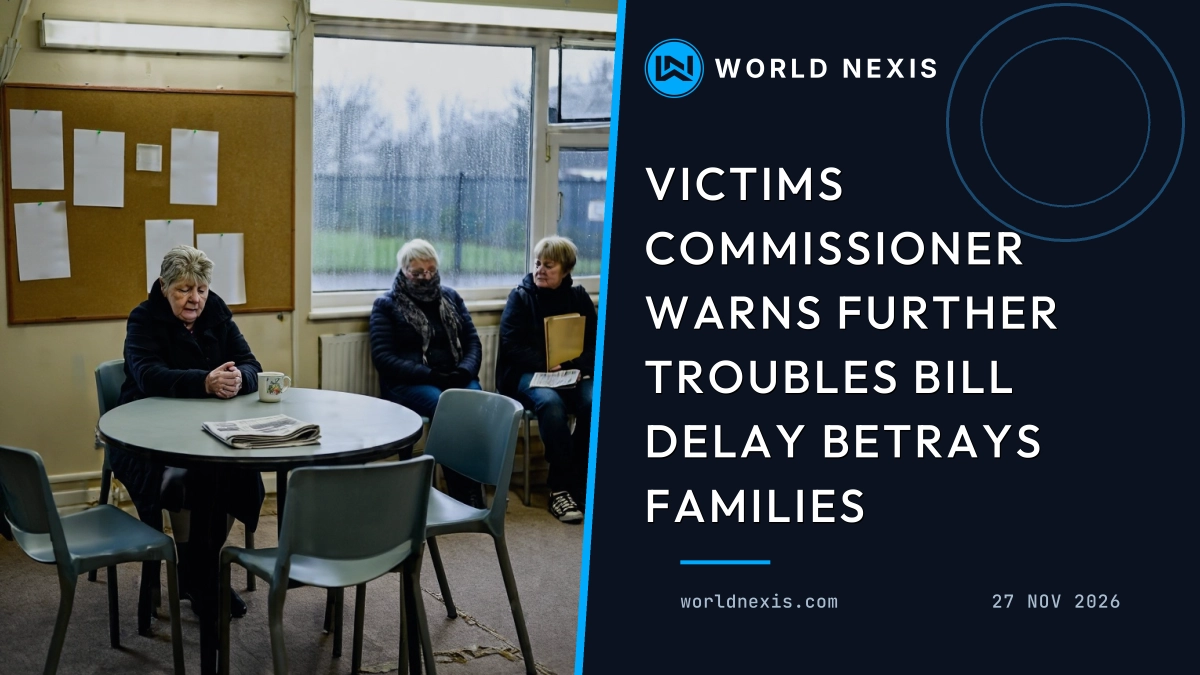
Joe McVey, the Commissioner for Victims and Survivors, has urged ministers to avoid any further delay to the Troubles Bill, warning that the people he speaks for “cannot afford to wait any longer”. The legislation, which would replace the 2023 Legacy Act, is being examined in the House of Lords.
The warning follows the disclosure that Lord Caine has tabled an amendment in the upper chamber proposing another period of consultation on legacy issues. Victims’ groups fear the move could push the bill’s passage back by months or even years.
Key points
- Joe McVey, the Commissioner for Victims and Survivors, says victims cannot absorb further delay to the Troubles Bill.
- Lord Caine has tabled a Lords amendment proposing a fresh consultation period on legacy.
- Dr Sandra Peake of the Wave Trauma Centre described the prospect as the “grossest mistreatment” of vulnerable people.
- The government calls the amendment a “wrecking” attempt and insists the Troubles Bill honours a manifesto commitment.
Troubles Bill warning as peers weigh new consultation
Mr McVey said he was “profoundly disappointed that we are once again facing the prospect of further delays in addressing the legacy of the Troubles/conflict”. He noted that for some victims and survivors the wait for truth, justice and acknowledgement has already lasted more than 50 years.
Almost three decades after the Belfast/Good Friday Agreement, and more than 10 years after the Stormont House agreement, many families are still waiting for answers. Others have died without ever receiving them.
He asked:
“How much longer are victims and survivors expected to wait?”
He argued that meaningful consultation and parliamentary scrutiny matter, but questioned what a further round would achieve beyond the extensive work already carried out. He said the Troubles Bill, while far from perfect, represents an attempt to fix the significant shortcomings of the 2023 Legacy Act.
His commission has been clear, he added, that the legislation still needs strengthening to meet the needs of all victims and survivors. Mr McVey said getting the law right and delivering it without unnecessary delay “should not be mutually exclusive”.
A delay of several months may look short in parliamentary terms, he said, but for someone who has waited half a century those months could make all the difference. He warned that time is running out for many, and that the consequences of further delay “will be measured not simply in months or years, but in lives”.
Trauma centre warns progress could slip for years
Dr Sandra Peake, chief executive of the Wave Trauma Centre, said the proposed consultation, if passed, could hold up progress for months or even years. She said: “This is nothing short of the grossest mistreatment of vulnerable men, women and children who have already suffered so much for so long.”
She added that calling for yet another consultation on legacy would be “laughable if it did not have such devastating consequences for victims and survivors”.
Government defends record on the Troubles Bill
A government spokesperson rejected the amendment, arguing that the previous administration left behind a Legacy Act that would have given immunity to the IRA had it not been rejected by the British courts. The spokesperson said: “Now those same voices have tabled a wrecking amendment attempting to block a key manifesto commitment which would bring in a fair, transparent system that will provide strong rights and strengthened protections for veterans and deliver a lasting solution for families still looking for answers about what happened to their loved ones.”
Ministers say the Troubles Bill is needed to deal with the unfinished business of the Good Friday Agreement. The spokesperson said engagement with victims groups, campaigners, veterans groups and parliamentarians has run for two years, with more than 40 meetings in recent months alone.
The government remains confident, the spokesperson added, that the legislation delivers for veterans and for families.
Why it matters
For thousands of bereaved families, the Troubles Bill decides whether they ever get an answer about a killing, a disappearance or an injury that has shaped their lives since the 1970s and 1980s. Every procedural delay is also a delay in disclosure, support and acknowledgement.
It matters for veterans too, who are promised strengthened protections under the new system. The balance at stake is whether the state can close an unresolved chapter without leaving either group feeling the law was written against them.
Analysis
Having covered Northern Ireland and devolution for World Nexis News, I look first at arithmetic: two years of work, more than 40 meetings in a matter of months, and a bill already under detailed scrutiny in the Lords. On those facts, the case for another consultation round is thin, and Mr McVey is right to say so.
In my view the victims commissioner’s argument is the stronger one. The people he represents have waited five decades, and a further consultation would largely re-ask questions already answered. Defenders of the amendment would say the bill is imperfect and the commission itself believes it needs strengthening — a fair point, but strengthening an imperfect bill is a job for the chamber it is already sitting in, not for another round of talking outside it.
I would watch what this does to trust. If the Troubles Bill slips again, the message sent to families is that the process is built for institutions rather than for them. That is a cost no parliamentary timetable ever records.
What happens next
The Troubles Bill continues its passage through the House of Lords, where Lord Caine’s amendment will be debated at a later stage. If peers back it, another consultation period would be expected to follow before the legislation can progress further.
What we don’t know yet
No date has been set for a vote on the amendment, and it is unclear how much support it commands in the chamber. There is also no confirmed timetable for when the replacement system would begin operating, leaving families without a firm date for answers.
Related coverage
- Bank tax hike: £1.5bn bill may hit borrowers, Bailey warns
- Zelensky interview: Putin a ‘killer’, Ukraine warns US
- Iran naval blockade vow as MP warns over Hormuz control
Further reading
- Victims commissioner urges ministers to avoid further delay to Troubles Bill
- Victims commissioner urges ministers to avoid further delay to Troubles Bill
About the author: Liam O’Connor is the UK Politics Reporter at World Nexis News (WNN), covering uk politics. The analysis section reflects the writer’s view.

Liam O'Connor
Liam O'Connor is UK Politics Reporter at World Nexis News, covering Westminster, devolved politics and the issues that matter to voters across England, Scotland, Wales and Northern Ireland. Based in London, he reports from primary sources — Hansard, official statements, published data — and explains…



