Brexit reset: Burnham says major EU deal can lift GDP 0.4%
Andy Burnham says the Brexit reset summit on Friday can lift GDP by 0.4% and admits the deal the UK was given has not worked, ahead of a major EU push.
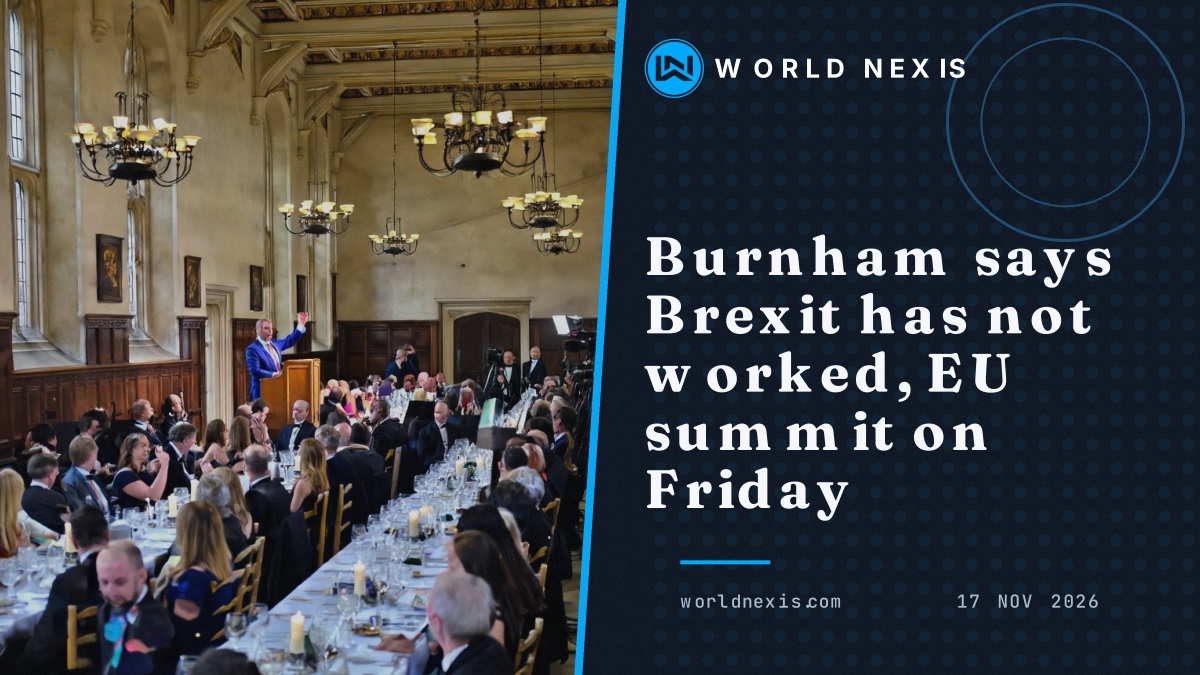
Andy Burnham has said the Brexit reset he will seal with the EU this week is a chance to admit the truth about leaving the bloc, telling the Lord Mayor’s Banquet that “the Brexit we were given has not worked”. The prime minister said the deals he expects to sign in Brussels on Friday could lift GDP by 0.4%, about £17bn, and that Britain had “lost more than we have gained”.
Key points
- Burnham told the Lord Mayor’s Banquet that the Brexit deal Britain was handed “has not worked”.
- He set three tests for his Brexit reset, including the so-called “Makerfield test” of tangible gains for voters.
- Agreements on food, emissions trading and youth mobility are due at Friday’s UK-EU summit in Brussels.
- The Conservatives say Labour is pulling Britain back into the EU “via the back door”.
The emperor has nothing on, Burnham tells the City
The Brexit reset speech was billed as his first major address on foreign policy and was delivered at the Guildhall in the City of London on Monday. Burnham compared Britain’s current arrangements with Brussels to “the emperor’s new clothes”. He said a “needlessly hard Brexit” had built barriers for business and that the promise to take back control was never delivered.
“It’s like the emperor’s new clothes, where no-one is prepared to say the obvious truth,” he said, according to the BBC. “Well, I say it as I see it. And to be frank, the emperor has nothing on.”
Burnham added: “The Brexit we were given has not worked. We have lost more than we have gained.” The line echoed a speech to the Welsh Labour conference on Saturday, when he first said the UK had lost more than it gained.
Brexit reset: three tests before the Brussels summit
Burnham set out three conditions for the Brexit reset he intends to sign in Brussels on Friday, November 20. The first demands consistency with Labour’s 2024 manifesto pledge of no return to the single market, the customs union or freedom of movement. The second requires an improved deal, closer to what people thought they were voting for in 2016.
The third is the “Makerfield test”, named after his Greater Manchester constituency. Any agreement must deliver tangible improvements to everyday life, including in areas “that have felt neglected for too long”. “This is a win-win,” Burnham said, describing a “new approach” that is “not adversarial. No longer burning bridges. But being constructive and positive”.
Much of the substance was settled by his predecessor, Sir Keir Starmer, whose deal struck in May 2025 covered fishing, trade and other areas. Draft texts on removing post-Brexit checks from food and agricultural exports, on emissions trading and on a youth travel and work scheme have been circulated to EU nations.
The government argues the food agreement will cut costs for business and could bring down prices for shoppers. According to the Guardian, Burnham says the package could lift GDP by 0.4%, roughly £17bn.
Rule taker warnings and a Farage clause
Critics argue the Brexit reset would make the UK a “rule taker” on food, bound by regulations it cannot vote on. Hamish Falconer, the EU relations minister, told the BBC that Britain would have a “voice in the room” but no vote on EU food policy.
Falconer also said the arrangement could carry an “exit clause” if a future government reverses it. The mechanism, previously nicknamed the “Farage clause”, reflects EU concern that a Reform UK or Conservative administration might undo the agreement.
The Conservatives said Labour were “dragging us into the European Union via the back door”. Boris Johnson, the former prime minister, told the Telegraph that Britain would “absolutely” vote for Brexit again if Burnham forced another vote on the issue.
“It is madness to escalate the Brexit issue as your political priority,” Johnson said. “He will impale himself and his party on this point, and he needs to move off it because he won’t win – because the reality is that people are not fools.”
A diminished standing, and a wider pitch
Burnham used the speech to argue that Britain’s influence had slipped since 2016, and that the damage reached beyond Europe. “In the decade since Brexit, our standing in the world has diminished,” he said. “We treated both allies and institutions with insufficient care, and the effects went beyond Europe.”
He said the UK had failed to “invest in the modernisation of the Commonwealth” and had “blown hot and cold” in relations with China. On the Middle East, he said Britain rightly condemned Hamas and the attacks of October 7, but that the response to what followed in Gaza left many “questioning our moral compass”.
He insisted that “Britain was back in the game in a big way” and would be a country that “leads with its values”. The BBC also reported that a new campaign against EU membership was launched before the summit.
Analysis
Having covered devolution, public services and local democracy for WNN, I look first at what the Brexit reset changes on the ground. Checks at the border, paperwork for exporters and prices on shelves matter more than the labels each side attaches to the deal. On that reading, the prime minister’s diagnosis is stronger than his critics allow.
I think Burnham has the better of the argument on the record of the 2016 settlement. The deal did create frictions its architects played down, and “take back control” never matched the experience of small exporters. The toughest counter-argument is not the “back door” cry but the rule-taker point, and the exit clause is the honest answer to it.
My concern is sequencing, not direction. His three tests are sensible and the Makerfield test is the right yardstick, but a national conversation about the long-term relationship should follow banked gains, not precede them. I side with those who say prove the food and youth mobility deals first, because voters will judge this on prices and queues.
What happens next
Burnham travels to Brussels on Friday to sign the Brexit reset, with agreements on food, energy and youth mobility expected. Draft texts have already gone to member states, and the food package is the most advanced.
Afterwards he will open talks with the EU on options for “our long-term relationship”, though he has ruled out major changes before the next general election. He has promised that “at every stage the British people will be the boss”.
Related coverage
- Milburn report: major national insurance cut for under-25s
- Royal visit India: William and Kate’s major 3-day trip
- United Airlines outage delays flights after major FAA halt
Sources
- UK has lost more than it gained from Brexit, Andy Burnham says (bbc.co.uk)
- Andy Burnham to say Brexit ‘has not worked’ and he will sign new deal with EU (theguardian.com)
- Burnham criticises hard Brexit deal which ‘diminished’ UK’s global standing (eveningnews24.co.uk)
- Burnham criticises hard Brexit deal which ‘diminished’ UK’s global standing (kilburntimes.co.uk)
- Burnham criticises hard Brexit deal which ‘diminished’ UK’s global standing (chesterstandard.co.uk)
About the author: Liam O’Connor is World Nexis News’s UK Politics Reporter, covering uk politics. The analysis section reflects the writer’s view.

Liam O'Connor
Liam O'Connor is UK Politics Reporter at World Nexis News, covering Westminster, devolved politics and the issues that matter to voters across England, Scotland, Wales and Northern Ireland. Based in London, he reports from primary sources — Hansard, official statements, published data — and explains…



