Chinese automakers could fill Canada auto gap, Carney warns
Mark Carney says Chinese automakers could fill the gap if U.S. trade talks fail, and Canada will move forward either way before meeting Xi Jinping.
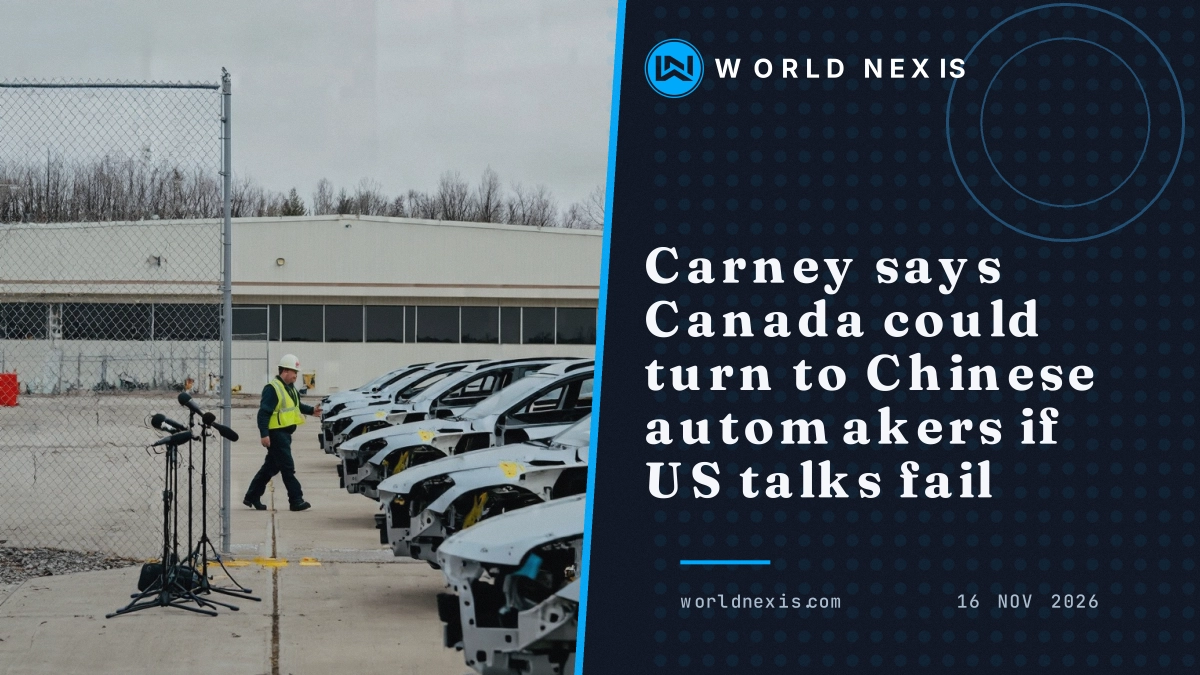
Updated 17 Nov 2026, 05:36 (UK time): Carney’s first day in Shenzhen produced announced Canada-China trade measures and cultural partnerships, with he and Xi calling for deeper ties, while a Trump envoy said Chinese cars built in Canada could not cross into the U.S.
Mark Carney’s first day in Shenzhen produced concrete output rather than the pre-trip signalling that dominated coverage earlier this week. A press release carried by the Standard-Freeholder announced new Canada-China trade measures and cultural partnerships, and headline reports said Carney and Xi Jinping called for deeper ties as Ottawa looks beyond Washington for trade. That moves the story past the “action, reaction” line he gave reporters in Phnom Penh.
The auto question also drew a response from the American side. According to a headline carried by EnergyNow, an envoy for President Donald Trump said Chinese cars built in Canada could not cross into the United States. That speaks directly to the danger Ontario Premier Doug Ford raised about Canadian-built vehicles being treated as a back door into the U.S. market.
Nothing has changed on the January arrangement itself: the tariff on Chinese electric vehicles remains at 6.1%, with an initial cap of 49,000 vehicles a year rising over time, and China’s tariff cuts on Canadian farm goods including canola stay in place. Carney’s conditions for any Chinese automaker investment — real factories, labor standards and Canadian critical minerals — were restated, not revised.
My take: the envoy’s statement removes the worst-case scenario Ford warned about, but it also caps the prize, because a Chinese plant in Canada would be selling into Canada alone rather than into North America. That is a smaller market than the one Carney’s auto workers were promised.
Chinese automakers could become Canada’s fallback if trade negotiations with Washington fail to preserve an integrated North American car industry, Prime Minister Mark Carney said on Monday, ahead of a meeting with President Xi Jinping in Shenzhen where vehicle manufacturing is expected to be discussed.
Speaking to reporters in Phnom Penh, Cambodia, Carney said a deal with President Donald Trump’s administration remains his priority. Yet he also signaled that Ottawa will not wait indefinitely for one, and he left open the prospect of Chinese automakers building inside Canada.
Key points
- Carney said Canada’s auto workers should be “fully deployed” in an integrated North American market that U.S. trade actions have made “less integrated”.
- Asked whether Chinese investment was leverage, he replied: “It’s not leverage. But action, reaction.”
- Canada cut its 100% tariff on Chinese electric vehicles to 6.1% in January, admitting up to 49,000 vehicles a year.
- Any Chinese automakers moving into Canada would need real factories, labor standards and domestic supply chains, he said.
Carney says Chinese automakers could fill the gap
The prime minister presented the option as a consequence of U.S. policy rather than a bargaining chip, the Guardian reported. “We have the best auto workers in the world, and we want them fully deployed, full opportunity, in an integrated North American market,” he said. “That market has become less integrated because of U.S. trade actions.”
Asked directly whether potential Chinese investment was leverage in the Canada-U.S. trade talks, Carney pushed back. He said that if Canadian plants and workers are not fully used in a North American context, “that provides other opportunities”.
“Canada is going to move forward either way.” — Mark Carney, in Phnom Penh
An opening to Chinese automakers would come with conditions. Carney said any investment would have to involve substantial manufacturing in Canada, rather than assembly of imported parts. He listed proper labor standards, manufacturing facilities and domestic supply chains that expand over time, including Canadian critical minerals used in electric vehicles.
“It’s not just about kit cars,” he said. “There has to be a manufacturing aspect involved.”
From Phnom Penh to Shenzhen: the Carney-Xi Jinping meeting
Carney’s comments came before a planned meeting with Xi this week in Shenzhen, a hub of Chinese auto manufacturing, and ahead of the Apec summit, according to the Associated Press. Vehicle production is expected to be on the agenda.
The two leaders reached an agreement in January that let tens of thousands of Chinese electric vehicles into Canada at reduced tariffs. Under the deal, Canada lowered its 100% duty to 6.1%, initially admitting up to 49,000 vehicles a year with the cap rising over time. China agreed to cut tariffs on Canadian farm products, including canola.
Carney said at the time that he expected the arrangement to attract Chinese investment and create jobs. He said in Manila on Saturday that any trade agreement with Washington must leave Canada with a viable auto industry, a condition he repeated on Monday.
He added that talks with the U.S. remain his priority, but that their outcome could determine whether Canada pursues alternatives involving European, Chinese or Japanese automakers.
Doug Ford’s warning and the Stellantis dispute
Ontario Premier Doug Ford, whose province sits at the center of Canada’s car industry, criticized the January deal. He warned that letting Chinese electric vehicles in could threaten Canadian jobs and jeopardize access to the U.S. market.
Those fears have sharpened as Trump’s tariffs disrupt a sector built on cross-border production. The Detroit Three — Ford, General Motors and Stellantis — run plants across Canada, the U.S. and Mexico, with parts sometimes crossing borders several times before a vehicle is finished. Trump has repeatedly pressed automakers to shift production to the United States from Canada.
In the latest flashpoint, Canada threatened to sue Stellantis after the company moved planned Jeep Compass output from Brampton, Ontario, to Illinois and agreed to sell its idled Canadian assembly plant.
Analysis
Having covered trade disputes and sanctions for WNN, I check first whether a threat like this is real or rhetorical. Carney’s version reads as real. The integrated market he describes is not a hypothetical that U.S. policy might damage one day; it is already coming apart, and the Stellantis decision is the clearest evidence. When production moves regardless of what Ottawa says, planning for Chinese automakers is prudence rather than brinkmanship.
On the central question, I side with Carney over Ford. Canada’s dependence on a single customer is the larger risk, and the January deal gave Ottawa an option it did not have before. Ford’s strongest counter is that letting Chinese vehicles in could hand Washington a pretext to treat Canadian-built cars as a back door into the U.S. market, and that danger is genuine. Even so, the conditions Carney attached — real factories, labor standards, Canadian minerals — are a serious attempt to answer it.
What I would watch is whether “action, reaction” survives contact with the negotiating table. A line like that costs little in Phnom Penh and a great deal in Detroit.
What happens next
Carney meets Xi in Shenzhen this week, with auto manufacturing expected to be discussed and the Apec summit following. Whether Chinese automakers end up as partners or merely as leverage will be settled there and in Washington.
He said on Saturday that he had spoken at length with Trump and senior U.S. officials, and that the two countries were making progress toward a possible trade deal, though differences remained.
Related coverage
- Iran drone attack: Blinken warns of ‘absolute disaster’
- Pope Leo Amazon speech demands justice for slain defenders
- Nvidia scandal: Megaspeed denies smuggling 240,000 AI chips
Sources
- Canada could work with Chinese automakers if US trade talks fail, says Carney (theguardian.com)
- Carney says Canada could turn to Chinese automakers if Trump trade talks fail (news4jax.com)
- Carney says Canada could turn to Chinese automakers if Trump trade talks fail (toronto.citynews.ca)
- Mark Carney says Canada could turn to Chinese automakers if Trump trade talks fail (hindustantimes.com)
- Carney says Canada could turn to Chinese automakers if Trump trade talks fail (idahopress.com)
About the author: Marcus Ellington is World Nexis News’s International Correspondent, covering world affairs. The analysis section reflects the writer’s view.

Marcus Ellington
Marcus Ellington is International Correspondent at World Nexis News, reporting on diplomacy, conflict and the political forces reshaping Europe, the Middle East, Asia and the Americas. Based in London, he focuses on explaining why events unfold as they do, using official statements, diplomatic documents and…



