Iran drone attack: Blinken warns of ‘absolute disaster’
Iran drone attack: Tehran fired six drones at a US radar base in Bahrain as Antony Blinken warned a ground invasion of Iran would be an absolute disaster.
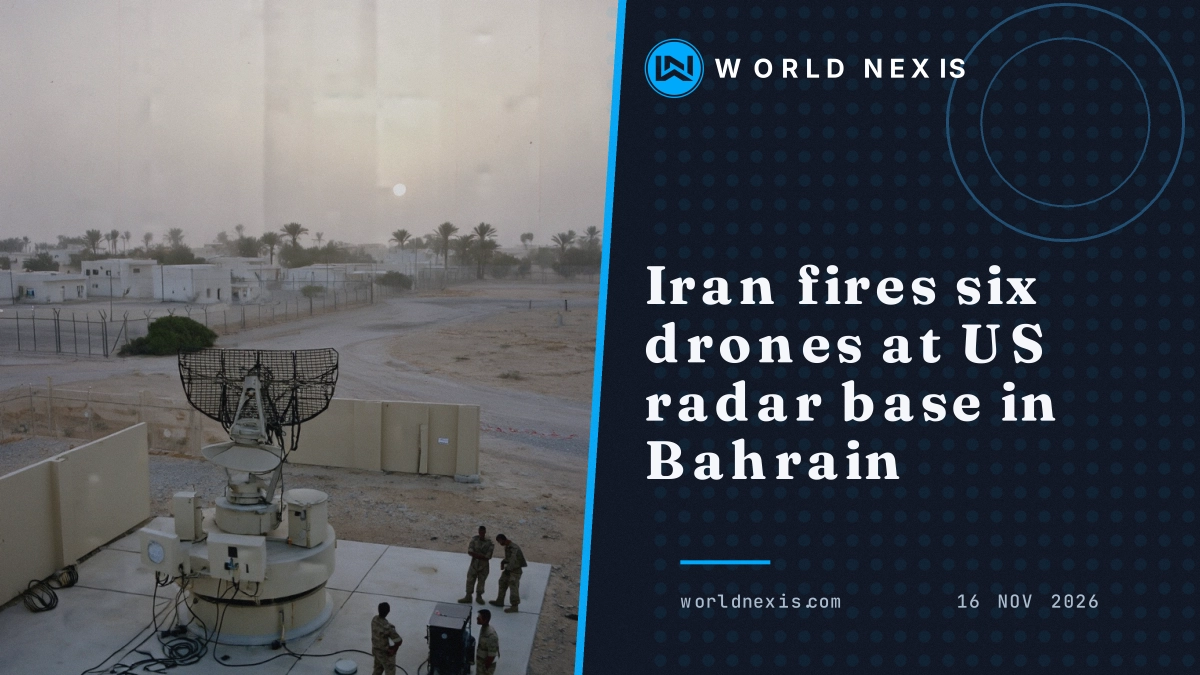
Iran drone attack: Tehran launched six drones at a US air defence radar at Bahrain’s Al-Rifaa base on Sunday, the Islamic Revolutionary Guard Corps said, its second strike on the kingdom in three days.
Bahrain said its air defences intercepted the drones before they reached their targets, while the IRGC claimed it had hit the facility. Air-raid sirens sent residents to shelters across the Gulf state, and the interior ministry urged people to move to their nearest safe location.
The Iran drone attack came as Antony Blinken, the former US secretary of state, warned that any American ground invasion of Iran would be an “absolute disaster”. It was the first strike on Bahrain since September, the Guardian reported, and it further dims hopes of a diplomatic breakthrough.
Key points
- Six drones took part in Sunday’s Iran drone attack on a US radar site at Al-Rifaa base; Bahrain says all were intercepted.
- It was the second Iran drone attack in three days and the first against the kingdom since a wave of strikes in September.
- Bahrain hosts the US Fifth Fleet and Naval Forces Central Command, making it a hub for American operations in the region.
- Antony Blinken said airstrikes alone cannot dismantle Iran’s arsenal and that a land invasion would be an “absolute disaster”.
The Iran drone attack on Bahrain: what we know
Sunday’s Iran drone attack followed a similar strike on Friday, when Tehran said it had hit a US early-warning radar facility in the kingdom. US Central Command said two drones were shot down that day, with no injuries or damage reported.
According to Iranian state media cited by Reuters, the IRGC said the latest operation targeted a US air defence radar at the Al-Rifaa helicopter base in retaliation for “hostile US actions”. Bahraini officials said the drones were stopped before they reached their targets.
Bahrain hosts significant American facilities, including a forward base that was home to the US Fifth Fleet and US Naval Forces Central Command. That headquarters operates as a central support hub for US military operations across the Middle East, which is why the drone attack on a US base in Bahrain carries weight well beyond the island.
At a press conference in Tehran, foreign ministry spokesperson Esmaeil Baghaei said Iran would keep responding to military aggression by the US or other states. Asked whether the strikes signalled a change of direction as negotiations stalled, he said Iran was “not waiting for anyone” and was focused on its security.
The wider war began with joint US and Israeli attacks on Iran in February and remains at an impasse. Washington maintains a naval blockade, while Tehran keeps its chokehold on the Strait of Hormuz.
Blinken: a land war would be an ‘absolute disaster’
Speaking at the 24th Hindustan Times Leadership Summit in New Delhi on Saturday, Blinken said airstrikes alone were unlikely to eliminate Iran’s weapons capability. Blinken’s warning landed as the Iran drone attack on Bahrain stoked fresh fears of escalation across the Gulf.
He pointed to Iran’s size, its population of roughly 90 million and production sites buried deep inside its territory. “The weapons that it continues to produce are back far enough, the range is great enough that you can’t just take everything out,” he said. “You’d probably have to have a land invasion of some kind to do that, which would be an absolute disaster.”
Blinken argued that Washington can escalate vertically by intensifying its bombing, but Tehran can escalate horizontally by hitting US installations, regional allies and critical infrastructure, either directly or through allied armed groups. “Even though we’re much more powerful, that asymmetry in their ability to escalate horizontally as opposed to vertically is not to our advantage,” he said.
He also stressed the geography. Iran is roughly four times the size of California, and “that coastline along the Strait of Hormuz goes on forever”.
Yemen, Hormuz and Iraq: the war spreads sideways
In Yemen, Iran’s Houthi allies advanced against pro-government forces in the south, opening a potential route towards Aden. The IRGC separately claimed that two ships struck mines in the Strait of Hormuz and that one, an oil supertanker carrying 2m barrels, sank after “massive explosions and fire”.
There was no immediate independent verification of that claim, and the US military recently said it had cleared all mines from main routes through the waterway.
In Iraq, officials have resisted proposals to sharply restrict trade and movement across the Iranian border. Iran International reported that Tehran fears Iraqi territory could be used to stage an American operation into southern Iran, while the newspaper Al-Mada reported on 9 November that the prime minister privately briefed Shia political leaders on an alleged US plan involving a ground offensive.
Iraqi Foreign Minister Fuad Hussein told France 24 that the region’s “no war and no peace” situation was unsustainable. The confrontation, he said, “either goes towards peace or it goes towards war”.
Analysis
Having covered conflict and foreign policy for WNN, I look first at what each side can still do to the other rather than at who holds more firepower. On that test, Blinken’s caution is better supported by the evidence than the case for escalation. Six drones sent at a Gulf host nation cost Tehran almost nothing, yet they force Washington to defend every radar site, airfield and shipping lane from Manama to the Red Sea.
The consequences for readers are not abstract. Gulf bases hold American and allied personnel, a large share of the world’s seaborne oil passes the Strait of Hormuz, and any widening of the war shows up in energy prices and insurance costs far from the region. The strongest counter-argument is that limited strikes have plainly not deterred Iran, which attacked Bahrain twice in three days; those who say only a ground campaign could dismantle the programme are right that air power has limits. But Blinken’s own concession cuts the other way: if you cannot take everything out from the air, then a ground invasion of Iran means occupying a country of 90 million people.
In my view, the facts of these three days favour Blinken. Trump has called the US strikes minor, says Gulf states warned him against large-scale combat, and has redirected JD Vance towards alleged domestic fraud instead. A land war would hand Tehran the horizontal fight it is built for. Restraint looks weak, and I understand why critics say so, but the alternative on offer is a disaster with a plan attached.
What happens next
Iran has signalled it will keep answering US strikes with its own, and Baghaei’s remarks suggest no pause while talks remain stalled. Trump said last week that Washington is no longer seeking a deal with Iran, which leaves little diplomatic track open for now.
Baghdad, meanwhile, says it has a responsibility to pursue mediation because Iraq has already been drawn into the conflict. The IRGC’s account of the sunken supertanker remains unverified, and the Houthi advance in southern Yemen will be watched for any threat to Aden.
Related coverage
- Pope Leo Amazon speech demands justice for slain defenders
- Sydney Sweeney jeans: 20 workers paid $144 a month
- Nvidia scandal: Megaspeed denies smuggling 240,000 AI chips
Sources
- Iran launches drone attacks against US military base in Bahrain (theguardian.com)
- Blinken warns US ground invasion of Iran would be ‘absolute disaster’ as Tehran escalates attacks (foxnews.com)
- Sirens send Bahrain residents to shelters as drones target U.S. radar base (abc7amarillo.com)
- Sirens send Bahrain residents to shelters as drones target U.S. radar base (wset.com)
- Sirens send Bahrain residents to shelters as drones target U.S. radar base (wchstv.com)
About the author: Marcus Ellington is World Nexis News’s International Correspondent, covering world affairs. The analysis section reflects the writer’s view.

Marcus Ellington
Marcus Ellington is International Correspondent at World Nexis News, reporting on diplomacy, conflict and the political forces reshaping Europe, the Middle East, Asia and the Americas. Based in London, he focuses on explaining why events unfold as they do, using official statements, diplomatic documents and…