Fit to Lead report: 71% of Australian MPs harmed by job
The Fit to Lead report finds 71% of Australian MPs say the job harmed their mental health, with social media abuse named the single biggest stressor.
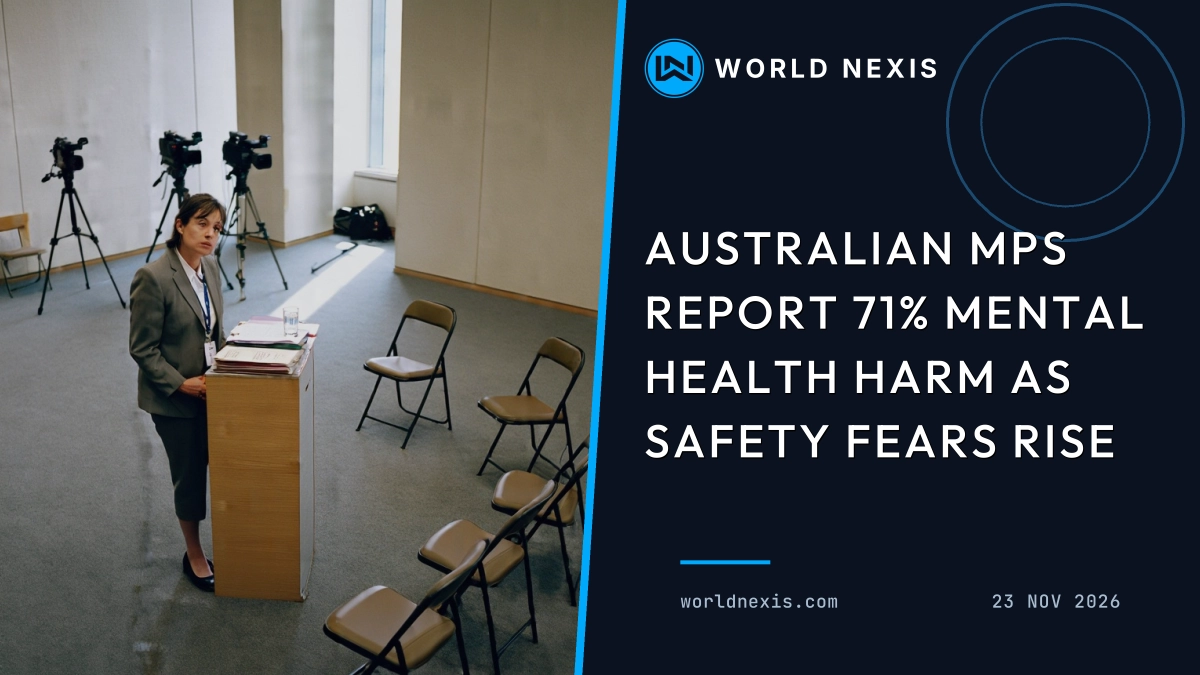
The Fit to Lead report, released on Monday at Parliament House in Canberra, found that 71 per cent of Australia’s state and federal parliamentarians say the job has damaged their mental health or wellbeing. The study, produced by the non-profit Better Politics Foundation, draws on 288 current and former elected representatives and concludes that the cost is being paid by the country’s democracy, not only by the people in it.
Key points
- 71 per cent of state and federal parliamentarians said their work had adversely affected their mental health, rising to 74 per cent among state politicians.
- Social media was the single biggest stressor: 97 per cent of those affected said online abuse and negativity had hit their wellbeing.
- Around one in five affected politicians reported thoughts of self-harm or ending their life; among the 21 federal parliamentarians who answered, the share was 33 per cent.
- The Fit to Lead report found 39 per cent said the strain had stopped them speaking out on issues they believe in.
What the Fit to Lead report found
Seven in ten of those surveyed said the job had harmed them, and the pattern holds across every level of government. Safety was a serious concern for 44 per cent of the politicians who reported harm, and for female parliamentarians it was the third-most significant stressor in the role.
Jonathan Granger, a director at Compassion in Politics Australia, a cross-party think tank that partnered on the study, said the threats behind those figures are often explicit. “I know a minister who had to get a security guard because someone rang up and said ‘I’m going to bring a gun to the office and going to get you and your family’,” he said. “I mean, that is just abhorrent.”
Women report a different job
The Fit to Lead report found that 86 per cent of women parliamentarians and 70 per cent of women councillors said their gender had shaped their experience of the role, compared with 53 per cent of male parliamentarians and 36 per cent of male councillors. For women in politics, the survey describes a job that is experienced differently from the first day.
Kimberly McArthur, co-CEO of the Better Politics Foundation, called the findings “shocking but not surprising”. She said similar studies in the US, UK, Ireland and Germany produced comparable results. “We work with aspiring and current leaders all over the world and we just kept hearing about the low wellbeing, the burnout, the trauma essentially that they were suffering, which was preventing them from doing the job they wanted to do,” she said.
Independent MP Allegra Spender said the culture of the workplace, not the resilience of the people in it, is the problem. “If we want our citizens to be well represented, we need to understand the culture that shapes how politicians work, and improve the culture that leads to so many politicians managing mental health issues,” she said.
Why the Fit to Lead report is being read beyond Australia
Alastair Campbell, Tony Blair’s former spokesman and co-host of The Rest is Politics, helped launch the report. He said the study “can have an impact not only in Australia, but across the democratic world”.
“We need good and effective politicians more than ever, and this report suggests we are failing those who serve, and deterring others from wanting to serve in the first place,” he said.
That deterrence is already visible, according to Women for Election, which says it is seeing women withdraw from candidate races in Australia because of safety concerns. Writing five weeks after an attack on independent MP Helen Haines, Licia Heath argued that Britain’s response to the murder of MP Jo Cox shows how quickly a candidate pipeline can thin.
She said the British reaction focused on protecting sitting MPs, with more security, police liaison and a democracy taskforce, all of which are under discussion in Australia. Far less was done, she argued, to change the culture that puts them at risk. She also pointed to newer British police programmes built to shield local officials and candidates from intimidation, and to Mexico, where 2021 reforms recognised digital violence as a form of gender-based violence and criminalised attempts to undermine a woman’s right to hold office, including online smear campaigns and doxxing.
Why it matters
For Australian voters, the Fit to Lead report describes a Parliament that is less candid than it appears. Nearly two in five politicians said the strain had stopped them speaking out on issues they believe in, so arguments that should be settled in public are quietly dropped instead.
The second cost is felt on the ballot paper. If women and anyone unable to absorb a stream of threats decide not to stand, the choice open to voters narrows long before election day. Parliament can point to record numbers of women today, but that counts for little if the pipeline behind them empties.
Analysis
Having covered conflict and foreign policy for World Nexis News, I read a report like this through one test: does the damage stop with the individual, or does it reach the institution? In my view the Fit to Lead report shows it reaches the institution. A legislature where two in five members stay silent on things they believe, and where a third of the federal politicians who answered have considered ending their life, is not healthy. It is functioning on habit.
I side with those, including Licia Heath, who argue that security spending alone will not fix this. Britain’s answer after Jo Cox’s murder was heavier protection, and the pipeline still thinned. The strongest counter-argument is that MPs volunteer for public life and can walk away, so money spent on their safety and wellbeing is money not spent on hospitals and schools. That is a fair point, but it treats a democratic problem as a perk, and the mental health of politicians as a private matter rather than a risk to the institution.
The likely next step is the cheap one: a taskforce, police liaison officers and a security review, all announceable within weeks. The harder work, from training staff to handle threats to forcing platforms to answer for coordinated abuse, takes years and wins no headlines. I know which one I would fund first.
What happens next
No legislation or timetable has been attached to the Fit to Lead report. The measures under active discussion in Australia, including extra security for MPs, police liaison arrangements and a democracy taskforce, mirror the British response that followed Jo Cox’s murder, according to Heath.
The Better Politics Foundation is continuing its international work. Its Better Politics Week in Brussels focused on sharing practice across countries on legislation, frameworks and protocols designed to keep women in public life safe.
What we don’t know yet
Whether the federal government will fund any of the proposals is unclear, and no date has been set for a formal response. The survey also cannot say how many politicians have left office because of the pressure. It records only those willing to answer, and just 21 federal parliamentarians answered the question on self-harm.
Related coverage
- Lead azide detonation in Iowa pushed to Wednesday
- Russian warship sunk by 7 drones in major Libya strike
- Fred Nile state funeral call dropped after LGBTQI backlash
Further reading
- The hidden factor that could be shaping Australia’s political future
- Women are fleeing politics. Here’s the uncomfortable reason why
About the author: Marcus Ellington is the International Correspondent at World Nexis News (WNN), covering world affairs. The analysis section reflects the writer’s view.

Marcus Ellington
Marcus Ellington is International Correspondent at World Nexis News, reporting on diplomacy, conflict and the political forces reshaping Europe, the Middle East, Asia and the Americas. Based in London, he focuses on explaining why events unfold as they do, using official statements, diplomatic documents and…



