Lead azide detonation in Iowa pushed to Wednesday
The lead azide detonation at an Iowa Army plant will go ahead by November 24 under emergency powers, the Army says, despite a court pause on its permit.
Updated 24 Nov 2026, 00:36 (UK time): The 8th US Circuit Court of Appeals declined on Monday to block the Iowa lead azide detonation, and President Trump said it will not go ahead unless Iowa Gov.-elect Rob Sand signs off.
The 8th US Circuit Court of Appeals declined on Monday to block the lead azide detonation, ruling that the environmental groups challenging the plan had failed to show they were likely to succeed. The court said it was “mindful of the very real risks” but that the degraded material presents a risk of an uncontrolled and unplanned explosion, which would occur without the safety measures the EPA permit puts in place.
Earlier on Monday, President Trump said the government would not carry out the blast, which the Army has scheduled for Wednesday, until the appeals court ruled and unless Iowa Gov.-elect Rob Sand signed off. He warned that if the governor-elect or the courts did not agree, he would hold the incoming governor responsible for any death or destruction caused by the material.
Sand said the administration should make the decision on the information gathered by the people it brought in months ago and who have been on the ground in Middletown for weeks, adding that Iowans are entitled to know how the town came to this situation. The governor-elect’s consent is not legally required, so a cleared court path is now paired with a political condition nobody can timetable.
A ruling that removes a legal obstacle and a promise that adds a new one do not give households inside the risk zone anything they can plan a Wednesday around.
Updated 23 Nov 2026, 04:41 (UK time): The Army said late on Sunday that the lead azide detonation at the Iowa Army Ammunition Plant has been moved to Wednesday, past the November 24 date it gave a federal appeals court, citing a need for optimal weather conditions and full mitigation measures.
The lead azide detonation at the Iowa Army Ammunition Plant in Middletown has been pushed back to Wednesday, the Army said in a statement late on Sunday, saying the move would “allow for optimal weather conditions and all mitigation measures to be emplaced.” The operation had already slipped from Friday to Monday, and the Justice Department had told a federal appeals court the Army would act by November 24.
Military officials said the Army and its interagency partners had been “working around the clock to safeguard all Americans in the region” and that health and safety “has and always will be our first priority.” The material to be destroyed in place amounts to nearly 10,000 pounds, or almost five tons, of degraded lead azide, which the EPA has said has recrystallized and grown more sensitive to friction and shock. The Army maintains that destroying it where it sits is the only responsible option.
The shift matters on two fronts. It takes the blast past the deadline the government gave the 8th US Circuit Court of Appeals, giving the judges room to act on the environmental groups’ Sunday motion to submit further evidence before anything detonates. It also leaves households inside the risk zone waiting longer under the same six-hour evacuation advisory, with no firm hour announced for Wednesday.
An emergency that can be postponed for better weather is hard to square with the urgency the government described in court, and it is a reminder that the notice problem at the heart of this case was never really about the calendar.
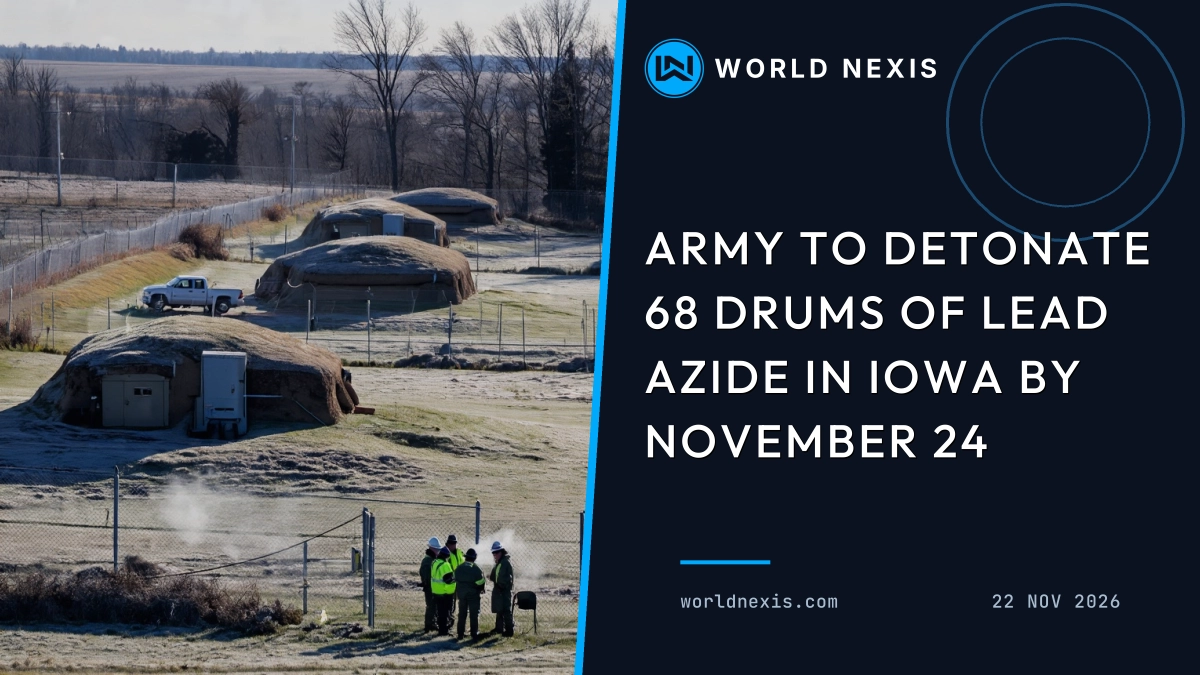
The lead azide detonation planned at the Iowa Army Ammunition Plant in Middletown now has a hard deadline of November 24, and the US Army says it will proceed under emergency powers even though a federal appeals court has paused its environmental permit. In a filing submitted late on Saturday, the Justice Department told the court that the Army intends to act by that date. The site holds 68 drums of the unstable compound, which is used as a detonator in military munitions.
Key points
- The Army plans a lead azide detonation of 68 drums at its Iowa ammunition plant by November 24.
- The 8th US Circuit Court of Appeals paused the EPA permit after environmental groups sued.
- The Army will invoke an emergency munitions and explosives exclusion to work without that permit.
- The government warns temperatures below 30F (-1C) could destabilize the material and trigger an accidental blast.
Why the Army says the lead azide detonation cannot wait
The filing describes an immediate risk that the material explodes on its own as temperatures drop below 30 degrees Fahrenheit in the next several days. The lead azide has deteriorated over time, and officials say falling temperatures could destabilize it further, making an unplanned blast more likely.
“The Army must perform a controlled detonation to protect the public from the more significant threat from an uncontrolled explosion, and the Army intends to act by November 24, 2026,” the Justice Department wrote.
An uncontrolled explosion at a plant that stores military munitions is the scenario officials say they are trying to prevent. The filing adds that a controlled blast lets the Army limit the risk of partial unexploded ordnance being thrown from the site and detonating later.
Emergency powers, a halted permit and a legal race
The Environmental Protection Agency had granted an emergency permit for the operation. The Army first scheduled the lead azide detonation for Friday, then moved it to Monday, before the appeals court froze the permit last week.
The Iowa Environmental Council and the Sierra Club’s Iowa chapter sued to stop the blast. They argue the Army did not properly weigh safer alternatives and gave people inside the risk zone only days to prepare. The council said there is no safe level of lead exposure.
Public notice is the other live dispute. The groups say the Army was more focused on clearing legal hurdles than on telling affected communities what was coming. The Army’s answer is that the operation has been planned in detail with the EPA and the Department of Health and Human Services.
On Sunday the groups returned to court, asking judges to hold proceedings so they can submit more evidence. Their motion includes declarations from environmental experts and local officials who dispute the Army’s assessment of the risk and its account of how much notice the public received.
Thien Chau, an Earthjustice attorney representing the groups, said the Army “seemed more concerned over the weekend with finding a way to sidestep the judicial process than on meeting the public’s demands for greater transparency, notice to affected communities, and far stronger protection of people, property, and the environment from serious harm.”
What the lead azide detonation could mean for residents
Dust is the central fear. Lead particles carried in a plume could spread across parts of Iowa and Illinois, settling on farmland and homes near the plant. An earlier Army advisory told households to leave for six hours around the blast and warned that everyone should stay away from the outdoors until the dust settled.
The plant dates from the 1940s and produces medium- and large-caliber munitions; the drums were stored in bunkers until the material became too risky to move. The Army says it will apply the same mitigation measures written into the paused permit for the lead azide detonation, including steps to limit how far lead dust travels.
Why it matters
For families inside the zone, the question has shifted from whether the blast happens to when. With no confirmed timetable, a six-hour evacuation request and a dust warning, households and farms are planning around a lead azide detonation that could come at any point before Tuesday.
Nationally, the case tests how far a federal agency can go once a court has told it to stop. If an emergency exemption can override a frozen permit here, the same argument becomes available at hazardous sites across the country.
Analysis
Having covered environmental enforcement for World Nexis News, I start with the material itself, and on that ground the Army has the better case. Degraded lead azide plus a hard freeze is a genuinely dangerous combination, and an uncontrolled blast at a munitions plant would hit the same Iowa communities far harder than a planned one. The plaintiffs’ strongest counter-argument is about process rather than chemistry: a government should not be able to sidestep a court-frozen permit by declaring an emergency, and on that narrow point they are right.
What troubles me is how this became an emergency at all. The material was known to be deteriorating earlier this year, yet residents say they were given days rather than months to prepare. Emergency powers are being used to cover a failure of public notice, and that is the part I think deserves a formal review once the operation is over.
My expectation is that the lead azide detonation goes ahead before Tuesday and the legal fight continues afterwards. The precedent will then be tested by whoever lives beside the next deteriorating stockpile.
What happens next
The lead azide detonation is due by November 24, according to the Saturday filing, and the Army says it will follow the permit’s mitigation measures even though they are no longer in force. The appeals court must now decide whether to grant Sunday’s request and take further evidence before the operation begins. The Army did not immediately respond to questions on Sunday about the precise timing.
What we don’t know yet
- The exact hour of the detonation, and how long residents will be asked to stay away.
- Whether the appeals court rules before the Army moves.
- How far lead dust could travel, and what testing follows.
Related coverage
- Palisades fire arson: guilty verdict, sentencing set for March 2027
- COP31 talks collapse as EU and UK reject fossil fuel deal
- COP31 talks risk collapse on day 2 as fossil fuels omitted
Further reading
- US Army to detonate tonnes of unstable explosives in Iowa despite court order
- U.S. Army plans to carry out detonation at Iowa plant despite indefinite pause, court records say
About the author: Hannah Lindqvist is the Climate & Environment Reporter at World Nexis News (WNN), covering climate & environment. The analysis section reflects the writer’s view.

Hannah Lindqvist
Hannah Lindqvist is Climate & Environment Reporter at World Nexis News, based in London. She covers climate policy, extreme weather, the energy transition, conservation and climate finance, grounding stories in scientific research, official data and documented commitments rather than slogans. She is interested in how…