Palisades fire arson: guilty verdict, sentencing set for March 2027
Jonathan Rinderknecht was found guilty of Palisades fire arson at his retrial in Los Angeles, five months after a jury deadlocked on the 2025 blaze.
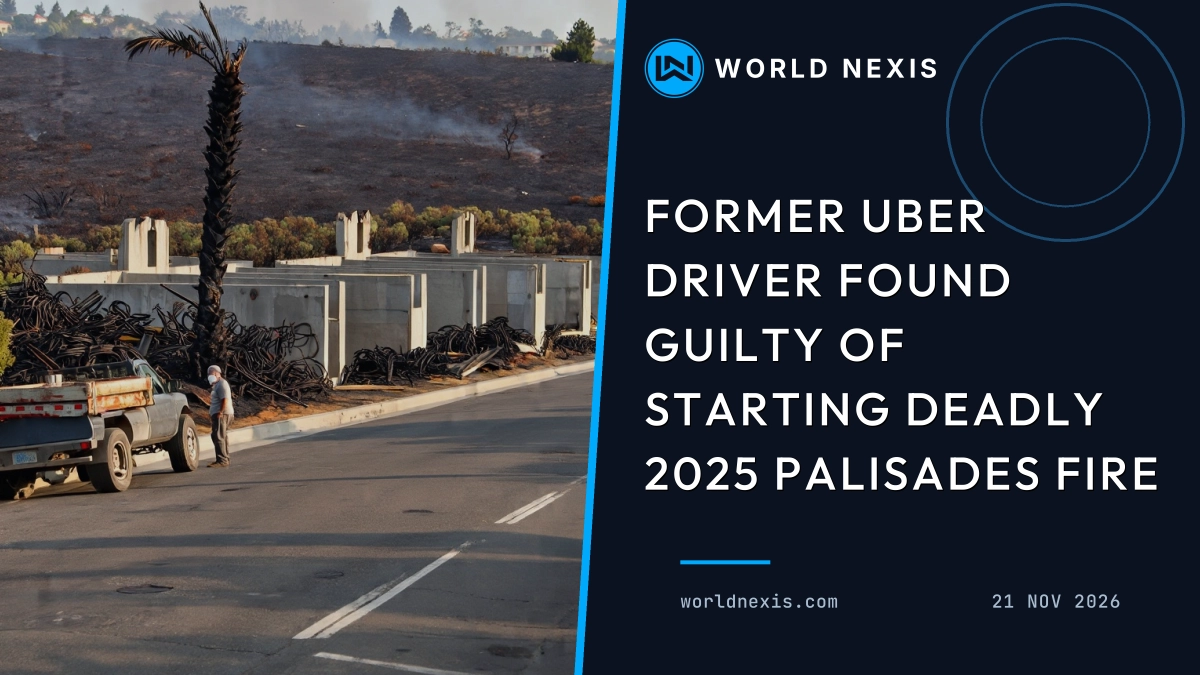
Updated 21 Nov 2026, 09:16 (UK time): Sentencing in the Palisades fire arson case has been scheduled for 17 March 2027, with Jonathan Rinderknecht facing between five and 40 years in federal prison after Friday’s conviction.
Sentencing in the Palisades fire arson case now has a date. Jonathan Rinderknecht, 30, is scheduled to be sentenced on 17 March 2027, and the two federal arson counts on which he was convicted on Friday carry a mandatory minimum of five years and a maximum of 40 years in prison.
The scheduling decision moves the case from verdict to punishment, and it gives survivors and displaced households a fixed point to watch. The conviction established who lit the Lachman Fire; the sentence will determine what the justice system says that spark was worth in prison time.
Nothing in the sentencing schedule touches the separate argument over the emergency response, which the court kept out of this retrial. That dispute now shifts to civil claims rather than the criminal docket.
A five-year floor for a fire that killed 12 people and levelled more than 6,800 structures will look thin to many in Pacific Palisades. The judge’s eventual number is where that argument finally gets answered.
Jonathan Rinderknecht was convicted of Palisades fire arson on Friday, found guilty on two federal counts of starting the brush blaze that smoldered for days before tearing through Los Angeles in January 2025 and killing 12 people.
The verdict closed a two-week retrial in Los Angeles, roughly five months after a first jury deadlocked and a mistrial was declared. It is the most serious criminal finding yet in a fire that destroyed thousands of homes and businesses.
Key points
- Rinderknecht, a former Uber driver, was convicted of destruction of property by means of fire and of arson affecting property used in interstate commerce.
- One juror said he was the only holdout for acquittal before changing his mind during deliberations.
- Prosecutors said phone data placed Rinderknecht about 30 feet from the flames as they began to spread.
- The Palisades Fire killed 12 people and destroyed thousands of homes and businesses across Pacific Palisades, Malibu and the Santa Monica Mountains.
The verdict in the Palisades fire arson retrial
The Palisades fire arson retrial gave a fresh panel of jurors two narrowed charges, after federal prosecutors secured a superseding indictment and dropped a timber count that featured in the first trial.
Jurors heard two weeks of evidence. One of them, identified only as Cameron, said he initially believed Rinderknecht was not guilty and was the sole holdout before going back over the material.
“I personally felt comfortable saying, without a doubt, specifically, that he was who started it,” Cameron said after the verdict.
Defense attorney Steve Haney said his team accepted the outcome without agreeing with it. “We are disappointed in the verdict, but respect the jury process,” he said, adding that the panel had clearly given the case a great deal of consideration.
At the first trial Haney had told jurors that “the evidence will show Jonathan did not start the Jan. 1 fire.”
How the Palisades fire arson case was built
Prosecutors said Rinderknecht lit a small hillside fire above Pacific Palisades at midnight on 1 January 2025, during an early shift as an Uber driver, using a lighter on dense vegetation. Crews put out what became known as the Lachman Fire that night.
Investigators later concluded the blaze was a holdover. It kept burning underground before reigniting on 7 January, when powerful winds swept embers across the ridge and drove flames into the neighborhood. Prosecutors portrayed Rinderknecht as an angry young man acting on personal grievances, and said he called 911 repeatedly, first left the scene, then returned when fire engines arrived and later lied about where he stood when the fire began.
The defense argued he was a witness rather than an arsonist, and pressed an alternative theory that fireworks had ignited the brush. Prosecutors called that theory “baseless” and objected to a late defense witness who would have testified about stains at a private property nearby.
State fire officials put the burn area at more than 23,000 acres, with over 6,800 structures destroyed. The fire was fully contained on 31 January 2025, 24 days after it began, and ranks as the third most destructive in California history.
The court directed jurors not to weigh the adequacy of the fire department’s response to either the Lachman or the Palisades blaze, after doubts among the first panel centred partly on whether crews could have finished the job.
Reaction: relief, anger and blame beyond the defendant
Los Angeles Mayor Karen Bass said no verdict could undo the loss. “So many are still struggling to rebuild,” she said. “For those still displaced, the devastation remains a daily reality.”
Jeremy Padawer, who lost his home in the fire, said the conviction mattered but drew a line at it. “That verdict does not absolve the city, the state, or the leaders responsible,” he said.
Rinderknecht’s father, Joel, rejected the jury’s conclusion and said the prosecution had offered what he called “a false narrative.” “It feels like when you’re in front of the government, it’s a big machine, like a steamroller,” he said. “There’s not much you can do.”
First Assistant U.S. Attorney Bill Essayli said the retrial followed the strength of the evidence. “We’re happy with this jury,” he said. “They did the right thing.”
Why it matters
For thousands of households still displaced or rebuilding, the verdict answers a question that has hung over the recovery for nearly two years: whether anyone would be held criminally responsible for the spark. It also removes the prospect of a third trial, which would have kept the case open and the recovery arguments unresolved.
The wider dispute over the emergency response is untouched. Residents who believe the first fire should have been fully extinguished now hold a conviction that says nothing about that failure, and nothing in Friday’s outcome assigns responsibility for it.
Analysis
Having covered emergency response and verification for World Nexis News, I look first at what this jury was actually asked to decide. In my view the evidence supports the Palisades fire arson conviction: a holdover fire that re-emerged days later, a defendant placed within feet of the ignition point by his own phone data, and a defense that could offer only a fireworks theory prosecutors dismissed as baseless.
Where I part company with the prosecutors’ framing is the suggestion that this closes anything. The court told jurors to set the fire department’s conduct aside, so the Palisades fire arson verdict settles who lit the fire and deliberately says nothing about whether the Lachman Fire was handled properly.
The strongest counter-argument is that a criminal trial is the wrong instrument for auditing a public agency, and that is fair: a jury cannot rewrite an emergency response. Even so, I side with residents like Jeremy Padawer who insist the two questions stay separate, because a conviction read as an all-clear would be the worst outcome of all.
What happens next
Rinderknecht now moves to sentencing before a federal judge, where the two counts will be weighed together. The Palisades fire arson verdict also moves the criminal case out of the headlines while the political argument over the response continues.
What we don’t know yet
No sentencing date has been announced, and no appeal has been signalled. It is also unclear whether the handling of the Lachman Fire will face any separate formal review.
Related coverage
- Waverley station: man, 38, charged over major knife find
- Sonia Exelby murder: Dwain Hall guilty of kidnap and murder
- Joanne Young case: four men guilty in landmark abuse trial
Further reading
- Man accused of sparking deadly Los Angeles wildfire found guilty
- Jonathan Rinderknecht found guilty in Palisades Fire case
About the author: Tariq Al-Mansoori is the Breaking News Reporter at World Nexis News (WNN), covering breaking news. The analysis section reflects the writer’s view.
Tariq Al-Mansoori
Tariq Al-Mansoori is a Breaking News Reporter at World Nexis News, covering major incidents, official statements and developing stories across the UK, US and internationally. Based in London, he works to confirm details before publication, attributes information to named sources where possible and updates stories…



