Sonia Exelby murder: Dwain Hall demanded £3,000 to kill her, trial heard
Forensic testimony in the Sonia Exelby murder trial links her blood to a knife Dwain Hall mailed to a friend, as prosecutors describe a calculated trap.
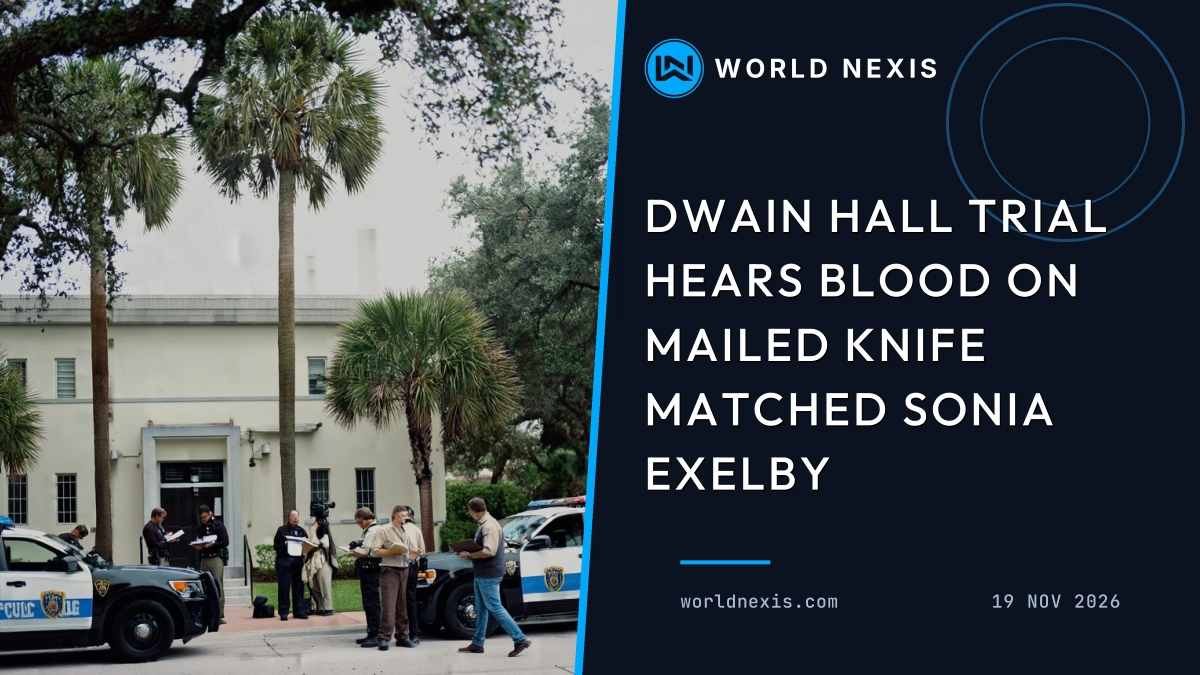
Updated 21 Nov 2026, 03:55 (UK time): Reporting from the Ocala trial adds a detail that was not in the verdict coverage: prosecutors told the court Dwain Hall, who used the username Alpha Sadist, demanded Sonia Exelby pay about $4,000 (£3,000) for him to kill her, after manipulating her for years.
The court record behind the Sonia Exelby murder conviction now includes a detail that the verdict alone did not carry: jurors were told that Dwain Hall, whose online username was Alpha Sadist, demanded that Exelby pay about $4,000 (£3,000) for him to kill her. Prosecutors said he had manipulated the 32-year-old, a music teacher from Portsmouth, for years before she flew to Florida in October 2025.
Assistant state attorney Amy Berndt told the court that Hall targeted Exelby because of her long history of mental illness and exploited her for his own sadistic pleasure, and that when he finally had her alone, thousands of miles from home, he stabbed her and buried her body. She was reported missing on 12 October 2025; her body was found in a shallow grave in Marion County on 17 October 2025.
Exelby’s family sat through the evidence. After the unanimous verdict, her brother Barry Wilton said Hall had pretended to care for her and had used her to fulfil his sick fantasies, while her sister Gemma Isaj said a vulnerable person had been preyed upon.
The conviction and the life sentence are unchanged. What the fuller record adds is a price agreed before the flight, which makes this harder to read as a woman simply travelling to die. A fee does not turn a killing into a service, and the fact that a figure was discussed only sharpens the question of who was supposed to say no.
Updated 20 Nov 2026, 18:56 (UK time): A Florida jury found Dwain Hall guilty of kidnapping and first-degree murder in the Sonia Exelby case, and he was sentenced to life in prison.
Dwain Hall has been convicted of kidnapping and murdering Sonia Exelby. A jury at the court in Ocala, Florida, returned its verdict on Friday, finding the 54-year-old auto repair and tow truck driver guilty of kidnap and first-degree murder, and he was sentenced to life in prison. He had denied the charges throughout.
The verdict follows a trial in which prosecutors argued that Hall groomed Exelby, 32, on a fetish website before she flew from Portsmouth to Florida in October 2025, and that her consent could not be a defence to first-degree murder because coerced submission through exploitation, threats or intimidation is not consent. His defence attorney had told the jury that Exelby travelled intending to die and that failing to stop a suicide is not murder.
For the Sonia Exelby murder case, this moves the story from evidence to outcome: the knife-handle blood DNA, the courier label and the Ohio parcel are now the record behind a conviction rather than the substance of a contested trial. Exelby’s sister, Gemma Isaj, said after the verdict that a vulnerable person had been preyed upon and a beautiful soul taken.
A guilty verdict settles the question a court can answer; it does not explain how a woman in crisis could find men online offering to end her life. That gap is where the next argument belongs.
The Sonia Exelby murder trial has produced its most damaging forensic evidence yet: a knife that Dwain Hall mailed to a friend in Ohio carried her blood beneath its handle, a court in Ocala, Florida, has heard. Hall, 54, an auto repair and tow truck driver, denies kidnapping and murdering Exelby, 32, who was reported missing from her home in Southsea, Portsmouth, on 12 October 2025. Her body was found in a shallow grave in Marion Oaks five days later.
Key points
- A crime laboratory biologist told the jury that DNA from reddish-brown staining beneath the knife handle matched a profile from Sonia Exelby, and that Hall was excluded as the source.
- Hall and Exelby were both named as “possible contributors” to mixed DNA on a bracelet found with the knife, while Hall, Exelby and his friend Rick Snyder were “possible contributors” to DNA on the sheath.
- Detectives in Washington county, Ohio, recovered the package from a bedroom dresser on 4 November 2025 after reading Facebook messages between the two men.
- Prosecutors allege Hall exploited a woman with a long history of mental illness and stabbed her “for his own sadistic pleasure”.
Forensic evidence at the heart of the Sonia Exelby murder trial
The jury was shown a photograph of the black knife, whose blade carries the printed line “Dorkworf pointy end goes in the other guy”. The biologist said she removed the handle after receiving “information that this item may have been cleaned”.
She took a sample from the staining under the handle, which gave chemical indications for blood, and sent it forward for DNA testing. The profile matched Sonia Exelby, she told the court, and Hall was excluded as its source.
That finding matters because it moves the Sonia Exelby murder case beyond messages and bank records. Blood sealed beneath a handle is difficult to explain as contamination, and the item was recovered in a different state from the grave.
The Facebook messages that led investigators to Ohio
Messages exchanged between Hall and Snyder in October 2025, now central to the Sonia Exelby murder trial, were shown to the jury. Hall refused to explain himself on the platform, writing: “can’t tell you here. Lease (sic) I say the better.” He also suggested his phone “may be tapped” and warned: “Might be a big storm coming for me.”
He then sent a photograph of a UPS label for a parcel addressed to Snyder. Hall asked for the contents back in six months “if this storm passes over with no lingering fallout”, and added: “Please, for the love of shadows, don’t lose this box.”
When Snyder remarked that the package looked like a delivery from Walmart, Hall replied: “LOL, I know best way to secretly send something.” A day before the body was found, Hall called the contents “two of my most prized possessions” and told Snyder that, apart from his wife Ginger, the box did not exist for anybody.
How the Sonia Exelby murder case began in Portsmouth
Exelby’s disappearance prompted an international search and a public appeal by Hampshire police. Investigators say Hall collected her from Gainesville airport in central Florida and drove her to an Airbnb rental.
Evidence gathered at the rental property included transactions on her bank cards and a video of Exelby stored on Hall’s mobile phone. In a message from her phone to a friend, recorded in an arrest affidavit, she wrote: “I’m sorry, he keeps taking my phone, he doesn’t trust me with it.” She added: “He made it clear there was no way out unless I shoot him.”
Assistant state attorney Amy Berndt told the court that Exelby had visited a website depicting graphic sexual abuse of women, where Hall was among several men who contacted her. Berndt said the 32-year-old, who had twice attempted suicide, “was trying to find someone who would kill her”.
“Unfortunately there was no shortage of depraved men willing to kill Sonia in the most torturous and vile ways possible.” — assistant state attorney Amy Berndt
A former boyfriend, Stevie Hunt, contacted the authorities after she vanished. He described her in court as kind, beautiful and loving, and said she had been in therapy for more than a decade.
Hall was arrested in November 2025. He accepts that he was in contact with Exelby and that the pair were intimate, but he denies killing her.
Why it matters
For British families, the Dwain Hall trial shows how quickly a missing-person report can become a transatlantic investigation. She was reported missing on 12 October 2025, and her body was found in a Marion Oaks shallow grave on 17 October; by 4 November, detectives in Ohio were searching a friend’s bedroom.
It also shows how much of the Sonia Exelby murder case now rests on data held by private companies. Messages, a courier label, bank card transactions and a phone video formed the spine of the prosecution case, and none of it came from a witness who saw a crime.
Analysis
Having spent two years on World Nexis News’s breaking news desk, where verification is most of the job, I look first at how the digital evidence was handled rather than at the quotes. The chain described in court is unusually clean: a courier label inside a message, a parcel recovered in another state, and a knife handle stripped in a laboratory because an analyst had been told it might have been cleaned.
On the record so far, the facts support the prosecution’s account better than any alternative I can construct. Blood sealed beneath a handle, matched to Exelby and excluding Hall, is hard to produce by accident. I also think Berndt framed the Sonia Exelby murder charge correctly for the jury: a woman in pain went looking for a way out, and someone used that.
The strongest counter-argument is that Exelby travelled to Florida herself and told strangers online what she wanted, so intent and consent are genuinely contested. That deserves a serious answer in court. It still does not explain why a man would post a bloodied knife across state lines and ask a friend to hide it for six months.
What happens next
The Sonia Exelby murder trial continues in Ocala, with prosecutors still presenting their evidence and the defence case to follow. Jurors will then decide on the kidnap and murder charges, which Hall denies. Any conviction would move the case to sentencing before the same court.
What we don’t know yet
- When the defence will open its case, and whether Hall will give evidence in his own defence.
- Whether prosecutors will seek charges against any of the other men who contacted Exelby through the website.
- How much of her mental health history the judge will allow the jury to hear beyond what was said in opening statements.
Related coverage
- Viagogo hidden fees: CMA warns over drip pricing on 3 sites
- Stormont budget: Bryant warns of crisis over £1.5bn offer
- Joanne Young case: four men guilty in landmark abuse trial
Further reading
- Prosecutors allege British woman ‘trying to find someone who would kill her’ lured to US and murdered
- Victim’s blood found on knife fetish website murder accused sent to friend
About the author: Tariq Al-Mansoori is the Breaking News Reporter at World Nexis News (WNN), covering breaking news. The analysis section reflects the writer’s view.

Tariq Al-Mansoori
Tariq Al-Mansoori is a Breaking News Reporter at World Nexis News, covering major incidents, official statements and developing stories across the UK, US and internationally. Based in London, he works to confirm details before publication, attributes information to named sources where possible and updates stories…



