Stormont budget: Bryant warns of crisis over £1.5bn offer
Stormont budget talks are deadlocked as Chris Bryant warns of a public sector crisis, with £1.5bn offered and ministers saying it is not enough.
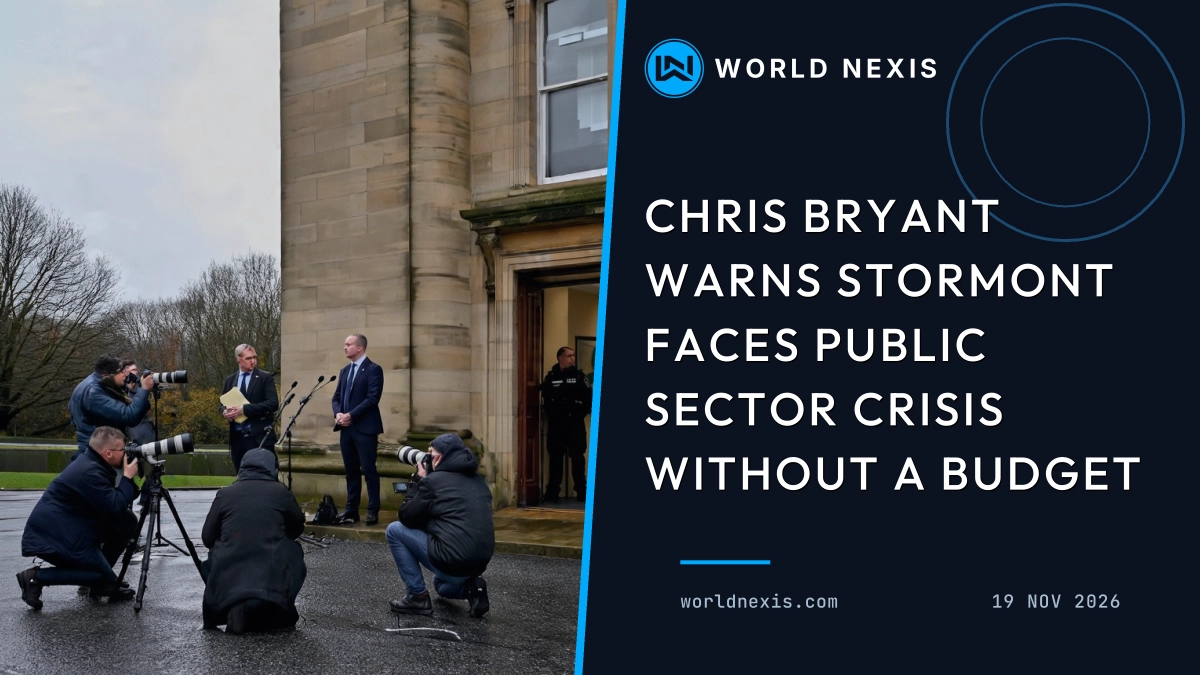
The Stormont budget standoff has moved into its most urgent phase, after the Northern Ireland Secretary warned that the devolved executive is heading for a public sector crisis unless ministers agree a financial settlement. Sir Chris Bryant said the region is running out of both time and legal room to spend, and that without a deal public sector staff may not be paid at the end of January, February and March.
Speaking at the British-Irish Intergovernmental Conference, he said the executive faces “a one-way ticket to a mad-man destination” if it does not set a budget.
Key points
- Sir Chris Bryant has warned that the Stormont budget impasse is fast approaching a “public sector crisis”.
- The UK Government has offered about £1.5 billion in extra funding over three years, including £525 million delivered this year.
- Last month’s UK Budget added £131 million for the current financial year, and £270 million across three years.
- Stormont departments are running on contingency budgets of 95% of last year’s spending.
Why the Stormont budget talks are deadlocked
Ministers in Belfast say they cannot strike a Stormont budget for 2026-27 without additional support from the Treasury, and that the sums offered so far are not enough to balance the books. Bryant has said repeatedly that no more money will be released, and that he does not want to legislate a budget from Westminster.
That option exists, but it carries weight. Previous Northern Ireland Secretaries have imposed budgets from London, yet only during periods when the power-sharing institutions were not operating. Doing so while an executive is sitting would be a different constitutional step, and ministers in London know it.
What has actually been offered
The Stormont executive funding picture is more layered than the headline figure suggests. The roughly £1.5 billion offer is spread across three years, with £525 million delivered in the current one. The UK Budget then added £131 million for this financial year and £270 million over three years, money that sits alongside rather than inside the original settlement.
Stormont departments are not yet in freefall. They are spending against contingency budgets set at 95% of last year’s total, a holding position that keeps services running but freezes new commitments. That arrangement expires with the financial year.
Bryant told reporters he would “combine a little bit of Shakespeare, a little bit of a hymn, and a little bit of the Sugar Babes”, adding that he was “getting bored with tomorrow and tomorrow and tomorrow”.
“The truth is that we are fast approaching quite a public sector crisis if there isn’t a budget set.” — Sir Chris Bryant
He then set out the mechanics in blunt terms. From 1 April, he said, the executive and the civil service “would not be able to expend anything, not a single penny”, because they would not even be permitted the 45% of last year’s spending normally allowed on account at the start of a financial year.
Stormont’s case: ‘a technical impossibility’
Gordon Lyons, the communities minister, rejected the framing that the executive is spending too much or simply failing to agree among itself. The problem, he said, is arithmetic rather than politics.
“It’s a technical impossibility for us to be able to balance the budget at this point in time.” — Gordon Lyons
Lyons argued that closing the Stormont budget gap through cuts would require redundancies, which would end up costing more money than they save. “The money is simply not there for us to balance our books,” he said, and asked the Secretary of State how he would propose to do it if he were sitting in the executive’s position.
Bryant also drew an unflattering comparison with the Irish coalition, noting that Fianna Fáil and Fine Gael are “two parties in government not entirely working together, and you managed to have a budget”.
Why it matters
For households in Northern Ireland, the Stormont budget is not an abstract row about block grants. It decides whether public sector staff across every category are paid on time, and whether services that are already stretched keep running through the spring.
Payroll is the immediate risk, but the longer damage is to planning. Departments cannot commit to contracts, staffing or capital work while they are capped at 95% of last year’s spend, so the Northern Ireland budget crisis will be settled later, in higher costs and longer waits.
Analysis
Having covered devolution and public services for World Nexis News, I look first at what a “technical impossibility” means inside a budget cycle. Usually it means a fixed set of legal duties, ring-fenced grants and demand-led pressures does not fit the envelope available. That is a real constraint, and Lyons is right that quick cuts tend to produce redundancy bills rather than savings.
Even so, I think the facts support Bryant on the deadline. A Stormont budget is a set of choices about priorities, and the executive has had months to publish one. The 95% contingency is a genuine cliff edge, and public sector pay is the first thing over it. The strongest counter-argument is that the Treasury has already moved, finding a further £131 million in-year, which weakens the “not a penny more” line — and that is precisely why both sides are waiting each other out.
Where I side with Stormont is on the arithmetic: the executive cannot invent money it does not have. But a Stormont budget that never arrives is worse for voters than one they dislike, and the parties sharing power will struggle to explain the difference.
What happens next
The clock runs to the end of January, when Bryant warned some public sector staff might not be paid, and then to 1 April, when spending authority lapses without a budget in place. The Stormont budget for 2026-27 must be agreed before then, and the Treasury insists the current offer is the limit.
What we don’t know yet
No date has been set for further talks or for an executive vote on a draft budget. It is also unclear whether Bryant would legislate from Westminster if the deadline passes, given that no Secretary of State has done so while power-sharing was functioning.
Related coverage
- Stormont budget impasse: Bryant says no money for £1.5bn ask
- Border poll: Bryant holds sole power to call the vote
- EV mandate: Flynn warns watering down 2030 plan unacceptable
Further reading
- Stormont on ‘one-way ticket’ to crisis without budget deal, warns Chris Bryant
- Stormont on ‘one-way ticket’ to crisis without budget deal, warns Chris Bryant
About the author: Liam O’Connor is the UK Politics Reporter at World Nexis News (WNN), covering uk politics. The analysis section reflects the writer’s view.

Liam O'Connor
Liam O'Connor is UK Politics Reporter at World Nexis News, covering Westminster, devolved politics and the issues that matter to voters across England, Scotland, Wales and Northern Ireland. Based in London, he reports from primary sources — Hansard, official statements, published data — and explains…



