EV mandate: Flynn warns watering down 2030 plan unacceptable
Stephen Flynn says watering down the EV mandate is wholly unacceptable, as the Climate Change Committee warns the UK could miss its climate targets.
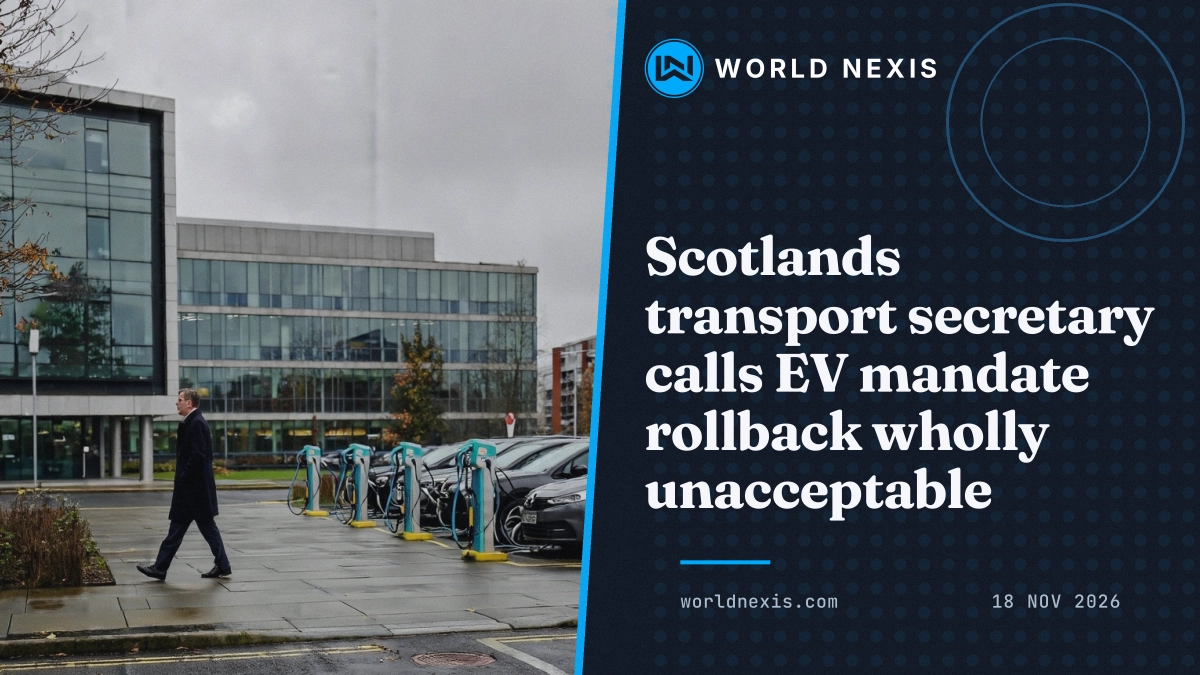
The EV mandate is at the centre of a fresh four-nations row after Scotland’s transport secretary, Stephen Flynn, said watering down the rules would be “wholly unacceptable”. His intervention came as the UK Government’s consultation on the policy continues, and after the Climate Change Committee warned on Wednesday that weakening the rules risks the UK missing its legally binding climate targets.
Key points
- Stephen Flynn said weakening the EV mandate would be “wholly unacceptable” and would undermine the four nations approach.
- The UK Government is consulting on possible changes to the zero emission vehicle mandate after concerns from carmakers.
- The Climate Change Committee warned on Wednesday the UK could miss its climate targets if the rules are weakened.
- Ministers insist they remain committed to phasing out new petrol and diesel cars by 2030, and to all new car and van sales being zero emission by 2035.
What the EV mandate does and why it is under review
The zero emission vehicle (Zev) mandate requires car manufacturers to sell an increasing proportion of electric vehicles each year. Because the requirement rises annually, manufacturers must sell proportionally more electric cars as the decade goes on.
Reports in recent weeks have suggested the UK Government could soften its position on the mandate. A consultation is being held on potential changes as a result of concerns from carmakers.
The Climate Change Committee, which advises ministers on climate policy, said on Wednesday that the Government risks missing its climate change targets if it weakens the rules. Its warning handed devolved ministers and campaigners a fresh argument against any dilution of the EV mandate.
Flynn: weakening the EV mandate is ‘wholly unacceptable’
Flynn urged the UK Government not to change the plans. He said a softer EV mandate would hamper the ability of devolved nations to reduce vehicle emissions, and that any change would require agreement from the devolved nations.
“It is wholly unacceptable that the UK Government is signalling a willingness to weaken ambition in relation to electric vehicles and undermine the well-established four nations approach to the Zev mandate by making repeated statements that take no account of the devolved nature of this policy area,” he said.
He added that Scottish ministers oppose any rollback, arguing it would increase prices for consumers during a cost-of-living crisis while severely weakening ambitions to reduce vehicle emissions.
“We are committed to delivering a future where electric car ownership is the norm, and the UK Government should not be putting that at risk,” he said.
Flynn also said he noted the Climate Change Committee’s view that the Zev mandate is working effectively and that current trajectories should be maintained. He called on the UK Government to work with devolved governments to strengthen climate action rather than undermine it.
His statement pointed to the committee’s assessment as evidence that the policy is delivering. It also framed the argument as one about trust between the four governments, not simply about electric car sales.
The UK Government’s response
A UK Government spokesperson said ministers remain committed to the phase out of all new petrol and diesel cars by 2030 and to all new car and van sales being zero emission by 2035, as well as to legally binding net zero targets.
“Our consultation on the mandate will not change this and will ensure we are taking a pragmatic and balanced approach to the ZEV transition.”
The spokesperson said the exercise would deliver a pragmatic and balanced approach to the transition. The Government has not set out, in the statements given so far, which parts of the mandate it is considering changing.
Devolution at the heart of the EV mandate dispute
Flynn’s central claim is procedural. He argues the policy depends on devolved legislation and can only be changed with the express agreement of the governments and parliaments of all four nations.
On that reading, the UK Government’s approach is inconsistent with the principles of mutual respect and co-operation that should underpin relations between the nations of the UK. The row therefore reaches beyond carbon budgets and into how the union governs shared markets.
The Zev mandate sits alongside the 2030 and 2035 phase-out dates that the UK Government says are unchanged. Flynn’s case is that repeated statements about softening the rules undermine the four nations approach, whatever ministers intend.
Analysis
Having covered devolution for WNN, I look first at process rather than headline numbers. The key question is whether ministers in London signalled a change to a framework that runs on devolved legislation before securing agreement from the other three governments.
In my view Flynn has the better of that argument. A consultation is a fair way to hear carmakers’ concerns, but a mandate that runs on four-nations consent cannot be rewritten by Westminster alone. His cost-of-living framing is the weakest part of his case, yet the process point stands.
The strongest counter-argument is that the mandate is a UK-wide market mechanism and that softening it might protect jobs and prices for buyers. That case deserves a hearing, but only with the devolved governments in the room. If ministers want to change the EV mandate, the burden is on them to say how they will win that agreement.
What happens next
The UK Government’s consultation on the EV mandate continues, and ministers say it will not alter the 2030 and 2035 commitments. The Climate Change Committee has said current trajectories should be maintained, a position Flynn has seized on.
Any change would then have to be squared with the devolved administrations, whose consent Flynn says is required. Scottish ministers say they will oppose any rollback and want the UK Government to work with devolved governments on climate action instead.
No outcome or timetable for the consultation has been set out in the statements issued so far.
Related coverage
- Iran dirty bomb plot: Trump warns of severe response
- Jensen Huang comeback shut down as Nvidia revenue doubles
- Imperial Brands job cuts: major cull of 2,500 roles by 2030
Sources
- Watering down EV mandate would be ‘wholly unacceptable’, says Stephen Flynn (bournemouthecho.co.uk)
- Watering down EV mandate would be ‘wholly unacceptable’, says Stephen Flynn (echo-news.co.uk)
- Watering down EV mandate would be ‘wholly unacceptable’, says Stephen Flynn (yourlocalguardian.co.uk)
- Watering down EV mandate would be ‘wholly unacceptable’, says Stephen Flynn (theargus.co.uk)
- Watering down EV mandate would be ‘wholly unacceptable’, says Stephen Flynn – AOL (aol.co.uk)
About the author: Liam O’Connor is World Nexis News’s UK Politics Reporter, covering uk politics. The analysis section reflects the writer’s view.

Liam O'Connor
Liam O'Connor is UK Politics Reporter at World Nexis News, covering Westminster, devolved politics and the issues that matter to voters across England, Scotland, Wales and Northern Ireland. Based in London, he reports from primary sources — Hansard, official statements, published data — and explains…



