Border poll: Bryant holds sole power to call the vote
Northern Ireland Secretary Chris Bryant says a border poll is at his discretion and refuses to set out factors that would trigger a unity vote.
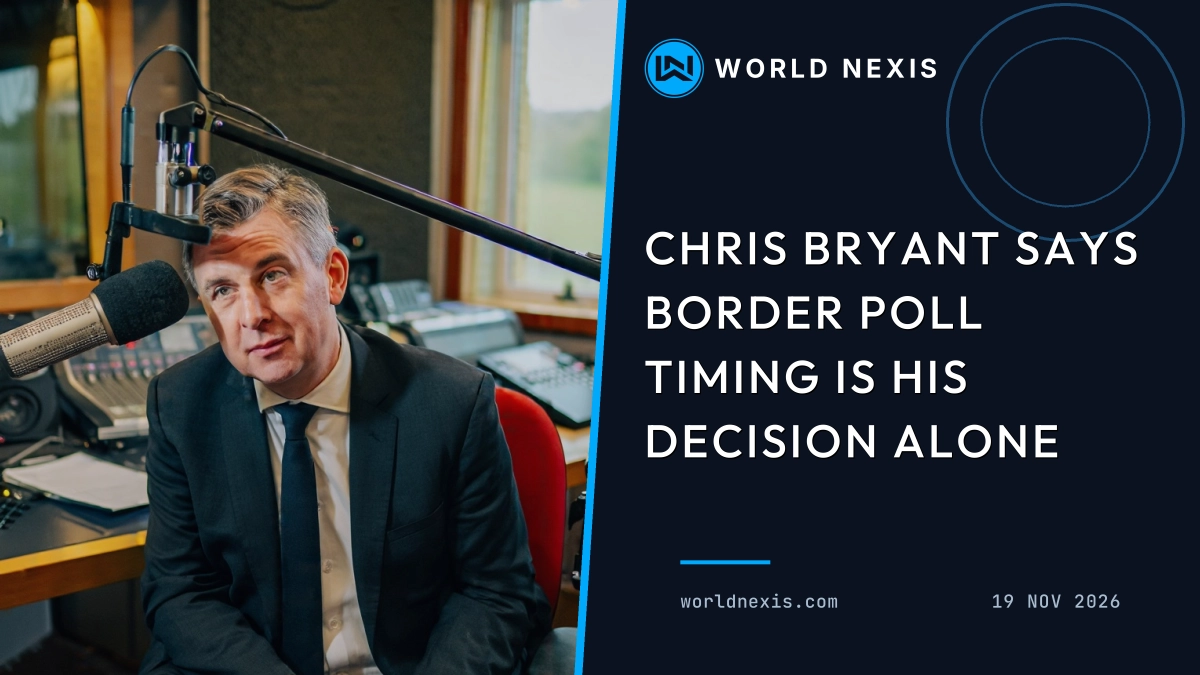
A border poll will only be called when it “appears likely” that voters would back Irish unity, and the judgement rests with the Northern Ireland Secretary alone, Sir Chris Bryant said on Thursday. The Cabinet minister repeatedly declined to set out the evidence or the polling threshold he would use, saying the decision is “at my discretion” and that campaigning for a united Ireland is not his job.
Key points
- Sir Chris Bryant said there is “one single factor” for calling a border poll and that it is “very clear” in the Good Friday Agreement.
- Pressed on how he would judge that test, he replied: “When it appears likely.”
- He said the power is a matter for the Secretary of State alone, as agreed by London and Dublin as co-guarantors of the 1998 Agreement.
- He spoke before attending the British-Irish Intergovernmental Conference in Dublin.
What Chris Bryant said about a border poll
Asked to list the factors that would guide him, Sir Chris pointed to a single test written into the Good Friday Agreement. “There’s one single factor and it’s very clear in the Good Friday Agreement,” he said. “You can argue that it’s nuanced, but it’s nuanced and clear.”
Pressed on how he would decide the moment had arrived, the Northern Ireland Secretary answered: “When it appears likely.” Asked again, he gave the same reply. He described that wording as the “legal determination” in the Agreement.
He rejected the argument that trouble over setting a budget at Stormont shows Northern Ireland cannot work in its present form. “My view is that it is for the people of Northern Ireland, to decide their future,” he said. “And that is one of the core principles of the Good Friday Agreement – and certainly as things stand I don’t detect a move for everybody wanting to join a united Island.”
The Good Friday Agreement test behind a border poll
The 1998 Agreement, co-guaranteed by the UK and Irish governments, allows the Secretary of State to order a vote on Northern Ireland leaving the UK and forming a united Ireland “at any time it appears likely to him that a majority of those voting would express a wish” for that to happen.
Sir Chris said the power is not shared with Dublin. “It’s very clear it’s a matter for the Secretary of State for Northern Ireland, and that is agreed by the two governments as co-guarantors,” he said. Asked why the Irish Government should not have a say, he replied: “Because the Good Friday Agreement says that it is a matter for the Secretary of State for Northern Ireland.”
He also set out what he sees as his own limited role. “There are people who’ve obviously been campaigning all of their life and it’s part of their kind of reason for existing in politics to campaign for a United Ireland, that isn’t my job,” he said. His job, he added, is to bring forward a border poll only when he believes people in Northern Ireland would want to join a united Ireland, and “I don’t detect that’s the situation now”.
Stormont rows, Dublin’s planning and the EU question
Asked whether unity preparations by Fine Gael and Fianna Fáil were destabilising powersharing at Stormont, Sir Chris said: “I don’t think so.” He was speaking before the British-Irish Intergovernmental Conference in Dublin, where UK ministers and the Irish Government meet as co-guarantors.
On the wider UK-EU relationship, he said the priority is a good deal between the whole of the United Kingdom and the European Union. He cited the common travel area on the island of Ireland as a historic and important economic strength for both parts.
He said sanitary and phytosanitary agreements due to be signed “over the next couple of days” would remove “a lot of the barriers and unnecessary paperwork”. On the pace of the reset, he added: “I can’t remember who it is, who’s saying ‘one day at a time sweet Jesus’, but I think we need – in our relationship with the European Union – we need to progress a little bit one day at a time.”
Why it matters
For voters in Northern Ireland, the question of who decides on a border poll is not abstract. It governs how stable the devolved institutions look to employers, investors and public-sector planners, and it shapes how every budget stand-off at Stormont is read on both sides of the constitutional divide.
The Secretary of State’s reading also matters in Dublin, where the Irish Government is a co-guarantor but, on his account, has no hand on the trigger. And the parallel EU track affects everyday trade paperwork for businesses moving goods across the Irish Sea.
Analysis
Having covered devolution and Northern Ireland for World Nexis News, I look first at what the text actually says, and on that Sir Chris Bryant is on solid ground. The Agreement gives the call to the Secretary of State, not to a joint British-Irish mechanism and not to a fixed polling number. His answer that Dublin has no veto is a fair reading of a clause both governments signed up to.
Where I part company with him is the refusal to say what evidence he would weigh. “When it appears likely” is a legal test, but a discretion exercised with no published method will be read as a veto by people who want a united Ireland and as a threat by people who want to stay in the UK. Neither reading helps a devolved executive that is already arguing over its budget. I side with those who want the criteria described in advance, even roughly.
The strongest counter-argument is that any written threshold becomes a target, inviting campaigners to game surveys and parties to chase a number rather than govern. That risk is real. Even so, a minister can explain what he would look at without turning it into a finish line, and refusing to do so costs more trust than it saves.
What happens next
Sir Chris travelled on to the British-Irish Intergovernmental Conference in Dublin, where the two governments meet as co-guarantors of the peace settlement. He also expects sanitary and phytosanitary agreements with the European Union to be signed within days, cutting paperwork on UK-EU trade.
What we don’t know yet
No published criteria for a border poll exist, and the Secretary of State has not said whether any will be drawn up. It is also unclear what evidence, beyond his own judgement, would satisfy the “appears likely” test, or whether Dublin will keep pressing publicly for a role in timing the vote.
Related coverage
- Stormont budget impasse: Bryant says no money for £1.5bn ask
- FDA nominee Heidi Overton dropped one day before major vote
- Orkney sunken vessel found weeks after Kilda tragedy
Further reading
- Northern Ireland Secretary says border poll at his ‘discretion’ – AOL
- Northern Ireland Secretary says border poll at his ‘discretion’
About the author: Liam O’Connor is the UK Politics Reporter at World Nexis News (WNN), covering uk politics. The analysis section reflects the writer’s view.

Liam O'Connor
Liam O'Connor is UK Politics Reporter at World Nexis News, covering Westminster, devolved politics and the issues that matter to voters across England, Scotland, Wales and Northern Ireland. Based in London, he reports from primary sources — Hansard, official statements, published data — and explains…



