Battery manufacturing warning over Australia’s minerals
CSIRO scientists warn Australia is losing battery manufacturing value by exporting lithium and other minerals raw, then importing finished batteries.
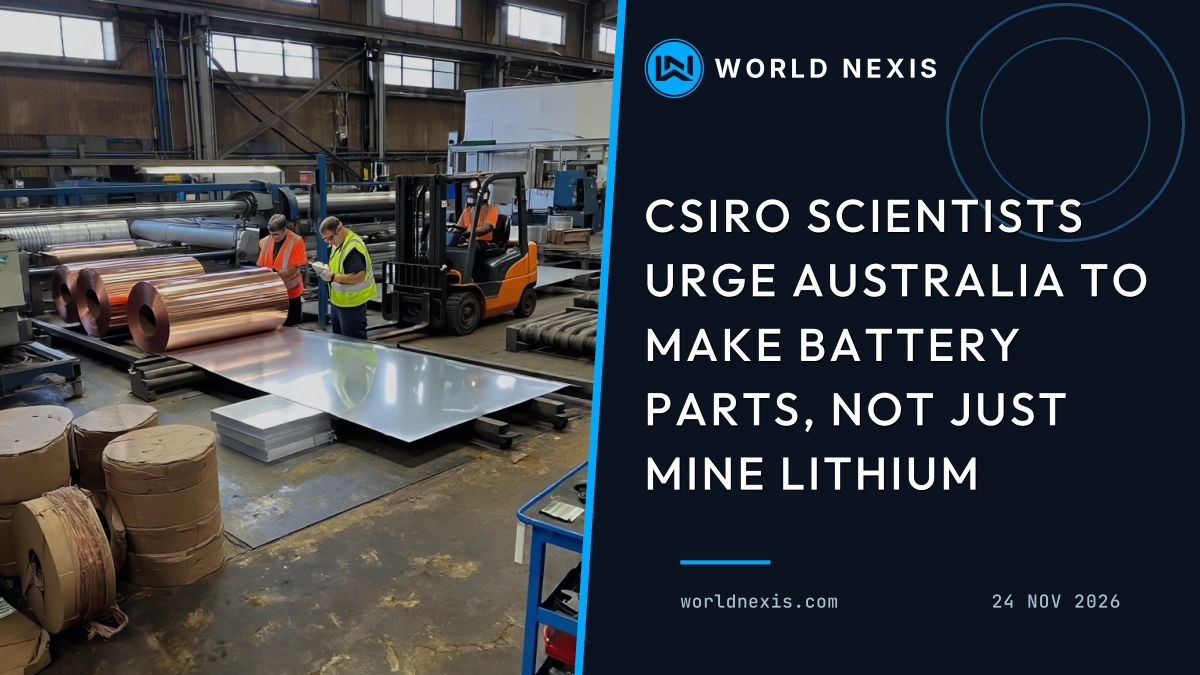
Australia is losing the value of battery manufacturing by exporting the minerals used in lithium-ion cells as raw material and importing finished batteries, scientists at the national research agency have warned. Researchers from the CSIRO used an event called Australia’s Battery Opportunity on Tuesday to set out how a country sitting on lithium, nickel, cobalt, manganese, aluminium, copper and graphite ends up buying back the products those minerals make possible. More than 600,000 home batteries have been installed under a federal scheme since July 2025, and electric vehicle sales have been rapid since March.
Key points
- CSIRO scientists say Australia ships critical minerals overseas unprocessed and imports the batteries made from them.
- They recommend building battery manufacturing around individual components, such as aluminium casings and copper foil.
- More than 600,000 home batteries have been installed under a federal scheme since July 2025.
- A CSIRO report published in early November identified gaps in the global battery supply chain that Australian firms could fill.
Battery manufacturing push targets the middle of the chain
Joanne Loh, a principal research scientist in CSIRO’s mineral resources division, said Australia’s mineral endowment is not in question.
“We have all the minerals needed for batteries, specifically lithium-ion batteries – we’re the number one producer in terms of lithium… we have nickel, cobalt, manganese, aluminium, copper, graphite, you name it,” Dr Loh said. “However, we export all of these as raw materials overseas so even though we might have it, we’re actually sending it overseas for processing, then importing them back as batteries.”
Dr Loh added that Australia also shreds batteries at the end of their lives and exports the resulting material rather than using it at home. Geoff de Looze, a senior research engineer at the agency, said the country has stopped making components that feed battery production, including aluminium foil.
The scientists argue that re-establishing that kind of capacity is more realistic than attempting to build complete batteries in competition with established manufacturers. That is the practical version of the battery manufacturing argument: find the narrow points in the global chain where Australian skills and minerals overlap, then manufacture for those markets.
Where battery manufacturing could start
A CSIRO report released early in November found Australia could apply its expertise in manufacturing aluminium aerosol cans to produce battery casings, or turn scrap wire into copper foil. Mr de Looze said the country should rank its capability gaps before committing money.
“We do have some gaps in Australia’s capability so when we look at them we need to rank them and work out which ones we can take on and which ones we want to leave alone,” he said. “Any of the manufactured parts going into batteries, Australia can take on.”
Adam Best, a senior principal research scientist at the CSIRO, said partnerships with larger manufacturers would open the door faster than a direct challenge to incumbents.
“We need to work closely with our partners in Asia, Pacific, North America, Europe, to find where we fit in this middle part such that we can do… that manufacturing, that value-adding, to capture more value from our resources,” he said. “Then Australia does have a brighter future that can lead to a future with energy security.”
Home battery boom sharpens the battery manufacturing question
The warning arrives while Australian households are adopting storage faster than any domestic supply chain has been built to serve them. More than 600,000 home batteries have been fitted under a federal scheme since July 2025, alongside rapid electric vehicle sales since March. That demand currently resolves into imports.
The researchers are not proposing to replace those imports outright. Their case is narrower and more practical: that a slice of the processing, casing and foil work could be done in Australia, keeping more of the value of its critical minerals onshore instead of exporting the raw material and buying it back.
Why it matters
For Australian households, the stakes are jobs and prices. If casings, foil and other components are made locally, part of the money already being spent on home storage and electric vehicles stays in the domestic economy, and the workforce that builds it acquires skills that outlast a single mine.
Supply security matters too. A country that exports unprocessed minerals and imports finished cells has handed control of its energy hardware to overseas processors, freight schedules and foreign industrial priorities. Battery manufacturing, on this reading, is an energy security question as much as an industrial one.
Analysis
Having covered global trade for World Nexis News, I read the CSIRO’s battery manufacturing intervention less as a lament about lost factories than as a map of where a mid-sized economy can actually win. The logic in the researchers’ own account is hard to argue with: being the world’s number one lithium producer counts for little if the next step after the mine is a ship.
In my view the facts support Adam Best’s middle-of-the-chain strategy over a go-it-alone push into complete batteries. Cell plants are capital-hungry, the incumbents in Asia are entrenched, and Australia’s realistic advantages sit in metalworking that already exists – foil, casings, precision parts – rather than in chemistry it would have to import expertise for. The strongest counter-argument is that a component supplier still lives off the order books of the companies that own the brands and the cells, and Australia has already watched an aluminium foil industry disappear once.
That is a fair warning, but it argues for patient, targeted industrial policy rather than for continuing to export ore and import finished batteries. If the country does nothing, the home battery boom will simply deepen a dependency it could be using as leverage.
What happens next
The battery manufacturing proposals from the CSIRO are recommendations to industry and to potential overseas partners rather than settled policy. Its November report is now the working document, setting out which parts of the global supply chain Australia could enter and where its own capability falls short.
What we don’t know yet
It is not yet clear whether governments will fund casings, foil or domestic recycling capacity, and no manufacturer has been named as a partner. Nor is it known whether end-of-life batteries will keep leaving the country as shredded material or whether the metals inside them will be recovered at home.
Related coverage
- Waymo service pause: Bay Area storm warning for Thanksgiving
- Medicare for All is back with a 2033 funding warning
- Tesla self-driving: 1.7m subscriptions, a safety warning
Further reading
- Australia urged to charge up battery manufacturing
- Australia urged to charge up battery manufacturing
About the author: Marcus Ellington is the International Correspondent at World Nexis News (WNN), covering world affairs. The analysis section reflects the writer’s view.

Marcus Ellington
Marcus Ellington is International Correspondent at World Nexis News, reporting on diplomacy, conflict and the political forces reshaping Europe, the Middle East, Asia and the Americas. Based in London, he focuses on explaining why events unfold as they do, using official statements, diplomatic documents and…