Waymo service pause: Bay Area storm warning for Thanksgiving
Waymo service pause: the robotaxi firm is halting rides across the San Francisco Bay Area on Monday as forecasters warn of storm flooding and high tides.
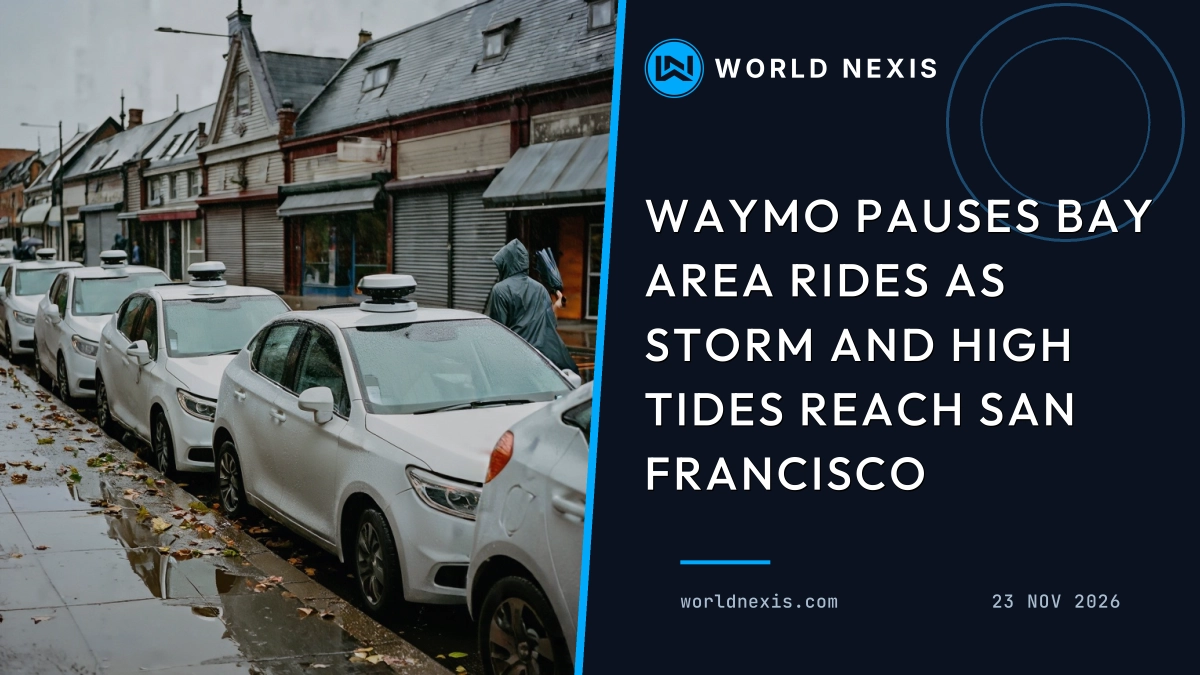
Waymo service pause: the robotaxi operator will stop carrying passengers across the San Francisco Bay Area on Monday, taking its cars off the road as a severe storm and high tides bear down on the city at the start of Thanksgiving week. San Francisco Mayor Lurie said the company had agreed to the halt. The decision hits the streets where the fleet has become a familiar sight, and it lands at one of the busiest travel periods of the American year.
Riders who use the service for airport runs or late shifts will need another way to travel on Monday. The move also hands city hall a direct say over when a private robotaxi network runs and when it does not.
Key points
- The Waymo service pause covers the San Francisco Bay Area and takes effect on Monday.
- It coincides with a severe storm forecast for Thanksgiving week, with high tides raising the risk of flooding.
- San Francisco Mayor Lurie said the company agreed to pause service.
- Waymo has also issued two recalls of its robotaxis as scrutiny of the technology grows.
Why the Waymo service pause lands at an awkward moment
Thanksgiving week is when Bay Area roads fill with holiday traffic and emergency crews are already stretched thin. A fleet that stalls in standing water or blocks a lane would add a problem the city does not need.
The engineering logic of a stand-down is straightforward enough: heavy rain, ponding and high tides cut the information a car can trust about the road ahead. This is a precaution, not a verdict on the technology. What is not yet public is which conditions triggered the call, or how far the pause reaches beyond Monday.
For passengers, the practical effect is a gap in a service that has become part of the city’s transport mix. Ride-hailing apps, buses and trains will absorb the demand. That is a nuisance for most riders and a real difficulty for anyone who cannot easily switch.
High tides and a request from the mayor
The Waymo service pause came after San Francisco Mayor Lurie said the company had agreed to it, a request that put city hall directly into the operating decisions of a private robotaxi fleet. The stand-down is tied to a San Francisco storm warning covering the run-up to the holiday, with high tides and a risk of flooding.
The ask reflects a specific fear. In an emergency, closed lanes, standing water and rescue vehicles need a road that can be cleared fast. Cars that stop or hesitate in those conditions become part of the hazard rather than part of the response.
Compliance also matters politically. A mayor who can point to a fleet standing down when asked has a template for the next storm, and for every argument about how far robotaxis should be allowed to spread.
Two recalls add to scrutiny of driverless cars
Waymo has also issued two recalls covering its robotaxis, a development that sharpens questions about how the vehicles behave when normal road rules are suspended. One recall concerns how the cars handle closed lanes and manual traffic control, the kinds of situations that appear when a storm shuts roads and officers wave traffic through by hand.
The Waymo service pause and the recalls are separate events, but they meet at the same question: how quickly can a machine-driven fleet be made to behave safely when the street stops working normally? Oversight runs through the California Department of Motor Vehicles and federal traffic safety officials in the United States, and both will see the findings.
Why it matters
For riders, the Waymo service pause is a reminder that a driverless service can vanish at short notice, and that an app on a phone is not a guarantee of a lift in bad weather. For city authorities, it is a live test of whether operators will step back when asked.
The bigger prize is trust. Every storm, flood and recall is now evidence in a public argument about whether autonomous cars belong on crowded streets, and the outcome will shape licensing, insurance and street design in American cities for years.
Analysis
Having covered autonomous vehicle policy for World Nexis News, I look first at one question in any stand-down: who holds the switch? Here the answer is the company, after a request from the mayor, and that is the part of this story worth remembering.
I think the Waymo service pause is the right call, and the mayor was right to ask for it. The safety case for robotaxis rests on the claim that software judges better than a tired human driver. In a storm, the honest version of that claim is not that the cars handle anything, but that the operator knows when they cannot and says so before the water rises. On the evidence available, the cautious side of this argument is better supported.
The strongest counter-argument is that a service which stops when the weather turns is not much of a transport system. Human drivers keep driving in rain, and the riders who lose a lift at short notice pay for the caution. I accept that. But the robotaxi service suspension also exposes a disclosure gap: a fleet that only stands down when a mayor asks has told the public less than it should. Announce your storm rules in advance and the caution becomes a selling point rather than an admission.
What happens next
The Waymo service pause is expected to hold while the storm passes, and the timing overlaps Thanksgiving Day on Thursday, so any restart is likely to be decided day by day. City agencies will be watching the tides and the flooding through the holiday.
The two recalls also need a fix and an account to regulators at state and federal level, who will want to know what changed in the software and whether the same conditions could return on a wet road.
What we don’t know yet
How many vehicles are affected, when service resumes, and whether the pause stretches beyond Monday into the rest of the holiday week. The company has not said publicly whether the recall remedies are already deployed on the cars that will come back into service.
Related coverage
- Tesla self-driving: 1.7m subscriptions, a safety warning
- Black Friday scams: urgent warning over AI-cloned stores
- Medicare for All is back with a 2033 funding warning
Further reading
About the author: Priya Nair is the Technology Correspondent at World Nexis News (WNN), covering technology. The analysis section reflects the writer’s view.

Priya Nair
Priya Nair is Technology Correspondent at World Nexis News, covering artificial intelligence, cybersecurity, consumer devices and the companies building them. Based in London, she explains how new technology works, who it affects and what the evidence actually shows, with attention to privacy, competition and the…