Tesla self-driving: 1.7m subscriptions, a safety warning
More seniors are using Tesla self-driving to stay on the road, as subscriptions hit 1.7m and safety experts question Tesla's 9x safety claim.
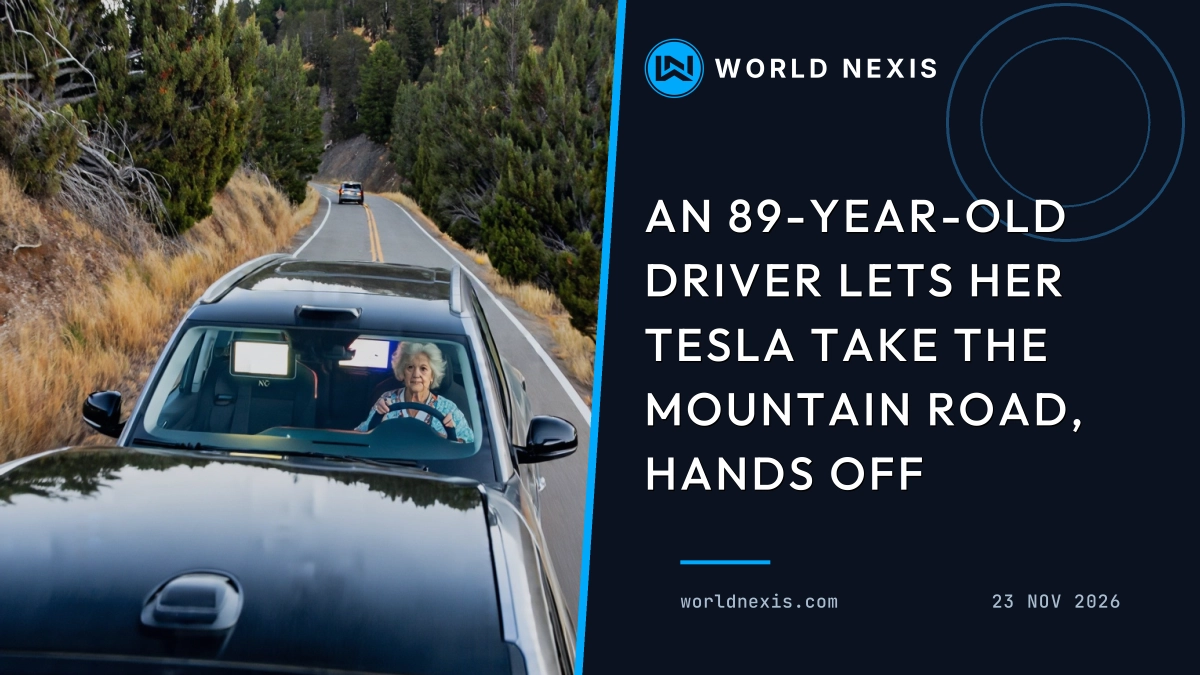
Tesla self-driving is now a family decision rather than a gadget story: Tesla says its Full-Self Driving (Supervised) system has more than 1.7 million active subscriptions, up 67% in a year, and older drivers form part of that growth. The company will not say how many subscribers are seniors, and safety researchers say its headline safety claim still cannot be checked.
Key points
- Tesla self-driving subscriptions top 1.7 million, a 67% rise in a year, at about $99 a month.
- Joan Spalding, 89, of Evergreen, Colorado, uses the system on narrow mountain roads after a serious crash two years ago.
- MIT research scientist Bryan Reimer says the technology has safety gaps and he would not use it.
- Tesla says FSD is up to nine times safer than human driving, a figure independent researchers cannot verify.
Tesla self-driving: how one Colorado family made the switch
Joan Spalding has driven the steep, winding road to her house outside Denver for more than 50 years. These days she barely touches the steering wheel or the pedals of her Tesla Model Y. She tells the car where she wants to go and presses a button on the large dashboard touchscreen.
The car handles tight turns through valleys of juniper and ponderosa pine. On a recent drive it took a dirt track barely wide enough for two cars, with a steep drop on one side, and stopped to let an SUV squeeze past. Spalding was skeptical at first of what Tesla officially calls Full-Self Driving (Supervised), a subscription that usually costs $99 a month.
“When I was driving, I saw that the kind of things that it did were safer than what I would do.” — Joan Spalding
Her confidence follows a serious crash two years ago while she was making a left turn. “I made a wrong decision. I wasn’t focusing on what I should be doing … I was lucky,” she said. “But I realized then that my abilities were not where I wanted them to be.”
Her son Mike Spalding had watched her driving worsen. He already drove a Tesla himself, so he suggested one for her: “It would be safer for mom if she was in a wreck because it’s got all kinds of safety features.” He said the same car would also be safer for the people around her, adding that the system is “better than me.”
Safety experts question Tesla self-driving claims
Bryan Reimer, a research scientist at MIT who studies how drivers interact with technology, is not convinced. “It’s not a technology that I would drive with. It’s not a technology that I would suggest that my loved ones use,” he said. “I think it has a few safety gaps that just make me uncomfortable.”
Tesla says FSD is up to nine times safer than human driving. Because the company releases little data about Tesla self-driving, Reimer said, it is impossible to independently verify whether that claim is true. That leaves the FSD safety claims resting on the manufacturer’s word.
Tesla does not disclose how its subscribers split by age, and outside researchers have no separate count of how many older drivers rely on the system. The overall subscription figure is the only public measure of how far the technology has spread.
Tesla sells the feature as Supervised, a label that points to the driver staying responsible while the car steers, brakes and accelerates. That distinction carries weight for an 89-year-old on a mountain road, and for the drivers, cyclists and pedestrians around her.
Why it matters
More older drivers are on the road than ever, and families often struggle with the question of when it is time to stop driving. A Tesla FSD subscription changes that conversation for households that can afford it, because it offers mobility to someone whose abilities have slipped.
At about $99 a month, the service is a recurring cost on top of an expensive car. The wider stake in Tesla self-driving is safety on shared roads, because confidence in the software is not the same thing as evidence about it.
Analysis
Having covered consumer tech and automated systems for World Nexis News, I look first at what a company can prove, not what it can demonstrate on a good day. On that test the skeptics have the stronger case. Tesla self-driving rests on a safety multiple that the company publishes without the data behind it, and Reimer’s careful wording leaves the central claim unverified.
I also think the families deserve more credit than much of the coverage gives them. Joan Spalding did not buy a robot; she bought a supervised system after a crash convinced her that she was no longer safe, and her son made a reasoned bet on safety features. The strongest counter-argument is that taking the keys away leaves a demonstrably worse human driver in charge, which may be the greater risk.
What I would watch is the language. Every step from “supervised” toward “self-driving” moves responsibility from the person in the seat to the software. In my view that shift should not happen until the evidence arrives first.
What happens next
Tesla self-driving stays a subscription product that the company describes as supervised, and its own growth figure of 67% points to more drivers, including older ones, trying it in the months ahead. Nothing in the record suggests Tesla is about to publish a breakdown of how many subscribers are seniors.
For now the verification question sits with the company. Reimer’s argument is that independent researchers cannot close the gap without data Tesla has not released, so this debate will keep running on company claims and individual testimony rather than audited numbers.
What we don’t know yet
- How many of the 1.7 million subscribers are older drivers.
- Whether the nine-times safety figure holds up under independent analysis.
- How families should weigh a supervised system against the risk of an older relative driving unaided.
Related coverage
- Black Friday scams: urgent warning over AI-cloned stores
- Brexit debate warning as Sunak tells Burnham not to reopen
- Parma shooting: victims named as police weigh self-defence claim
Further reading
- US army to blow up bomb-making chemicals despite safety concerns
- Seniors embrace Tesla automated driving technology despite questions about safety
About the author: Priya Nair is the Technology Correspondent at World Nexis News (WNN), covering technology. The analysis section reflects the writer’s view.
Priya Nair
Priya Nair is Technology Correspondent at World Nexis News, covering artificial intelligence, cybersecurity, consumer devices and the companies building them. Based in London, she explains how new technology works, who it affects and what the evidence actually shows, with attention to privacy, competition and the…