Brexit debate warning as Sunak tells Burnham not to reopen
Rishi Sunak warns Andy Burnham that reopening the Brexit debate would be divisive and all-consuming, as Conservative ex-prime ministers weigh in.
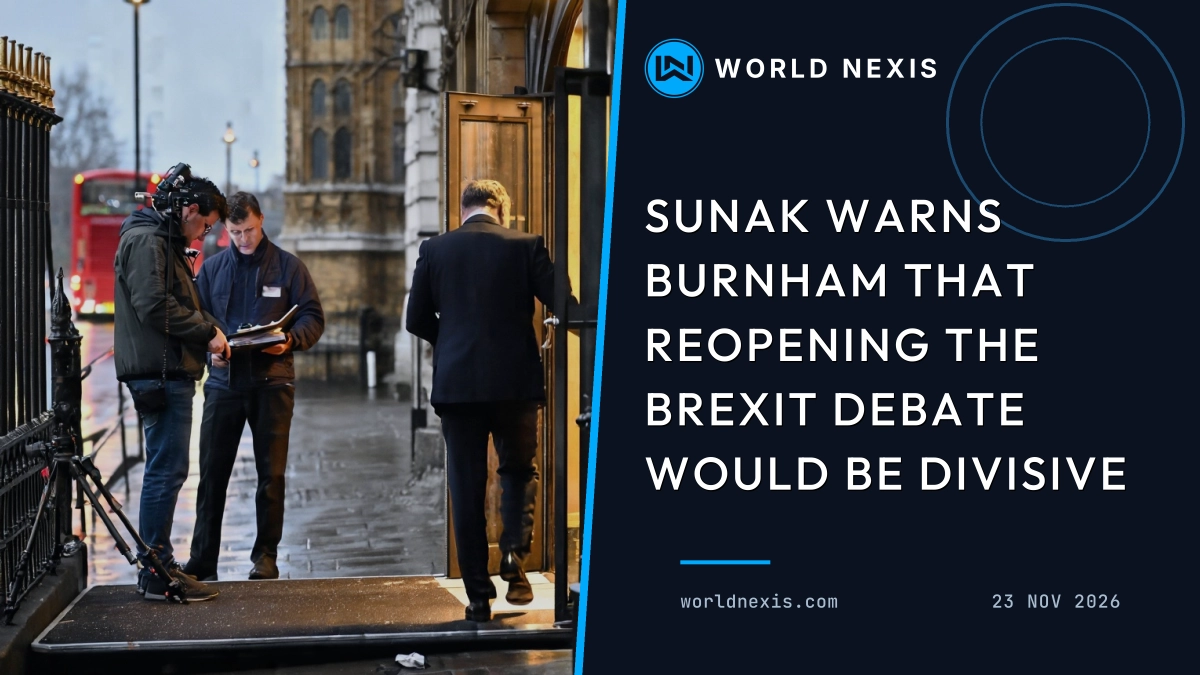
Rishi Sunak has warned Andy Burnham that reopening the Brexit debate would be “divisive” and risk becoming an “all-consuming” distraction for the Government. The former Conservative prime minister said he did not see the UK rejoining the EU within five years, making him the latest in a string of former leaders to caution against revisiting the question of future UK-EU ties.
His intervention came in a Sky News interview that airs in full on Tuesday. It follows Theresa May’s plea to Mr Burnham to “accept Brexit and move on”, and earlier warnings from Boris Johnson and Lord David Cameron. Sir Tony Blair, a Labour former premier, argued on Sunday that Britain should only rejoin the EU if the bloc reforms and allows more technological innovation.
Key points
- Rishi Sunak said he “certainly wouldn’t reopen up this whole debate about rejoining the EU”.
- Theresa May told Andy Burnham: “people voted for Brexit. Brexit is done. Just accept Brexit and move on.”
- Boris Johnson and Lord David Cameron have already cautioned against reopening the Brexit debate.
- Andy Burnham will discuss options for future EU ties over the next 12 months, after deals struck at Friday’s Brussels summit.
Sunak’s Brexit debate warning
Asked whether Britain could be back inside the bloc within five years, Mr Sunak replied: “I don’t see that.” He added that Mr Burnham has himself said he would not want to go back into Europe on financial services or technology, “because they’re so critical to our future growth”.
“I certainly wouldn’t reopen up this whole debate about rejoining the EU. Obviously it’s divisive. But we saw last time around, it was also all consuming.”
Mr Sunak was prime minister from 2022 to 2024. He oversaw an improvement in UK-EU relations after the rancour of the Johnson years and agreed the Windsor framework, which eased post-Brexit trading arrangements for Northern Ireland, the thorniest outstanding issue with Brussels.
In another clip trailed before the broadcast, he reflected on his record in Downing Street, saying: “I don’t think the country probably saw the best side of me.” He put that down partly to circumstances and partly to experience.
Theresa May and the warnings from former leaders
Baroness May of Maidenhead, whose time in office between 2016 and 2019 was overshadowed by her unsuccessful attempt to carry a Brexit deal, warned that negotiations with Brussels consume vast amounts of government time and resources.
“That’s one of the reasons why I look slightly aghast at what Andy Burnham is talking about, further negotiations of going into the EU. When I was prime minister I was very clear, we should deliver on that vote. So, I’m afraid my message to him really is… people voted for Brexit. Brexit is done. Just accept Brexit and move on.”
Her remarks, made in a Sunday television interview, were echoed by the Conservative premiers either side of her. Both Mr Johnson and Lord Cameron have already warned against reigniting the Brexit debate.
Sir Tony Blair took a different route. The Labour former prime minister argued on Sunday that Britain should rejoin only if the bloc reforms and permits more technological innovation, attaching conditions to a question the others would rather leave closed.
What Andy Burnham is proposing
Mr Burnham intends to discuss options for future ties with the EU over the next 12 months. The work follows deals struck at Friday’s Brussels summit covering food and agriculture exports, emissions trading, and a youth experience scheme.
Those agreements address specific sectors rather than membership, and the next phase is described as a discussion of options rather than a negotiation. Even so, the scope has been enough to restart the Brexit debate among former leaders, who argue that any negotiation with Brussels carries a political cost at home.
Why it matters
For exporters, the three areas covered at the Brussels summit are the practical core of the story: food and agriculture shipments, carbon costs under emissions trading, and opportunities for young people. Each affects how easily British firms and workers can operate across the Channel, and each depends on goodwill that a fresh Brexit debate would put at risk.
For Northern Ireland, the stakes are higher still. The Windsor framework settled the most sensitive part of the post-Brexit settlement. Any reopening of the Brexit debate risks unsettling arrangements that businesses and households have spent years adapting to.
For the Government, the arithmetic is blunt: time spent on Europe is time not spent on public services. The former leaders warning Mr Burnham are speaking from direct experience of how quickly the issue consumes a premiership.
Analysis
Having covered devolution and local democracy for World Nexis News, I look first at what a row like this does to the machinery of government rather than to the slogans. Theresa May’s warning is the most credible in the pile, because her premiership is the clearest evidence we have that EU negotiation can swallow an entire domestic agenda. On that point I side with her and with Mr Sunak.
The counter-argument deserves more respect than it is getting, though. Mr Burnham has not proposed rejoining the EU; he has proposed 12 months of talks about options, after signing deals on food and farm exports, carbon and youth experience. Scrutinising how those deals work is not the same as relaunching the Brexit debate, and his critics are in effect asking for years of silence on a subject that shapes the economy.
Where I think the critics are right is on framing. The moment a 12-month discussion becomes a rolling review of “future ties”, the Brexit debate restarts and the headlines write themselves. If Mr Burnham wants scrutiny without the storm, the test is whether he can keep the talks technical, published and time-limited, and resist turning each round into a statement about Europe.
What happens next
Mr Sunak’s interview airs in full on Tuesday, with further clips expected before then. Mr Burnham’s 12-month programme of discussions on future UK-EU ties begins against that backdrop, with the Brexit debate now reopened by his predecessors and the three Brussels agreements already in place.
What we don’t know yet
It is not yet clear what form the discussions will take, whether they will produce formal proposals, or which policy areas beyond the three summit deals will be covered. Nor is it known how far the warnings from former leaders will shape the Government’s public position, or whether other parties will follow Mr Burnham’s timetable.
Related coverage
- Black Friday scams: urgent warning over AI-cloned stores
- California king tides: urgent flood warning for Thanksgiving
- Chapo Isidro capture triggers violence warning in Sinaloa
Further reading
- Rishi Sunak warns against reopening ‘divisive’ Brexit debate
- Rishi Sunak warns against reopening ‘divisive’ Brexit debate
About the author: Liam O’Connor is the UK Politics Reporter at World Nexis News (WNN), covering uk politics. The analysis section reflects the writer’s view.

Liam O'Connor
Liam O'Connor is UK Politics Reporter at World Nexis News, covering Westminster, devolved politics and the issues that matter to voters across England, Scotland, Wales and Northern Ireland. Based in London, he reports from primary sources — Hansard, official statements, published data — and explains…



