Banned books scholar Dulcey Hunter targets US censorship
Dulcey Hunter, the University of Chicago's first banned books scholar, will spend a year building a teaching framework as US book challenges rise.
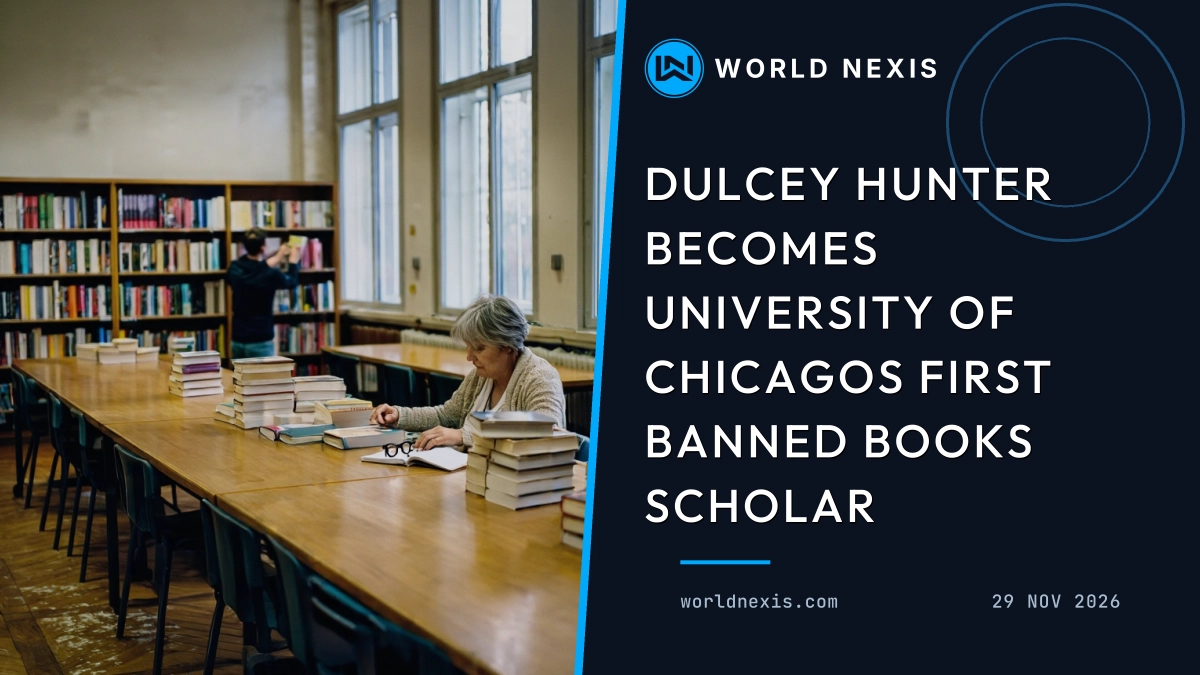
Dulcey Hunter is the University of Chicago’s first banned books scholar, and she will spend the next academic year building a teaching framework for the titles that US schools are increasingly pulling from their shelves. The university library, working with the Chicago Forum for Free Inquiry and Expression, has appointed the former Florida English teacher to turn a fast-growing archive of censored books into material teachers can actually use. Her brief is specific: explain why certain stories get targeted, then prepare classrooms to handle the difficult material inside them.
Key points
- Hunter taught middle and high school English language arts in Florida for more than two decades before taking the post.
- The role is the university’s first dedicated banned books scholar position, run by the library with the Chicago Forum for Free Inquiry and Expression.
- She will design a pedagogy framework for teaching banned and challenged titles, built around a trauma-informed approach.
- Chicago runs Book Sanctuaries across 77 community areas and 81 library branches, and Illinois passed a library funding law in 2023.
- The University of Chicago Library has gathered thousands of banned and challenged titles since launching its Banned Books Initiative in 2023.
What the banned books scholar will do first
Hunter starts from a simple premise: the English and literacy classroom is a cultural site, not a neutral room. Teachers, she argues, should not have to bracket the hardships of life in the name of safeguarding children.
“They’re vital educational spaces where the difficulties and hardships of life don’t necessarily have to be bracketed in the name of safeguarding children, but rather exploring those more painful truths together in a way that can broaden understanding, empathy, connection and insight,” Hunter said.
Her research looks at the politics behind the removals as well as the practical classroom problem. She wants to show how book-banning campaigns reveal a wider argument over whose stories may be told and whose suffering is allowed to be seen.
“My work explores how book-banning efforts reflect a broader cultural narrative, reflecting struggles over whose stories may be told, whose suffering is permitted cultural visibility and whose experiences may be collectively understood,” she said.
In that framing, censorship is not only a fight about individual titles. It is a question about why some forms of suffering become threatening once they are made visible.
Why teachers are the target audience
The framework is aimed at teacher preparation as much as at serving staff. Hunter hopes to give trainee and working teachers a more comprehensive, trauma-informed way of teaching contested books, and to sharpen their ability to engage students who have already been through trauma themselves. That is the part of the job, she suggests, that training programs rarely reach.
How Chicago built a refuge for challenged books
The appointment is the third stage of a local strategy that began before the national fight over school libraries peaked. In 2022, the city and Chicago Public Library set up Book Sanctuaries across 77 community areas and 81 library branches, widening access to banned or challenged titles.
A year later, Illinois became the first state to pass a law allowing the secretary of state’s office to withhold grant funding from municipal and school district libraries that refuse to adopt the American Library Association’s Library Bill of Rights. That document states that materials “should not be proscribed or removed because of partisan or doctrinal disapproval”.
Also in 2023, the University of Chicago Library launched its Banned Books Initiative, collecting banned and challenged books from across the country and making them available on campus in digital form and through interlibrary loan. The collection now runs to thousands of volumes.
Torsten Reimer, dean of the University Library, describes the work in phases. First came the collecting and the access, then the public argument about why the books matter. With the shelves filled, the next step was academic research into what bans actually do, which is where the new banned books scholar comes in.
“This is the chance to have a full-time researcher who can go into a level where none of us librarians have the time and broaden our understanding of what’s happening and how it’s impacting people,” Reimer said. “Now we’ll hopefully have a much more substantial debate with more evidence.”
Reimer’s wider worry is institutional. Challenges to books have accelerated, according to the American Library Association, and he says most are driven by interest groups. Bans, in his view, undercut librarians’ role as trusted information brokers, which in turn feeds suspicion of science, research and evidence-based argument. He also argues that removals weaken the library as a place where people can find material that looks at the world from different perspectives.
Why it matters
For parents and students, the practical question is what sits on the shelf and who decides. The university’s first banned books scholar cannot settle that argument, but a documented record of which titles are pulled, where and why shifts the debate from anecdote to evidence.
For teachers, the stakes are closer to home. Staff in contested districts already make judgment calls about set texts with little training and no cover, and the new framework is meant to hand them a defensible method rather than a list of approved titles. Book bans in schools are usually reported as a board-room vote; this is an attempt to measure what happens afterwards.
Analysis
Having covered school funding and youth services for World Nexis News, I look first at what reaches the classroom rather than at what is announced on a campus. On the evidence here, the research-led approach is the stronger bet. Reimer is right that libraries have largely argued from conviction while campaigns to remove books have argued from a list, and a banned books scholar who can document the impact of removals redresses that imbalance better than another petition.
I also think Hunter has chosen the harder and more useful problem. Most coverage of book bans stops at the vote; fewer people ask what a 15-year-old does when the novel their class was studying disappears mid-term. A trauma-informed method for teaching difficult books is a modest intervention, but it is the kind that reaches students directly instead of reaching a press release.
The counter-argument deserves respect. Many parents who back removals are not censors, and they have a legitimate claim to a say over what their own children read in a public classroom. The weakness of that position is that it has been used to remove titles for everyone rather than to excuse one child. I side with the parents who want a route out of a set text, not a padlock on the library.
What happens next
Hunter’s work runs through the next academic year, with the pedagogy framework as the first deliverable. The University of Chicago Library will then use her findings to support research and public programming on the effect of book bans, alongside the Chicago Forum for Free Inquiry and Expression, which the dean says should produce a better-evidenced public argument.
What we don’t know yet
The sources do not say which titles the framework will use as case studies, whether it will be published openly, or how districts outside Chicago might adopt it. Nor is it clear how the Illinois funding condition has been enforced in practice, or how many school libraries have changed their policies as a result. The scale of the challenge is also unquantified beyond the library’s own collection and the association’s warning that challenges have accelerated.
Related coverage
- Curriculum overhaul to let GCSE pupils drop history and languages
- Pharmacy prescription powers: major overhaul of 1968 rules
Further reading
- George Pyle: Credit to the first-time candidate who knocked out Utah’s book ban author
- Meet Dulcey Hunter, the University of Chicago’s first banned books scholar
About the author: Isabella Rossi is the Education & Social Affairs Reporter at World Nexis News (WNN), covering education & social affairs. The analysis section reflects the writer’s view.
Isabella Rossi
Isabella Rossi is Education & Social Affairs Reporter at World Nexis News, based in Manchester. She covers schools, universities, family policy, immigration and the social issues that shape opportunity, working from official statistics, institutional data and direct accounts, and giving institutions a fair opportunity to…