Left-wing creators set to challenge Democrats’ Senate leader
Left-wing creators who helped Democrats win the 2026 midterms are now pressing the party, including a fight over Chuck Schumer's Senate leadership.
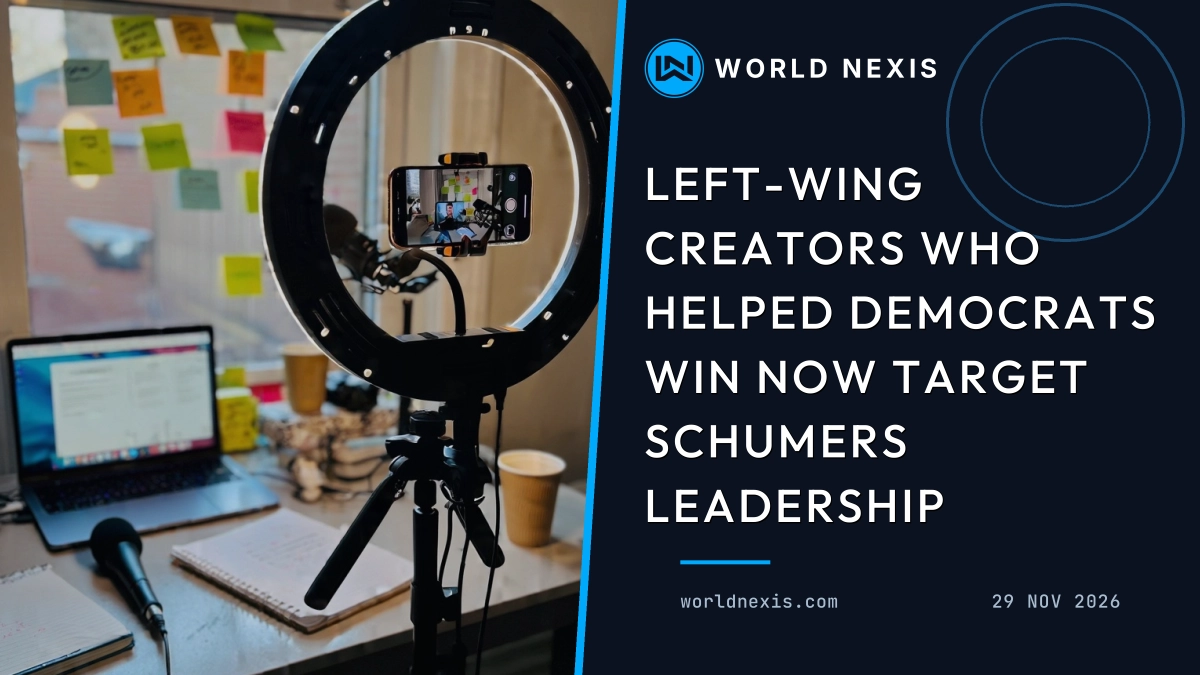
Left-wing creators who spent two years building the digital machine that helped Democrats win historic midterm victories in 2026 are now aiming it at the party’s own leadership, with pressure campaigns forming against Senator Chuck Schumer’s reelection as Democratic leader. The open question in Washington is whether the people who sold an affordability and corruption message to billions of views will spend the next two years as cheerleaders or as auditors.
The shift has been quick. Democrats spent two years catching up to a Republican online operation that overwhelmed them in 2024. Now they control Congress, are looking toward 2028, and depend on a creator economy the party does not own and has never had to disclose.
Key points
- Left-wing creators helped deliver historic midterm wins in 2026 by pushing an affordability and corruption narrative online.
- The Democratic National Committee’s creator group chat grew from about 20 members in summer 2025 to nearly 700 a year later.
- Paid political posting is common, but influencers are generally not required to say who is paying them.
- Some creators are now running pressure campaigns against Schumer’s leadership, while others plan to cheer the party on.
How left-wing creators built the 2026 machine
After the 2024 defeats, one conclusion was near-universal inside the party: Republicans had drowned Democrats out on platforms such as TikTok and YouTube. Strategists responded with networks of political influencers rather than more conventional advertising. By 2026 those creators were amassing billions of views.
The first big effort appeared immediately after the 2024 election. Chorus, founded by progressive podcast host Brian Tyler Cohen, runs an incubator for “pro-democracy” content creators. Participants are paid a flat rate for their time and are not required to post anything; they get self-employment crash courses, legal primers and messaging training instead.
“We’ve likened it to a grad school for content creators,” Cohen said. “We’re just teaching them how to be more effective communicators online.”
A second operation, Project Bullhorn, was built by political strategist Jason Berkenfeld to raise the volume of left-leaning content. Its 2026 programs included paying influencers for posts, according to the group’s own public solicitations on SideShift, an online influencer marketplace.
The Democratic National Committee built its own bridge. Matt Rein, the party’s influencer and creative partnerships director, said a creator group chat on the encrypted messaging app Signal grew from about 20 members in summer 2025 to nearly 700 a year later. His team pushed video clips and campaign talking points into the app, although posting was never obligatory, and the chat worked as a conduit to campaigns, helping some creators get to rallies or meet candidates.
Cohen argues the strategy changed the terms of the fight.
“I’ve been doing digital political media for about a decade now, and it’s always been, you know, the left is on defense, swatting back disinformation,” he said. “For the first time, the left was able to own the narrative in this cycle.”
The disclosure gap facing left-wing creators
Little of this is visible to the audience. Unlike influencers promoting brands, people advocating political views are generally not required to disclose their financial interests or say whether they are being paid to post. Both parties have increasingly used political influencers to push their message or opposition research, sometimes for free, sometimes for money, sometimes for perks such as access or training.
Trump did the same in 2024, mobilizing podcasters, comedians and other creators with considerable success. What is new is the scale on the left, and the stakes: with legacy media shrinking, the creator layer has become a crucial battleground.
Not every creator accepts the arrangement quietly. Aidan Kohn-Murphy, founder of the advocacy group Gen Z for Change, said political creators like him feel empowered to shape the debate about the party’s future, even when that means criticizing it.
“Assuming that creators are going to be your little mouthpieces, that’s not going to work,” Kohn-Murphy said.
A leadership fight moves online
The first test has arrived. Some left-wing creators are preparing pressure campaigns to stop Schumer’s reelection as Democratic leader, arguing the party needs a more aggressive voice in the Senate. Others intend to act as cheerleaders for a caucus that has just taken control of Congress.
It is not a rupture yet. But it leaves the party relying on communicators it cannot instruct, and the loudest of them command audiences larger than most cable news hours.
Why it matters
For voters, the practical effect is that more political information now arrives from left-wing creators whose funding is invisible. A video praising a senator, or attacking one, can be a genuine opinion, a paid placement or both, and no rule requires the audience to be told which.
For Democrats in Congress, the stakes are control of their own message at the moment they finally hold power. The people who reach millions can shape a primary, a leadership race or a presidential field long before any ballot is cast.
Analysis
Having covered accountability and election data for World Nexis News, I look first at the money rather than the loyalty. The louder story is the revolt against Schumer, but the disclosure gap is what will outlast this news cycle. A party that pays for posts through a marketplace, while the groups around it publish nothing about who funds what, has built a machine it cannot vouch for.
On the substance of the fight, I side with Kohn-Murphy. Left-wing creators who proved useful because they sounded like angry outsiders cannot be turned into disciplined messengers overnight, and the fact that some are pressing Schumer before collecting anything from the party suggests they mean it. Party strategists have a fair counter: undisclosed paid posting is exactly how a movement gets captured by whoever holds the biggest budget.
My view is that both problems point to one answer, and it is not loyalty oaths. If the DNC and groups such as Chorus and Project Bullhorn want their network of left-wing creators to hold up in 2028, they should get ahead of disclosure themselves. The alternative is that a congressional committee, a journalist or a rival operator does it for them in the worst week of a presidential campaign.
What happens next
The immediate focus is the internal Democratic contest over Senate leadership, where the pressure campaigns will test whether online audiences can move votes inside a closed caucus. Then the 2028 presidential race opens with a creator layer already in place, and the incubator and paid-posting programs built for 2026 keep running.
What we don’t know yet
Nobody has published how much money reached individual creators in 2026, and none of the main groups has committed to disclosing it. Whether the pressure on Schumer changes votes among Senate Democrats is also unresolved, because public audiences and private caucuses do not always move together.
Related coverage
- Andrea Stewart-Cousins: José Serrano takes top New York Senate post
- American Airlines wing clip: FAA probes major tarmac contact
- California homelessness crisis rises 20.3% despite $40bn
Further reading
- After helping Democrats win, left-wing creators consider how to champion and challenge them
- After helping Democrats win, left-wing creators consider how to champion and challenge them
About the author: Ayesha Rahman is the Senior Political Correspondent & Columnist at World Nexis News (WNN), covering politics & opinion. The analysis section reflects the writer’s view.

Ayesha Rahman
Ayesha Rahman covers politics and opinion for World Nexis News from London, focusing on elections, legislatures and the policy choices that shape everyday life in the US and UK. She writes analysis and columns that separate what is confirmed from what is claimed, working from…