California homelessness crisis rises 20.3% despite $40bn
California homelessness rose 20.3% between 2019 and 2025 even as Gavin Newsom steered about $40bn into housing, with 64% of people unsheltered.
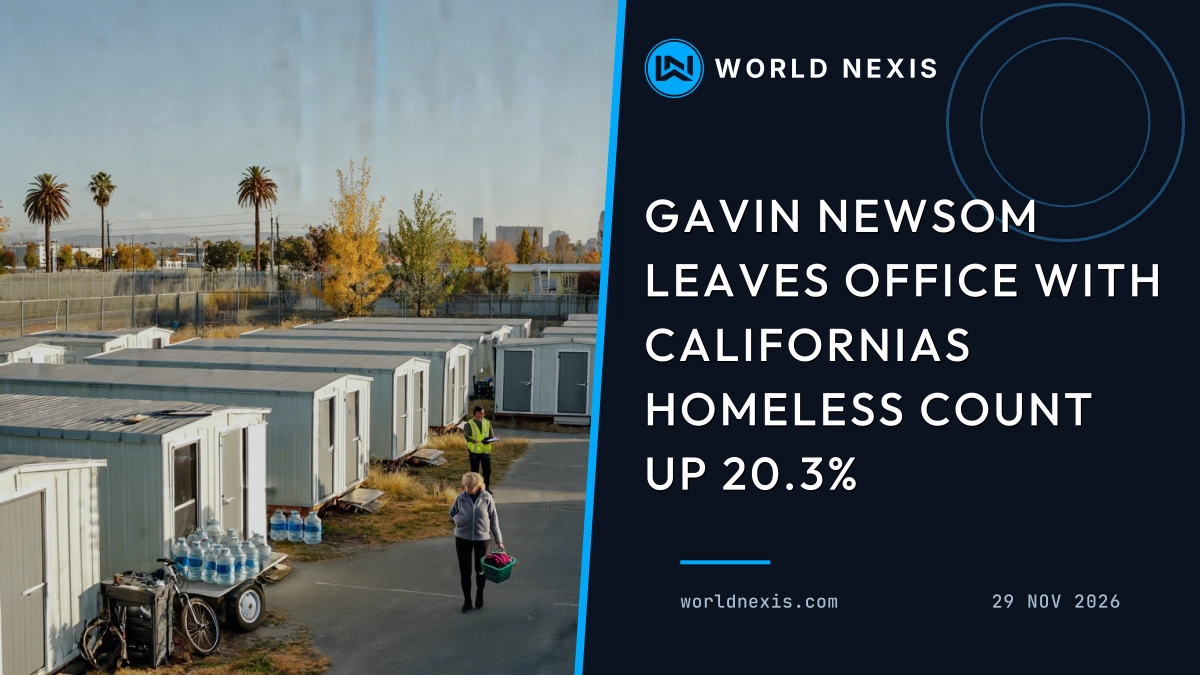
California homelessness rose 20.3% between 2019 and 2025, even as Governor Gavin Newsom directed about $40 billion in state money into housing and shelter. The Democrat leaves office with a record that moved thousands of people indoors and left the crisis larger than he found it.
Key points
- California homelessness climbed 20.3% from 2019 to 2025, according to federal data published by the U.S. Department of Housing and Urban Development.
- About $40 billion in state money has gone to homelessness and affordable housing since 2019, the nonpartisan Legislative Analyst’s Office says.
- Nearly 182,000 people are homeless in the state, close to a quarter of the national total, and 64% are unsheltered.
- Newsom rejects Republican claims that weak oversight let fraudsters take millions from public funds.
What $40 billion of state money bought
Newsom took over a problem that had largely been left to cities and counties. He did it on one principle, that housing is healthcare, and with more state money than any governor in California history: about $40 billion since 2019, according to the Legislative Analyst’s Office. Hundreds of millions in federal dollars already spent by cities and counties sit on top of that.
The output is concrete. California has added tens of thousands of beds in shelters, transitional housing sites and permanent units. Many of those slots come with supportive services such as counseling and food assistance.
In Sacramento, a sprawling tiny-home campus partly paid for with state money has given people temporary shelter. Cindy Rapp, who has been homeless on and off for roughly a decade, was selected for a place there earlier this year. She says getting indoors helped her stop using meth and alcohol, and she now receives mental health treatment.
Newsom set the ambition early. “I don’t think homelessness can be solved. I know homelessness can be solved,” he told state lawmakers in 2020. “This is our cause. This is our calling.”
Whether that California homelessness money was well spent is now a national question, because the governor is a likely White House contender.
California homelessness still up 20.3% since 2019
The statewide count tells a harder story. Federal data shows a rise of 20.3% across the six years, despite some recent improvement.
The latest tally estimated nearly 182,000 homeless people in California, close to a quarter of the national total. About 64% of them are unsheltered, the highest rate in the country.
Comparisons cut both ways. Arizona, New York, Oregon and Washington all recorded larger increases from 2019 to 2025. Texas had a smaller rise and Florida a slight decline. California’s difference is that poverty is rising and a housing shortage has pushed prices sky high.
Jeff Olivet, who led the U.S. Interagency Council on Homelessness during the Biden administration, described the gap plainly: “Newsom has enacted policies that have gotten people successfully housed, but new people become homeless all the time, and the problem is we just don’t have enough places for them to go.”
For anyone trying to read the California homelessness numbers honestly, that sentence is the crux. Inflow, not placement, has been the deciding variable.
Republicans attack cost, results and oversight
Republicans in Sacramento and Washington have made the crisis a political target. They call taxpayer-subsidized housing too generous and too costly, and argue that “housing first”, which gives someone a home without requiring sobriety or treatment, does not work.
They also say weak oversight under Newsom let fraudsters steal millions from public California homelessness funds. Newsom rejects that charge.
Service providers, meanwhile, still struggle to move people off the streets. The political risk is obvious, because Newsom put homelessness at the front of his agenda in the nation’s most populous state, and it may now be a vulnerability.
Why it matters
For California residents, the numbers translate into encampments in public spaces and a running argument about whether their taxes are working. For everyone else, the state is the largest test of whether state money alone can shrink a street population.
For voters nationally, the California homelessness record will be used as evidence in a presidential argument about competence and compassion. That is why a state program is being debated far beyond the state.
Analysis
Covering US politics for World Nexis News, I have learned to separate what a government spends from what it changes, and here the two numbers point in opposite directions. In my view, the facts support those who say the strategy was necessary but far too small for the problem. The tens of thousands of beds are real, and Cindy Rapp is in one of them.
I side with Jeff Olivet’s diagnosis, that there are not enough places to go, over both the governor’s optimism and the Republican claim that the money was wasted. Where the Republican case does land, in my view, is oversight. A state that cannot show its dollars are clean loses the argument before it reaches results, and Newsom’s rejection of the fraud charge is a denial, not an accounting.
The strongest counter-argument is that no governor can outspend a housing shortage created by local zoning and national prices, and that judging Newsom on one headline percentage is unfair. That is fair, but it is also an argument for fewer shelters and more building, which is not what the past six years delivered.
What happens next
Newsom leaves with the money spent and the count higher. The next administration inherits the beds, the service contracts and the argument.
The California homelessness figures will keep arriving annually, and each federal count will be read as a verdict on his model.
What we don’t know yet
It is not clear whether the recent improvement will survive the next federal count, how much state money remains unspent, or what a new governor will keep, rewrite or drop. It is also unclear how the fraud allegations will be resolved.
Related coverage
- Mandelson peerage: No 10 shelves law despite Starmer vow
- Justin Herbert ruled out as Chargers’ crisis deepens
- Black Friday deals spark overnight camps in California
Further reading
- Gov. Gavin Newsom took on homelessness. As he exits, California’s crisis remains
- Gov. Gavin Newsom took on homelessness. As he exits, California’s crisis remains
About the author: Ayesha Rahman is the Senior Political Correspondent & Columnist at World Nexis News (WNN), covering politics & opinion. The analysis section reflects the writer’s view.

Ayesha Rahman
Ayesha Rahman covers politics and opinion for World Nexis News from London, focusing on elections, legislatures and the policy choices that shape everyday life in the US and UK. She writes analysis and columns that separate what is confirmed from what is claimed, working from…