Huw Edwards salary: £200,000 repayment refused in BBC row
Huw Edwards salary: the former BBC presenter says he will not repay £200,000 until the corporation acknowledges his service and restores his archive.
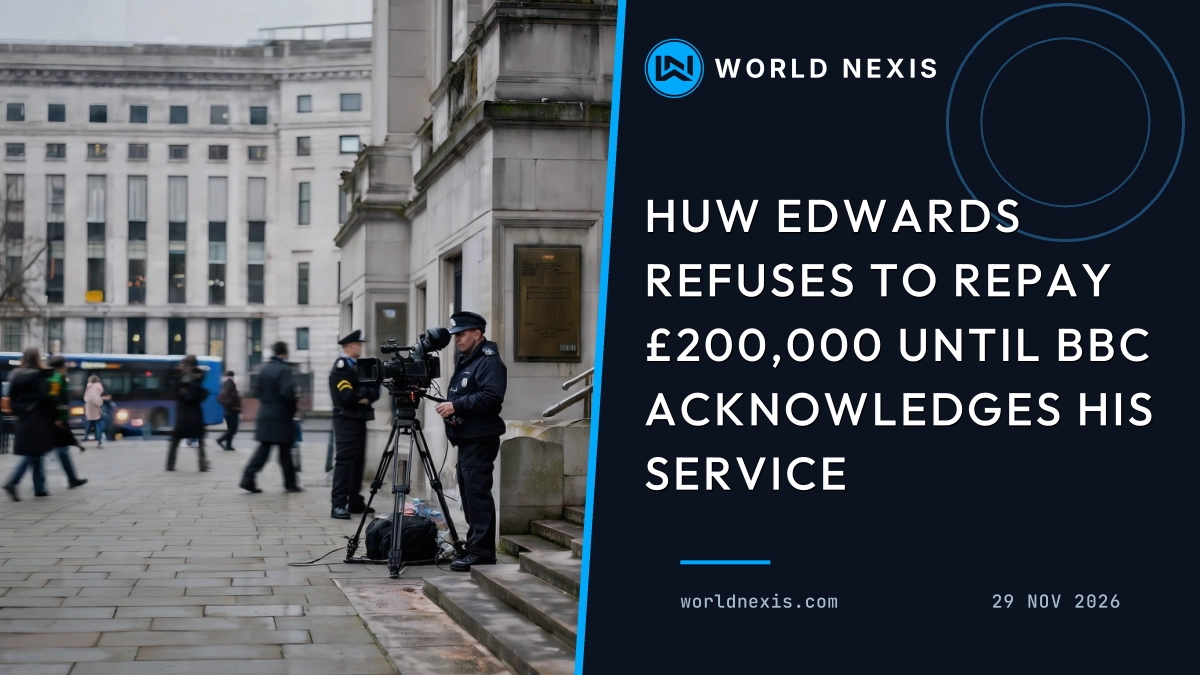
The row over the Huw Edwards salary payment has hardened into a public standoff, after the former BBC newsreader said he will not return the £200,000 he received after his arrest until the corporation acknowledges his “service”. Edwards, for decades one of the broadcaster’s highest-paid presenters, set out the condition in a newspaper interview and admitted he sometimes regrets pleading guilty to making indecent images of children.
He wants the BBC to restore programmes featuring him to its archive, and to settle its position on its chairman, Samir Shah, before any money is discussed. The corporation has repeatedly urged him to hand back the pay he received during the five months after his arrest, when he remained on its payroll.
Key points
- Edwards says no repayment will be discussed until the BBC acknowledges his broadcasting record and restores his programmes to its archive.
- The Huw Edwards salary payment covers five months after his arrest, while he was still employed by the corporation.
- BBC chairman Samir Shah has called Edwards “the villain of the piece” and said he should return the money.
- A Channel 4 film about Edwards has been criticised by victims’ campaigner Dame Jasvinder Sanghera and shadow home secretary Chris Philp.
The conditions attached to the Huw Edwards salary
The Huw Edwards salary was paid after his arrest but before his conviction, a period when the BBC kept him on its books. The corporation’s position is that the sum should come back. Its chairman has been blunt about why.
In the interview, Edwards argued that a criminal conviction does not cancel out a career. “You know, the fact that I’ve been convicted for a crime doesn’t erase your achievements in broadcasting,” he said. He then listed what he wants first.
“So I’ve said (to the BBC), ‘You deal with Samir Shah, you deal with the archive, you deal with acknowledging my service, then we can talk about a payment.'”
Shah has already set out his own view of the man who once fronted the corporation’s flagship bulletins. He called Edwards “the villain of the piece” and said that “if he has an ounce of moral rectitude, he would return the money”.
From News at Ten to a suspended sentence
Edwards presented BBC News at Ten for decades and led some of the corporation’s most watched coverage, including the death of Queen Elizabeth II. His position collapsed in July 2023, after a newspaper report alleged that a “top BBC star” had paid a teenager for sexual pictures. Days later his wife named him as the presenter at the centre of the story.
In July 2024 he pleaded guilty to making indecent images of children. He admitted being in possession of 41 photographs on WhatsApp, including seven of the most serious type. The images had been sent to him by Alex Williams, a convicted paedophile. He was given a six-month prison sentence, suspended for two years.
Reflecting on the plea, Edwards said the decision still troubles him. “Do I wake up some days and wish I hadn’t (pleaded guilty)? Yes. Of course I do,” he said. He described a family in “great distress” and said he wanted to “put a stop to this”, adding: “And I was prepared to say I’m guilty because I did click on the files, you know?”
A Huw Edwards documentary, a platform and the victims
Edwards is the subject of Huw Edwards – Guilty, an upcoming Channel 4 film that follows him as he adjusts to life after conviction. The broadcaster has defended the project, saying it does not diminish the “seriousness” of his crimes and does not “entitle him to sympathy, redemption or rehabilitation”.
Dame Jasvinder Sanghera, the victims’ rights campaigner, said in a broadcast interview that she found the film “quite troubling”. “He has the right to tell his story, but that doesn’t mean the public must accept his interpretation of events, nor should it come at the expense of recognising the victims,” she said.
She said she finds herself wondering “about the children, those children in the images, what they’ve lost, and who is telling their experiences”. She called the decision to broadcast “totally irresponsible” and suggested the £200,000 could be given to charities supporting children who have been harmed.
Chris Philp, the shadow home secretary, said in a separate radio interview that the documentary should not be shown at all. “He did some terrible things, and giving him a platform of any kind, I think, is wrong,” he said, adding that Channel 4 had “made a misjudgement”.
Why it matters
The £200,000 was paid by a publicly funded corporation, and whether it comes back tells audiences something about how the BBC handles a star who has admitted a serious crime. The Huw Edwards repayment question is therefore a test of institutional nerve, not just a private dispute about money.
The archive argument matters too. Programmes that once shaped how the country watched major national events are now attached to a criminal record, and the corporation has to decide how to treat that record without pretending it did not happen.
Analysis
My beat at World Nexis News is UK politics and public services, so I read this row through one question: who is accountable to whom? On the evidence here, I side with Shah and the corporation, even though the BBC has plenty of its own to answer for.
Edwards is treating a moral obligation as a negotiating position. Nothing links the return of post-arrest pay to the restoration of old programmes, and making the archive a bargaining chip inverts his own argument: he is asking for an institutional endorsement of his career as the price of doing the decent thing. Shah’s line about moral rectitude describes what is actually being tested. The strongest counter-argument is that the money was contractually his while he was still employed and not yet charged, and that is legally true. It simply does not answer the question the public is asking.
Nor do I think the BBC escapes scrutiny. Those payments continued for five months after an arrest, and I want a fuller public account of how that happened and who signed it off. Demanding money back is the easy part. Explaining the delay is the harder one, and it is the part that would show real change.
What happens next
Channel 4 is still due to broadcast its film, and has repeatedly defended the decision to make it. The BBC has kept up its call for repayment, and the Huw Edwards salary dispute now rests on whether either side moves from the positions set out this weekend.
What we don’t know yet
It is unclear whether the BBC will reinstate any of the archive material Edwards wants restored, or whether either party has taken legal advice on recovering the £200,000. Edwards has not said what he will do if his conditions are refused.
Related coverage
- Huw Edwards documentary: Channel 4 defiant over backlash
- Macy’s parade returns after storm with 1,000 extra police
- DWP cyber attack: urgent payment pledge as systems stay down
Further reading
- Huw Edwards will not pay back £200,000 salary until BBC acknowledges ‘service’
- Huw Edwards will not pay back £200,000 salary until BBC acknowledges ‘service’
About the author: Liam O’Connor is the UK Politics Reporter at World Nexis News (WNN), covering uk politics. The analysis section reflects the writer’s view.

Liam O'Connor
Liam O'Connor is UK Politics Reporter at World Nexis News, covering Westminster, devolved politics and the issues that matter to voters across England, Scotland, Wales and Northern Ireland. Based in London, he reports from primary sources — Hansard, official statements, published data — and explains…