Conversion therapy Bill: DUP may use veto over two-year term
The DUP's Pam Cameron says her party reserves the right to veto the conversion therapy Bill at Stormont, where a two-year jail term is proposed.
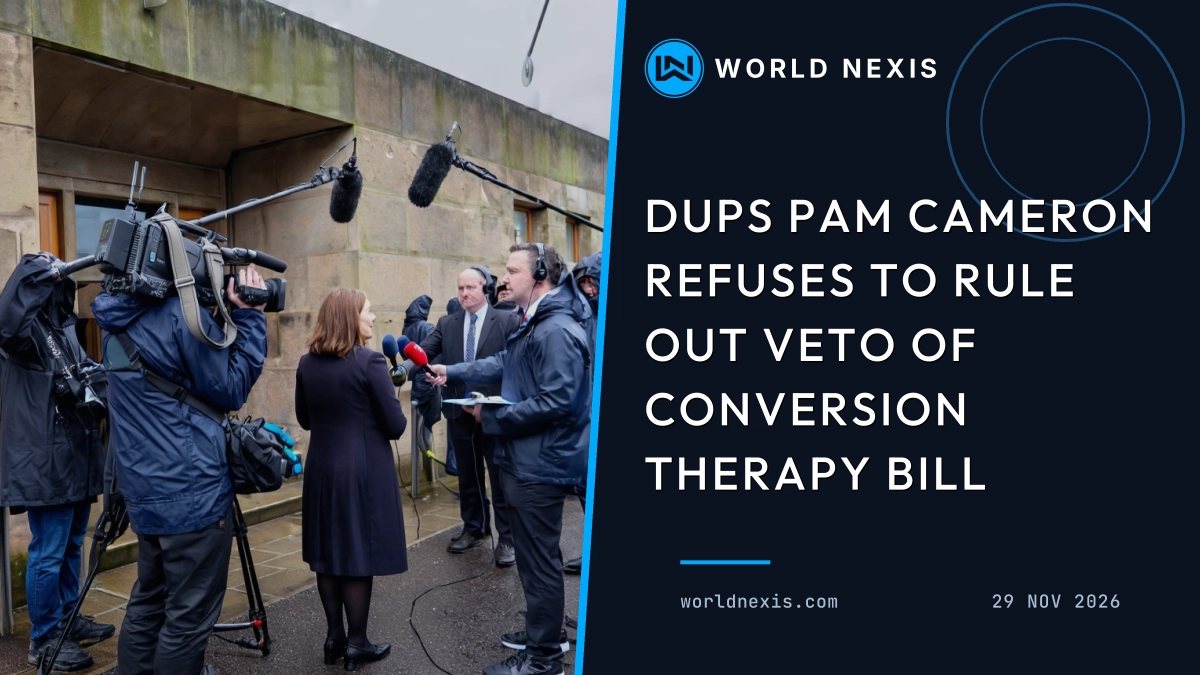
A conversion therapy Bill that would jail anyone found providing gender or sexuality conversion practices in Northern Ireland for up to two years is facing the threat of a cross-community veto, after DUP assembly member Pam Cameron said her party “absolutely reserves the right” to use the mechanism. The South Antrim MLA spoke on Sunday, as the Conversion Practices (Criminalisation) Bill continues its committee stage at Stormont.
The Private Member’s Bill was tabled by Alliance Party deputy leader Eóin Tennyson. Ms Cameron called it “harmful legislation” that is “very muddled and confused”, and confirmed the DUP has not ruled out forcing a cross-community vote if the text is not amended to answer unionist concerns.
Key points
- Pam Cameron said the DUP “absolutely reserves the right” to deploy a petition of concern against the conversion therapy Bill.
- The Bill would create criminal offences for providing conversion practices, with a maximum sentence of two years.
- Alliance’s Eóin Tennyson said the veto would be “morally wrong” and that the test written into the law is harm.
- Committee stage is under way, and the DUP says its concerns have not yet been met.
What the conversion therapy Bill would do
The conversion therapy Bill would criminalise attempts to change or suppress another person’s sexual orientation or gender identity. Anyone convicted could be jailed for up to two years. Members are currently taking evidence on the text at committee stage, before it returns to the Assembly chamber.
Mr Tennyson said conversion practices rest on a belief that LGBTQ+ people are ill and in need of a cure. He described “cruel and archaic acts” which “are a relic of a very distant past”, and said some areas, such as talking therapies, “fall into grey areas”.
Because it is a Private Member’s Bill rather than executive legislation, its survival depends on building a majority in the chamber rather than on ministerial sponsorship. That makes the mood of individual MLAs, and the discipline of the party blocs, decisive.
Unionist MLAs have opposed the Bill on freedom of expression grounds, arguing that coercive practices and abuse are already criminal offences. Some churches have also expressed concern, although some Christian organisations have backed the proposed law.
A petition of concern and the DUP warning
Asked whether her party would use a petition of concern to force a cross-community vote, Ms Cameron said: “We absolutely reserve the right to use the petition of concern should the Bill not be amended sufficiently to deal with the concerns that have been raised, which are many.”
She added: “Are we really serious about locking people up for two years for having a view that you don’t agree with? These are very serious implications.” The mechanism turns a vote in the chamber into a cross-community one, so a measure backed by most members can still fail if one bloc does not support it.
Mr Tennyson responded that the move is “permissible under Assembly processes, but it would be morally wrong”. He said the legislation criminalises only conduct shown to cause harm, and that where conversations have caused no harm “there would be no criminality found”.
Medical bodies and a divided chamber
Supporters of the conversion therapy Bill point to the weight of medical opinion behind it. Mr Tennyson said “growing evidence” links conversion practices to anxiety, depression, suicide and self-harm. The practices, he said, are “condemned by the British Medical Association and the Royal College of GPs, and virtually every major medical and health body in the UK”.
He argued the law is needed “to protect people from harm on the basis of who they are or who they love”, while accepting that “strong safeguards” and a careful balance are required. He also said the dispute comes down to a small number of MLAs who “do not believe that my relationship with my partner is as legitimate or valid as their own”.
Why it matters
For LGBTQ+ people in Northern Ireland, the outcome decides whether practices that major medical bodies link to suicide risk become criminal offences, or whether the Assembly’s safeguards are used to stop the law altogether. For everyone else, it is a test of how the cross-community veto is used: as a shield for a community’s core interests, or as a blocking device on contested social legislation.
The two-year maximum is the detail that turns a moral argument into a criminal one. Whatever the chamber decides will set the boundary between a private conversation and conduct serious enough to carry a prison sentence.
Analysis
Having covered devolution and Northern Ireland politics for World Nexis News, I look first at what a petition of concern is actually for. The mechanism exists so that one bloc cannot be outvoted on something fundamental to its identity. Stretching it to cover a criminal justice Bill about harm to a minority weakens a safeguard that only works while both sides accept its limits.
I side with Mr Tennyson on the substance. The DUP’s central claim, that the conversion therapy Bill would jail people for holding a view, does not match a text whose test is harm, and the backing of the British Medical Association and the Royal College of GPs is the weightier evidence in this argument. The strongest counter-point is his own: he concedes that talking therapies sit in grey areas, and grey areas in criminal law should worry every MLA.
That is an argument for amending the Bill in committee, not for holding a veto over the process. Reserving the right to block while scrutiny is still running turns that scrutiny into leverage. If the DUP’s concerns are genuine, they can be settled in the wording, and a better-drafted law would be a win for both sides.
What happens next
The conversion therapy Bill remains at committee stage, where MLAs are taking evidence and can propose changes. The DUP’s position is conditional: if the text is amended to meet its concerns, the case for a petition of concern weakens. If it is not, the party has said it will consider forcing a cross-community vote that could stop the legislation.
What we don’t know yet
No date has been set out for the committee stage to finish or for a final vote in the chamber. It is also unclear what amendments, if any, will be brought forward, and whether the DUP would follow through on the veto once the text is settled.
Related coverage
- Troubles Bill: victims commissioner warns over fresh delay
- O2 Arena anniversary: star-studded 20-year concert lineup
- Luis Robert Jr. seals $12m one-year return to Orioles
Further reading
- DUP MLA says party ‘reserves right’ to use veto against conversion therapy Bill
- DUP MLA says party ‘reserves right’ to use veto against conversion therapy Bill
About the author: Liam O’Connor is the UK Politics Reporter at World Nexis News (WNN), covering uk politics. The analysis section reflects the writer’s view.

Liam O'Connor
Liam O'Connor is UK Politics Reporter at World Nexis News, covering Westminster, devolved politics and the issues that matter to voters across England, Scotland, Wales and Northern Ireland. Based in London, he reports from primary sources — Hansard, official statements, published data — and explains…



