Energy prices could climb even higher, IEA chief warns
Energy prices could climb even higher this winter, the IEA's Fatih Birol warns, as Ofgem prepares a 26% cap rise that adds £443 to typical bills.
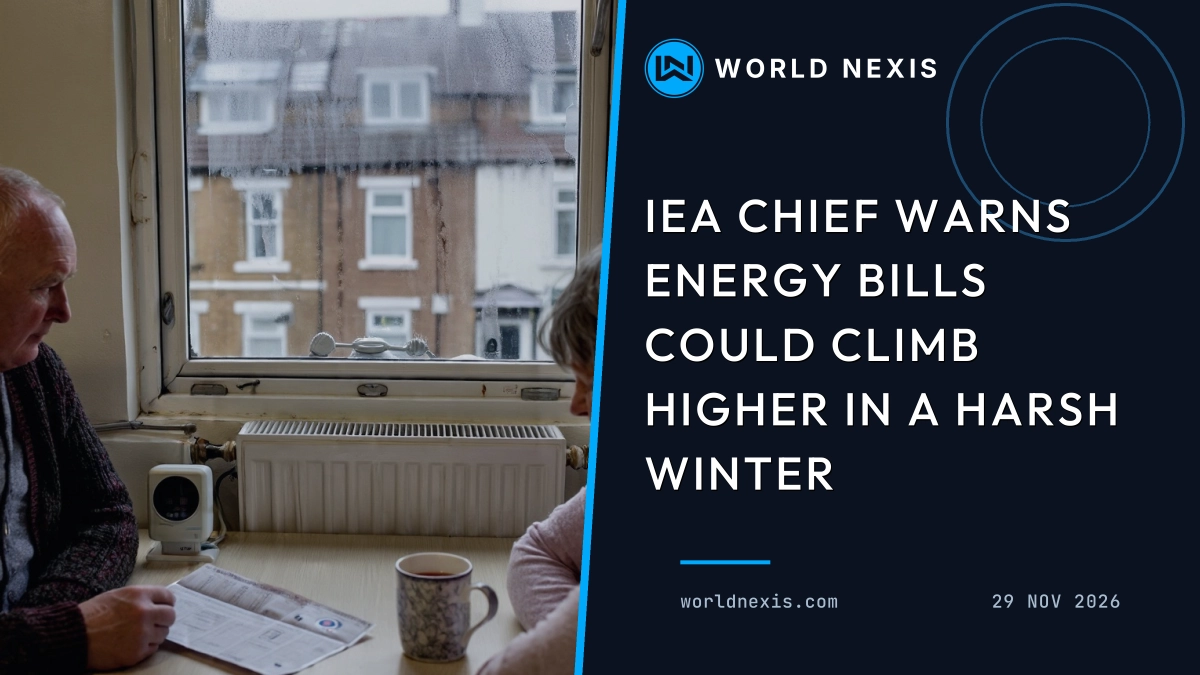
Energy prices could climb even higher in the coming months if Europe endures a harsh winter, the head of the International Energy Agency has warned, as UK households count down to a 26% rise in the Ofgem price cap on 1 January.
Dr Fatih Birol said a cold European winter combined with the continued closure of the Strait of Hormuz could push energy prices beyond the levels already built into January bills. He said he does not expect shortages, but warned that households and businesses could face “even higher prices than we have now”.
Key points
- The Ofgem price cap rises 26% on 1 January, adding £443 a year, or £36.91 a month, for a typical household in England, Scotland and Wales.
- A typical annual bill goes from £1,723 to £2,166 if the new level lasts a year, the highest cap since the second quarter of 2023.
- Dr Birol said a harsh winter in Europe and a closed Strait of Hormuz could drive energy prices above current levels, though he does not expect shortages.
- He sees “no credible pathway” back to the pre-war energy system: “The vase is broken.”
Energy prices: the IEA chief’s warning
In an interview broadcast on Sunday morning, Dr Birol said the market’s next move depends on whether the strait reopens. “Everything will depend on, first of all, if the Strait of Hormuz is going to be opened, and in a convincing way for all the market,” he said.
He added: “If we have a harsh winter in Europe, we may have difficulties. I don’t think that we will have shortages, but we may see even higher prices than we have now.”
Dr Birol called the Iran war, which began in February, “the largest energy security threat in history”. He said the two oil shocks of the 1970s, added to the gas shock that followed Russia’s invasion of Ukraine, still amount to less than the disruption caused by this conflict.
He was blunt about the idea of returning to the old normal. “Impossible. The vase is broken. Once it is broken, you cannot bring it back together,” he said, adding that he sees no credible pathway back to the pre-war system.
He also said attempted cyber attacks on energy infrastructure have risen by 400% in recent years, a warning aimed squarely at grid and pipeline operators.
What the 26% cap rise means for households
Ofgem set out the increase on Wednesday. The cap moves by 26% from 1 January, taking a typical dual-fuel bill for a household paying by direct debit from £1,723 to £2,166 a year.
The regulator said the rise is driven entirely by higher wholesale costs faced by suppliers, primarily because of the Iran war. Wholesale gas prices were up 33% over the three months used to set the cap and have more than doubled since late 2025.
Energy prices are reset four times a year under the cap, so January’s figure is a snapshot rather than a ceiling. Energy charities and suppliers expect arrears to climb and more households to need emergency support as the colder months bite.
Rosebank would be ‘some contribution’, not a game-changer
Asked whether the government should approve the Rosebank oil field, Dr Birol said it would make a contribution to UK production but would not be a “game-changer”. He said the field would move domestic supply from about 5% to 4.8% or 4.9%.
He added that it would have “no impact whatsoever” on international oil prices and would contribute 0.02% of overall tax revenues. Asked for 100 suggestions for the government, he said Rosebank “wouldn’t be in the first 90”.
In practice, that means the field would not lower the energy prices households pay, which track international markets. His priority would instead be replacing fossil fuels with electricity from wind farms and solar panels. “We have to build a system in the UK now that’s much more modern, much more nimble, affordable,” he said.
Why it matters
For households, the warning means the January increase may not be the end of the squeeze. The April cap will be built on wholesale prices over the next three months, so a cold snap in Europe lands directly on spring bills.
Energy prices also ripple outward. Higher gas and oil costs feed into petrol, food and freight, so a harsh winter on the continent would be felt well beyond the electricity and gas bill, and would complicate the wider fight against the cost of living.
Analysis
Having covered the energy transition for World Nexis News, I look first at what Dr Birol’s numbers do to the argument over new North Sea oil. They are brutal for Rosebank’s loudest supporters: a fraction of a percentage point of domestic supply and 0.02% of tax revenue will not move a single household bill.
In my view the evidence supports those who argue that Britain’s exposure to imported gas, not the modest size of its own oilfields, is the real problem. The 26% rise is a pass-through of a war-driven price shock, and no licensing decision changes that arithmetic.
The fairest counter-argument is security of supply, which genuinely matters when a strait is closed: domestic production can cushion a crisis even when it barely moves the global price. But supply security and affordability are different tests. If the government wants to shorten the next shock, wind, solar and electrification do more per pound than a field that shifts the dial by a rounding error.
What happens next
The new cap takes effect on 1 January. Ofgem will then set the April to June cap using wholesale prices over the coming three months, and traders will be watching the Strait of Hormuz and European weather forecasts in parallel.
Ministers still face a decision on whether to approve Rosebank, and pressure over support for bills will not ease while energy prices stay this high. Dr Birol’s interview is broadcast on Sunday 29 November.
What we don’t know yet
Whether the strait reopens, and how cold Europe actually gets, will decide whether energy prices climb again in the spring. Neither is predictable and neither is in Britain’s hands. The one thing the IEA is not forecasting is shortages, only cost.
Related coverage
- Camilla open letter warns 1 in 11 children own no book
- Troubles Bill: victims commissioner warns over fresh delay
- Zelensky interview: Putin a ‘killer’, Ukraine warns US
Further reading
- Harsh winter in Europe could drive energy prices ‘even higher’, agency boss warns
- Fears energy prices could climb ‘even higher’ if Europe sees harsh winter
About the author: Hannah Lindqvist is the Climate & Environment Reporter at World Nexis News (WNN), covering climate & environment. The analysis section reflects the writer’s view.

Hannah Lindqvist
Hannah Lindqvist is Climate & Environment Reporter at World Nexis News, based in London. She covers climate policy, extreme weather, the energy transition, conservation and climate finance, grounding stories in scientific research, official data and documented commitments rather than slogans. She is interested in how…