Thanksgiving travel ends as 63 million face weather alerts
Thanksgiving travel ends in disruption as 63 million Americans face wind alerts and 1,600 flights are delayed on the busiest return day of the holiday.
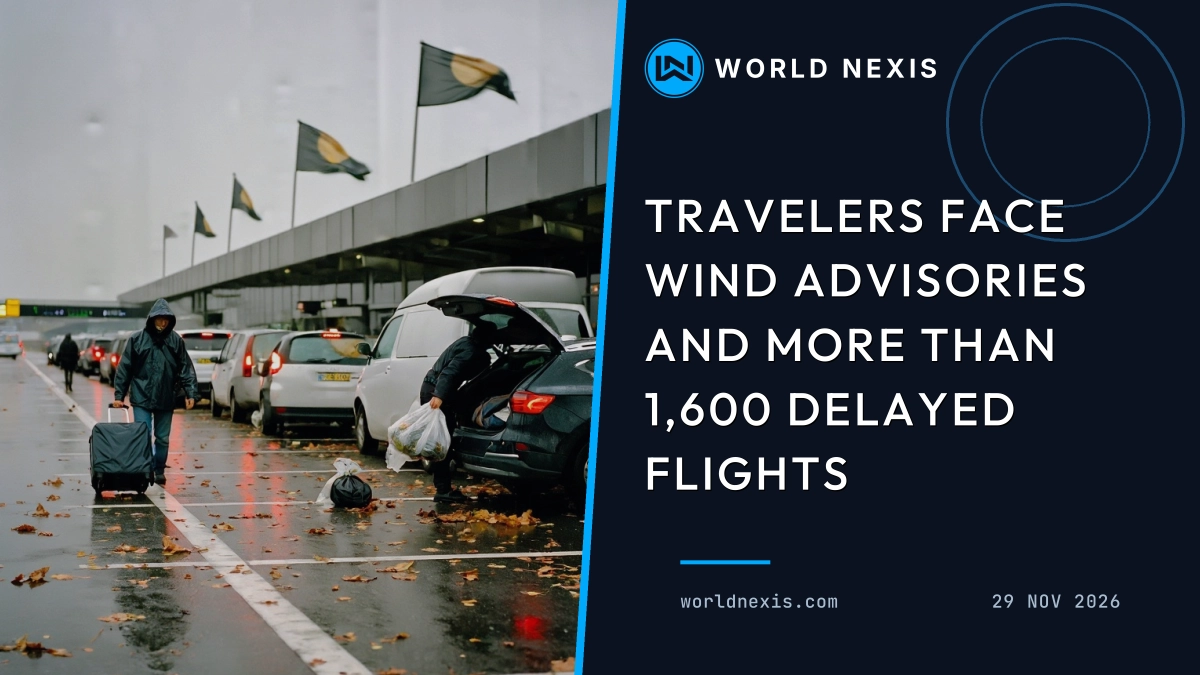
Thanksgiving travel was ending in disruption across the United States on Sunday, with more than 63 million people under weather alerts, powerful winds sweeping from the Pacific Northwest to the Gulf Coast and airlines already counting more than 1,600 delayed flights.
The National Weather Service issued wind advisories for parts of more than a dozen states, warning that gusts of up to 45 mph could bring down trees and power lines. Forecasters said the winds would make driving difficult, especially for high-profile vehicles, and urged people to secure loose outdoor items.
Key points
- More than 63 million people were under weather alerts on Sunday as wind advisories stretched from the Pacific Northwest to the Gulf Coast.
- The Transportation Security Administration expected to screen more than 3 million people at US airports on the busiest day of Thanksgiving travel.
- More than 1,600 flights had been delayed and more than 450 cancelled by Sunday morning, according to the tracking firm FlightAware.
- A separate storm system is forecast to bring heavy rain and a risk of flash flooding to Southern California from Tuesday.
Wind advisories across a dozen states
The advisories covered portions of Alabama, Arkansas, California, Kansas, Kentucky, Louisiana, Mississippi, Missouri, Oklahoma, Oregon, Tennessee, Texas and Illinois, where gusts were expected to be even stronger than elsewhere.
Forecasters also reported hurricane-force wind gusts across the south-central High Plains early on Sunday, as colder air pushed in behind a low pressure centre moving east.
Most of the wind advisories in place early on Sunday were due to expire by the end of the night, although gusty conditions were expected to spread across much of the eastern US on Monday.
Flight delays on the busiest Thanksgiving travel day
This was meant to be the heaviest day of the holiday period. The TSA said it anticipated screening about 17.6 million air travellers nationwide across the Thanksgiving window, and projected that Sunday alone would bring more than 3 million people to checkpoints.
“We are prepared to handle the increased passenger volumes expected during the Thanksgiving holiday travel period while maintaining our focus on security,” TSA Administrator David P. Cummins said.
Transportation Secretary Sean Duffy said on Saturday that weather, rather than technology or staffing, had caused the majority of delays during the holiday. He advised passengers to check the forecast and their airline before setting out.
Rail offered some relief. Amtrak, for which Thanksgiving travel is the busiest period of the year, said it could surpass last year’s record of 1.2 million trips and asked passengers to plan ahead.
On the roads, AAA expected nearly 73 million people to travel by car over the holiday, a slight decline on last year driven in part by higher gas prices. State transport departments still braced for heavy volumes, particularly later on Sunday. In Maine, roadside safety signs carried the messages “Eyes on the road, not pie” and “Mash potatoes not the gas.”
Rain first, then a second storm for California
Rain was forecast to stretch across the eastern half of the country from Florida up to parts of Maine, with thunderstorms possible in Alabama and Tennessee. East Coast travellers who left late on Sunday risked steady rain and heavy traffic.
On the West Coast, a string of Pacific storms was expected to bring widespread rain, mountain snow, gusty to high winds, coastal flooding and high surf into next week. Northern California and southwestern Oregon faced the heaviest rainfall.
“The biggest concern that we are looking at in terms of real hazardous weather is heavy rainfall, some of it perhaps quite excessive, across southern California,” said Brian Hurley, a meteorologist with the service’s Weather Prediction Center.
Hurley said the system due to arrive on Tuesday and Wednesday carried a strong risk of flash flooding, and potentially mudslides, in the ranges north of Los Angeles.
Why it matters
For travellers, the cost of this weather is measured in hours and money: missed connections, unplanned hotel nights, extra fuel and the knock-on effect on Monday’s return to work and school. Crosswinds also make lorries and high-sided vehicles genuinely dangerous on exposed bridges and open freeways.
The timing matters too. Sunday is the single busiest screening day of the Thanksgiving period for the TSA, so even modest disruption at a handful of hubs can cascade across the network for a day or more.
Analysis
Having covered breaking news and emergency response for World Nexis News, I look first at what forecasters can actually verify, not at the number at the top of the story. The 63 million figure is real, but it measures how many people live under an advisory, not how many are in danger. A wind advisory covering half a state tells a driver far less than a specific gust forecast for the road ahead.
In my view the facts support Brian Hurley’s framing better than the broader alarm: the genuine hazard in this system is heavy rain and the flooding and mudslides it could set off in Southern California from Tuesday. I also think Sean Duffy is right that weather, not systems, is doing most of the damage to schedules during this Thanksgiving travel weekend. That is the version of the story people can act on.
The strongest counter-argument is that blunt alert numbers are what push people to check a flight and leave earlier, and that is worth something. Even so, a story that leads with a tally and buries the timing of the real risk does readers no favours.
What happens next
Most wind advisories lapse on Sunday night, but rain is expected to reach the Mid-Atlantic in time for Monday morning’s commute, and forecasters say wet and windy conditions will linger into Monday afternoon in Maine. Parts of New England could see rain briefly turn to snow before Tuesday.
The Pacific storms are expected to keep hitting the West Coast through the coming week, with the flash-flood risk in Southern California peaking on Tuesday and Wednesday.
What we don’t know yet
It is not yet clear how many flights will ultimately be cancelled once the weekend ends, or whether the California system will produce the widespread flash flooding forecasters fear. Final TSA screening totals for the period will also take days to confirm.
Related coverage
- Port Orange flooding: Thanksgiving dinner survives 8 inches
- Macy’s Thanksgiving parade leaves families paying $900
- California homelessness crisis rises 20.3% despite $40bn
Further reading
- Storms expected to affect travel for some as millions head home after Thanksgiving
- 63 million under alerts as powerful winds, difficult weather impact last of Thanksgiving travel for some
About the author: Tariq Al-Mansoori is the Breaking News Reporter at World Nexis News (WNN), covering breaking news. The analysis section reflects the writer’s view.

Tariq Al-Mansoori
Tariq Al-Mansoori is a Breaking News Reporter at World Nexis News, covering major incidents, official statements and developing stories across the UK, US and internationally. Based in London, he works to confirm details before publication, attributes information to named sources where possible and updates stories…