Zomi Frankcom: families file major legal challenge in Israel
Families of Zomi Frankcom and other aid workers killed in Gaza ask Israel's attorney-general to release military evidence and order a criminal inquiry.
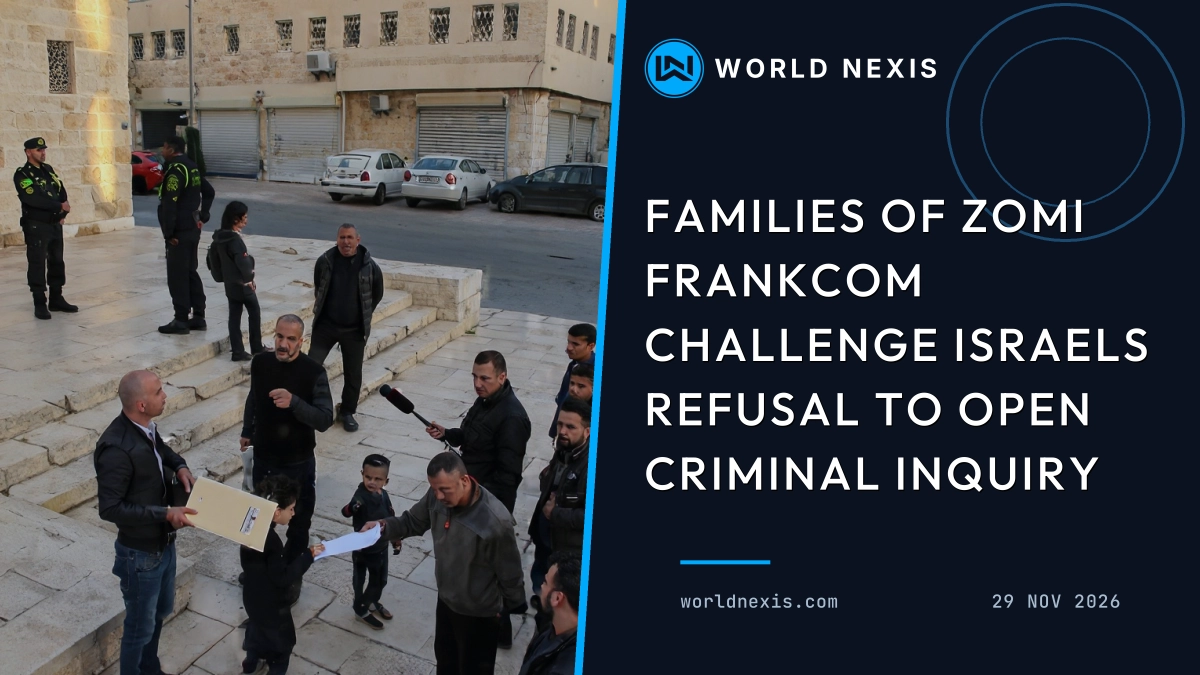
The family of Zomi Frankcom is one of five families of aid workers killed in Gaza that have lodged a legal challenge with Israel’s attorney-general, seeking the evidence behind a refused criminal investigation. The filing asks Attorney-General Gali Baharav-Miara to order disclosure of the material the chief military prosecutor held before rejecting a criminal probe.
Baharav-Miara has the formal power to overturn that refusal and order an investigation. Seven World Central Kitchen staff, including the Australian aid worker Zomi Frankcom, were killed when an Israeli air strike hit their marked convoy on 1 April 2024.
Key points
- Five families of international humanitarian workers from Australia, the UK, the US and Canada are jointly challenging Israel’s refusal to open a criminal investigation.
- Their lawyer in Israel, Sawsan Zaher, wants operational logs, situation-room records, drone footage and command recordings released.
- The military said in August there was no reasonable suspicion of criminal misconduct over the World Central Kitchen strike.
- Two officers were dismissed and three senior officers reprimanded after Israel acknowledged it misidentified the convoy.
Why the Zomi Frankcom case is back before Israel’s attorney-general
The challenge is the families’ latest attempt to force a criminal inquiry. In August the military said it had completed reviews of 150 incidents of troop conduct in Gaza and reached decisions in five cases. One of those was the strike on the World Central Kitchen convoy.
Sawsan Zaher, counsel for the families in Israel, said the refusal leaves them with no clear right to see the reasoning behind it. “The military’s choice not to investigate leaves the families with no clear right to see why,” she said. “That is circular and it shields the decision from scrutiny.”
She said the joint nature of the case sets it apart. “What is unusual here is five families of international humanitarian workers, from Australia, the UK and the US and Canada, are jointly challenging the decision,” she said.
Ms Zaher is seeking disclosure of all material the chief military prosecutor had before turning down a criminal probe. If the attorney-general intervenes, her powers could reach the findings of the military’s fact-finding mechanism and the material they rest on. That includes operational logs and situation-room records, aerial and drone footage, and command and communication recordings.
The strike that killed Zomi Frankcom, and Australia’s response
The World Central Kitchen convoy carrying Zomi Frankcom and her colleagues was marked when it was hit. The military initially claimed it was being used by Hamas, then acknowledged the misidentification and errors in the decision-making process. Two officers were dismissed from their posts and three senior officers were formally reprimanded.
Mal Frankcom, brother of the killed aid worker, said the wait has been painful and traumatic for every family involved. “Our families had to wait two and a half years to be informed no further action is warranted,” he said. “At no point did any Israeli representative reach out to discuss any aspect of the investigation.”
He said the refusal, announced on World Humanitarian Day on 19 August, was “particularly insulting”. The families say they were never advised of the evidence considered or how the conclusion was reached.
Australia’s foreign minister, Penny Wong, said the government was outraged that no criminal proceedings would be pursued against those responsible. She summoned Israel’s ambassador, Hillel Newman, for an explanation, and he defended the military’s inquiry while expressing sorrow for the Frankcom family.
Canberra has also requested audio of the drone strike footage on the family’s behalf. Prime Minister Anthony Albanese raised Zomi Frankcom’s death with Israeli President Isaac Herzog during the president’s visit in February.
Why it matters
The Gaza aid worker investigation has become a test of whether foreign families can see how a state concludes that no crime occurred. For anyone whose relatives work in humanitarian relief, the question is whether markings, coordination and clear identification still protect a convoy.
For Australia, the Zomi Frankcom challenge keeps a difficult diplomatic dispute alive more than two years after the deaths. The government has already called the outcome outrageous; this filing asks whether that anger produces access to evidence or only public statements.
Analysis
Having covered conflict and accountability for World Nexis News, I look first at what a refusal actually discloses, and here it discloses almost nothing. There is no reasoning, no list of evidence, and no route for a family to test the conclusion reached. Sawsan Zaher’s description of a circular process is, in my view, the strongest argument in the file: a decision that cannot be examined cannot really be challenged.
The counter-argument deserves a hearing. The military did act within days, dismissing two officers and reprimanding three, and no army readily hands over operational logs, situation-room records and drone footage. An attorney-general who overrides a military legal decision also sets a precedent that outlasts this case, and prosecutors guard that independence for good reason.
Even so, the facts here favour the families. Families from four countries lost people in a marked convoy that Israel itself says it misidentified, and the response was administrative rather than criminal. When reviews of 150 incidents produce decisions that grieving relatives cannot inspect, the burden shifts to the reviewer to explain why. Until that material is released in the Zomi Frankcom case, I think the process is protecting itself, and that matters for every aid group weighing whether Gaza’s deconfliction system can be trusted.
What happens next
The attorney-general must decide whether to order disclosure of the military’s findings and underlying material, and whether to reopen the question of a criminal investigation. Sawsan Zaher said the families intend to exhaust every domestic avenue open to them.
“Accountability will not happen by itself,” she said. “Australians should not assume the Israeli process, left to run its course, will deliver it.”
The families behind the Zomi Frankcom challenge now wait on a decision they have no power to timetable.
What we don’t know yet
No timetable for a decision has been made public, and it is unclear whether the families would pursue avenues outside Israel if this challenge fails. The attorney-general’s office, the military prosecutor and the Israeli embassy in Canberra were all contacted for comment on the filing.
Related coverage
- UNIFIL withdrawal: 7,500 peacekeepers begin major exit
- Left-wing creators set to challenge Democrats’ Senate leader
- Voting access poised to expand in three major states
Further reading
- Legal contest in Israel over slain Aussie aid worker
- Legal contest in Israel over slain Aussie aid worker
About the author: Marcus Ellington is the International Correspondent at World Nexis News (WNN), covering world affairs. The analysis section reflects the writer’s view.

Marcus Ellington
Marcus Ellington is International Correspondent at World Nexis News, reporting on diplomacy, conflict and the political forces reshaping Europe, the Middle East, Asia and the Americas. Based in London, he focuses on explaining why events unfold as they do, using official statements, diplomatic documents and…