Baobab trees rescued as five are replanted in South Africa
Five baobab trees rescued from a Durban freight yard have been replanted in South Africa, but experts warn their survival is far from certain.
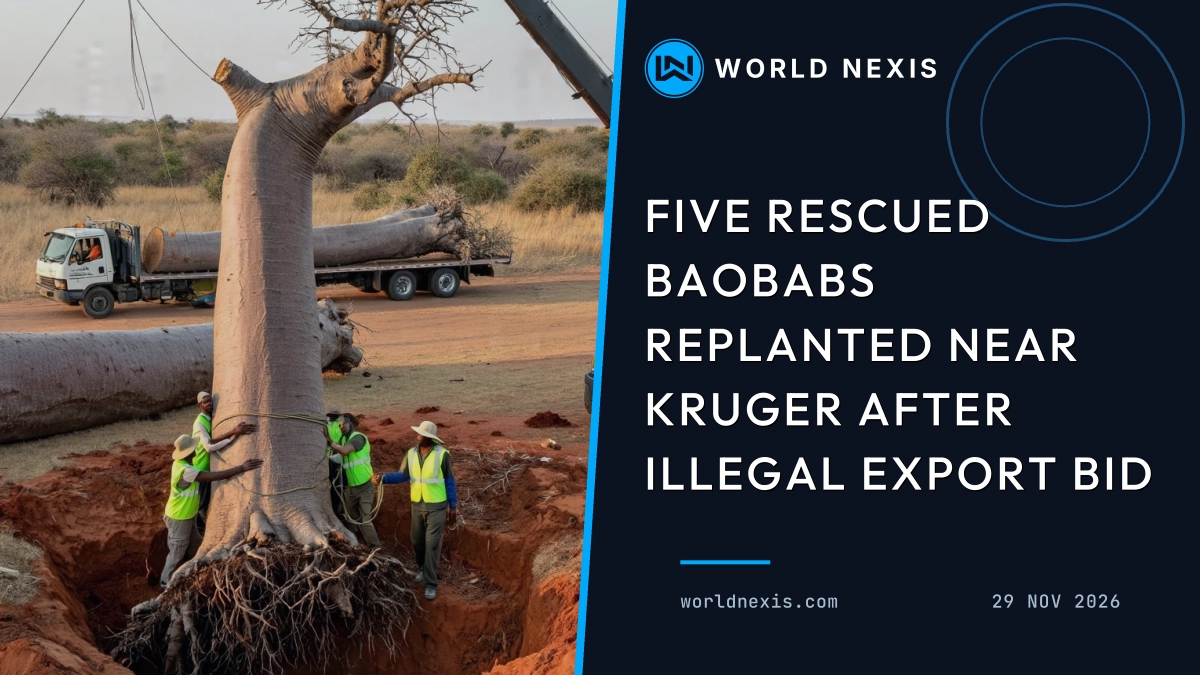
Five centuries-old baobab trees rescued from a freight yard at a South African port have been replanted in the wild, in a last-ditch attempt to keep an illegally harvested piece of Africa’s natural heritage on the continent. The trees, estimated at 200 to 300 years old, were moved nearly 1,000 kilometres (621 miles) to the Timbavati Nature Reserve near Kruger National Park earlier this month.
South Africa’s environment ministry and the Baobab Foundation conservation group led the operation, which used heavy trucks and cranes to shift the trunks. It remains unclear whether the baobab trees rescued in July will survive at least four months out of the ground with their roots and branches cut.
Key points
- Five baobab trees rescued in Durban were found lying on their sides in a freight company’s parking lot in July.
- They had been uprooted without authorisation and were bound for an unidentified private collector in Georgia.
- The ministry and the Baobab Foundation moved them about 1,000 kilometres to a privately owned reserve next to Kruger National Park.
- A landscaper has been charged with wildlife offences over the unauthorised harvesting of protected trees.
How the baobab trees rescued in Durban were found
Ministry officials came across the trees in July, lying on their sides in a parking lot used by a freight company in Durban, the busy port city on South Africa’s east coast. Officials believe the baobabs had been illegally taken from another part of northern South Africa, where the species grows, and hauled to the coast for export.
Their intended destination was an unidentified private collector in Georgia, the country on the eastern shore of the Black Sea in the Caucasus, officials said. The trees were intercepted just in time, before they could be loaded for shipping.
The ministry said a landscaper has been charged with wildlife offences related to the unauthorised harvesting of protected trees.
Baobabs are among Africa’s most distinctive species. Their thick trunks and root-like branches make them look as though they are growing upside down, and they can live for 1,000 years in dry conditions because they store water inside.
Five trunks, one crane and a long road north
The rescue was as much a logistics exercise as a botanical one. For the baobab trees rescued at the port, the route ran north to Timbavati, a privately owned reserve within the wider Kruger ecosystem, where oversized trucks delivered the trunks and cranes lifted them upright into prepared holes.
The baobab trees rescued from the Durban yard had spent at least four months on tarmac. Yet despite the cutting, they began to sprout leaves, a sign that the water held in their trunks had kept them alive.
“It’s an amazing tree and that’s why it’s an icon of Africa,” said Sarah Venter, an ecologist at the Baobab Foundation, as the trees were being replanted. Their water storage may have saved them, she said, but they would not have lasted much longer.
Venter said the trees will be checked twice a year for the next 10 years, and that electric fencing will keep elephants away while they recover, because the animals knock baobabs over to reach their leaves and shoots.
“These trees are really just symbolic of everything that we are losing out of Africa to people who just want to take them for their collections, for their gardens, where they play no role, no ecological role,” she said. “We want our natural resources to stay here in Africa.”
Why it matters
The case tests whether South Africa defends its protected plants as vigorously as its famous animals. Endangered species such as the black rhino dominate conservation budgets and headlines, yet conservation groups estimate that around 500,000 plants, from tiny succulents to tall trees, are poached in the country every year.
For ordinary South Africans, that trade erodes something that cannot be rebuilt quickly. Mature baobabs store water in dry landscapes and anchor the scenery that draws visitors, and a tree of 200 to 300 years cannot be replaced on any human timescale.
Analysis
Having covered trafficking and cross-border trade for World Nexis News, I look first at where this chain broke, and it was not at a border. Five mature baobabs were cut down, lifted onto heavy transport and driven across South Africa to a port, then left in a parking lot for months. Every one of those steps needed equipment, paperwork or money, and the first serious intervention came from environment officials rather than the export system itself.
In my view, Sarah Venter and the Baobab Foundation have the stronger argument. Plant poaching in South Africa is still treated as a specialist curiosity next to the rhino wars, when the numbers say it is industrial: roughly half a million plants taken every year. The baobab trees rescued this month are a genuine win, but they are also a warning about how much leaves the country unnoticed.
The fairest counter-argument is that wildlife authorities are already overstretched, that cases over plants are slow and technical, and that a prosecution over five trees may soak up resources a rhino case would use better. I think that reasoning fails on consequences: demand for rare plants is set abroad, in private collections and landscaped gardens far from the bushveld, and it will only be deterred if the trade looks risky at the point of export.
What happens next
The criminal case against the landscaper continues, and no further charges have been announced. The trees themselves will be watched for a decade, with inspections planned twice a year and electric fencing kept around them while they establish.
The five baobab trees rescued from the port will keep drawing researchers and rangers either way. For the ministry and the Baobab Foundation, the next few seasons will show whether a tree that survived months on tarmac can survive being put back in the ground.
What we don’t know yet
- Whether all five trees will live long term after months out of the soil.
- Who the private collector in Georgia is, and whether any authority there is examining the attempted purchase.
- What penalty the landscaper faces, and whether more arrests follow.
Related coverage
- Democratic attorneys general flip five states in major shift
- UNIFIL withdrawal: 7,500 peacekeepers begin major exit
- Nehru Kashmir 1962: BJP MP alleges historic division deal
Further reading
- South Africa makes a last-ditch effort to save centuries-old baobab trees dug up for export
- South Africa makes a last-ditch effort to save centuries-old baobab trees dug up for export
About the author: Marcus Ellington is the International Correspondent at World Nexis News (WNN), covering world affairs. The analysis section reflects the writer’s view.

Marcus Ellington
Marcus Ellington is International Correspondent at World Nexis News, reporting on diplomacy, conflict and the political forces reshaping Europe, the Middle East, Asia and the Americas. Based in London, he focuses on explaining why events unfold as they do, using official statements, diplomatic documents and…