Nehru Kashmir 1962: BJP MP alleges historic division deal
BJP MP Nishikant Dubey says Nehru Kashmir 1962 talks included a plan to divide the region with Pakistan, opening a fresh attack on the Congress.
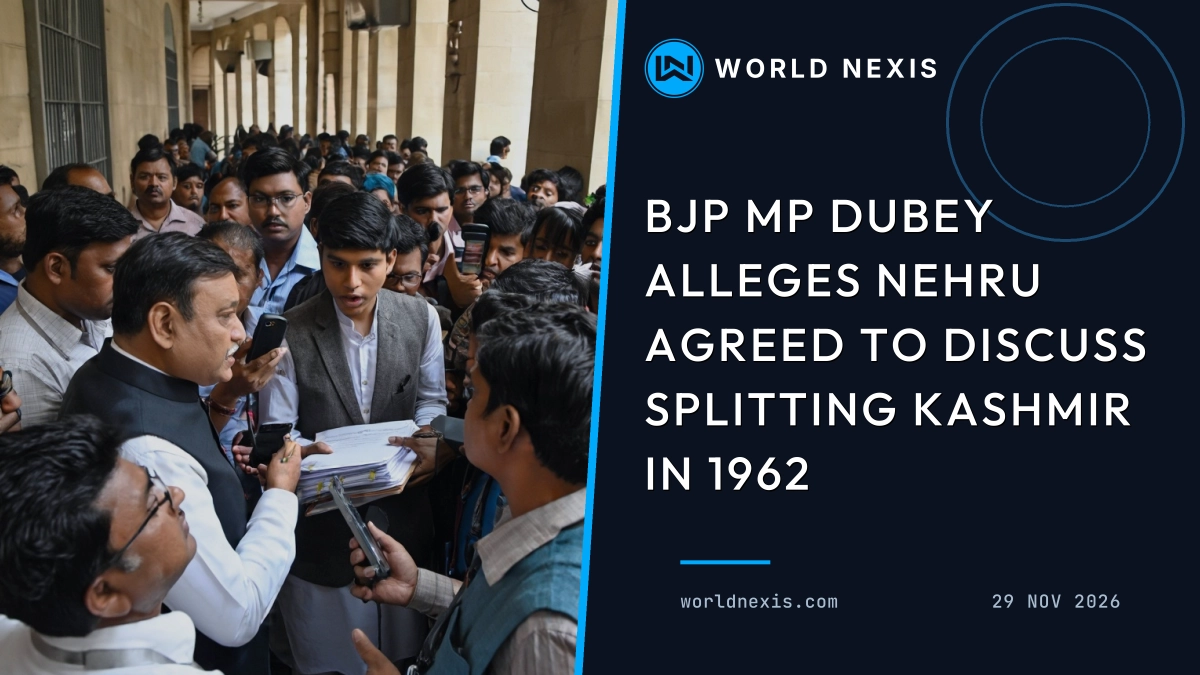
BJP leader Nishikant Dubey has thrust the Nehru Kashmir 1962 record back into India’s political argument, alleging that Jawaharlal Nehru agreed to discuss dividing Jammu and Kashmir with Pakistan at a joint meeting on 29 November 1962. In a post on X on Sunday, Dubey published historical documents on the talks, tagged Leader of Opposition Rahul Gandhi, and called the episode a dark chapter of the Congress party.
The Nehru Kashmir 1962 allegation centres on discussions that month between Nehru, British cabinet minister Duncan Sandys and American envoy Averell Harriman, followed by a meeting with Pakistan’s then president, General Ayub Khan. Dubey says the sequence shows the prime minister was ready to see the state split in two.
Key points
- Dubey alleged that Nehru agreed to discuss dividing Jammu and Kashmir with Pakistan in November 1962.
- The Nehru Kashmir 1962 documents he shared name Sandys, Harriman and General Ayub Khan.
- The post is the 258th instalment of his “Congress’s Dark Chapter” series on X.
- Dubey accused the Gandhi-Nehru family of acting as brokers for the United States and Britain.
What the BJP leader alleged
The post is numbered 258 in a series Dubey runs on X under the title “Congress’s Dark Chapter”. In it, he alleged that Nehru met Ayub Khan on 29 November 1962 in order to divide Jammu and Kashmir into two parts, and issued a statement afterwards.
Dubey wrote that Sandys and Harriman reached Delhi on 27 November 1962 and met Nehru. He added that they then travelled to Pakistan on 28 November 1962 with a proposal to divide Jammu and Kashmir, and met Ayub Khan there.
He further alleged that on 29 November 1962 the British and American ministers told Indian journalists and the BBC that there was an agreement to divide the territory. That disclosure, he said, produced an uproar from Parliament to the streets.
Turning to the Lok Sabha debate that followed, Dubey wrote: “Nehru appeared to see his plans fall through. He said that he did not read newspapers or listen to BBC news.” He then asked Rahul Gandhi to read Nehru’s statement in the Lok Sabha on 30 November 1962.
The MP tied the episode to the war with China. “China had already defeated us in the war and occupied our territory. We fought this war with American money, with military support from the British government,” he wrote.
His conclusion was blunt. “Acting as a broker for America and Britain is part of the Gandhi-Nehru family’s ideology,” he wrote. The claims are his own reading of the papers he published.
Nehru Kashmir 1962: what the documents cover
The Nehru Kashmir 1962 material deals with discussions held that November about Jammu and Kashmir, and about the possibility of India and Pakistan resuming talks on the dispute. Dubey’s account puts two Western envoys in Delhi and then in Pakistan within two days.
Timing carries his argument. The talks came in the same month as the border war with China, which he describes as already lost, and at a point when, in his words, India was fighting “with American money” and “military support from the British government”.
The series is Dubey’s own project. By his description, it gathers allegations about the Congress party’s political and historical record, and it now runs past 250 instalments.
Why it matters
The Nehru Kashmir 1962 dispute matters because it moves an old diplomatic file into live party politics. Dubey is challenging Rahul Gandhi, the Leader of Opposition, over the record of the Congress party’s most consequential prime minister.
It also draws Britain and the United States into an Indian domestic argument. If Dubey’s reading holds, two Western powers sat close to a proposal on Kashmir’s future within weeks of the war with China, a charge that touches how Delhi still presents that period.
Analysis
Having covered diplomacy for World Nexis News, I read claims like this one against a simple test: what do the papers actually say, and who is speaking? On Dubey’s own account, the Nehru Kashmir 1962 file contains a proposal carried between Delhi and Karachi by two foreign envoys, plus a briefing given to journalists. That is a long way from a signed instrument of partition, and the gap matters because the post presents itself as settled history.
I think the stronger case belongs to those who want the record examined properly rather than settled by hashtag. The crisis of 1962 is real, and Dubey’s papers put a British minister and an American envoy at the centre of it, which is exactly why the material should go to historians who can date, test and contextualise each page. Scrutiny of that diplomacy, and if MPs want it a parliamentary examination of the documents, would serve readers better than a numbered series aimed at one opposition leader.
The fairest counter-argument is that Congress has left this ground unguarded for decades, and a party that never fully explained 1962 can hardly complain when a rival narrates it. That is a fair hit. Even so, the test I would apply is whether the documents survive independent checking; if they do, the story belongs to every Indian voter, not to a party feed.
What happens next
Nothing in the material points to a formal inquiry, a parliamentary motion or a legal step. The next move is political: whether Rahul Gandhi or the Congress party answer the Nehru Kashmir 1962 claims in public, and whether other BJP figures amplify the documents.
What we don’t know yet
It is not established whether the documents Dubey published have been independently authenticated, or whether any contemporaneous record corroborates his account of the 29 November 1962 meeting. It is also unclear whether the Congress party disputes his reading of the papers or will simply ignore it.
Related coverage
- Macy’s parade marks 100th run after historic postponement
- USS Doris Miller: historic carrier keel laid next week
- BAE Systems CV90 deal: major £4.5bn order for 400 vehicles
Further reading
About the author: Marcus Ellington is the International Correspondent at World Nexis News (WNN), covering world affairs. The analysis section reflects the writer’s view.

Marcus Ellington
Marcus Ellington is International Correspondent at World Nexis News, reporting on diplomacy, conflict and the political forces reshaping Europe, the Middle East, Asia and the Americas. Based in London, he focuses on explaining why events unfold as they do, using official statements, diplomatic documents and…



