UNIFIL withdrawal: 7,500 peacekeepers begin major exit
The UNIFIL withdrawal starts January 1 as 7,500 peacekeepers leave southern Lebanon, with no agreed plan for security in the south once they are gone.
The UNIFIL withdrawal is due to begin on January 1, when the United Nations starts pulling 7,500 peacekeepers out of southern Lebanon after nearly 50 years, with no agreed plan for who keeps the border calm once they are gone. The mission’s mandate expires in December 2026, following a Security Council vote last year that ended it under pressure from the United States and Israel. Lebanon wanted the force to stay.
Key points
- The UNIFIL withdrawal starts on January 1 and removes about 7,500 peacekeepers from southern Lebanon.
- The Security Council ended the UNIFIL mandate in December 2026 after pressure from Washington and Israel.
- Israel calls the mission a failure; the force says it kept relative calm for 17 years before October 2023.
- The Lebanese army is expected to take over security in the south, with no certainty it can hold the line.
Inside Naqoura as the UNIFIL withdrawal approaches
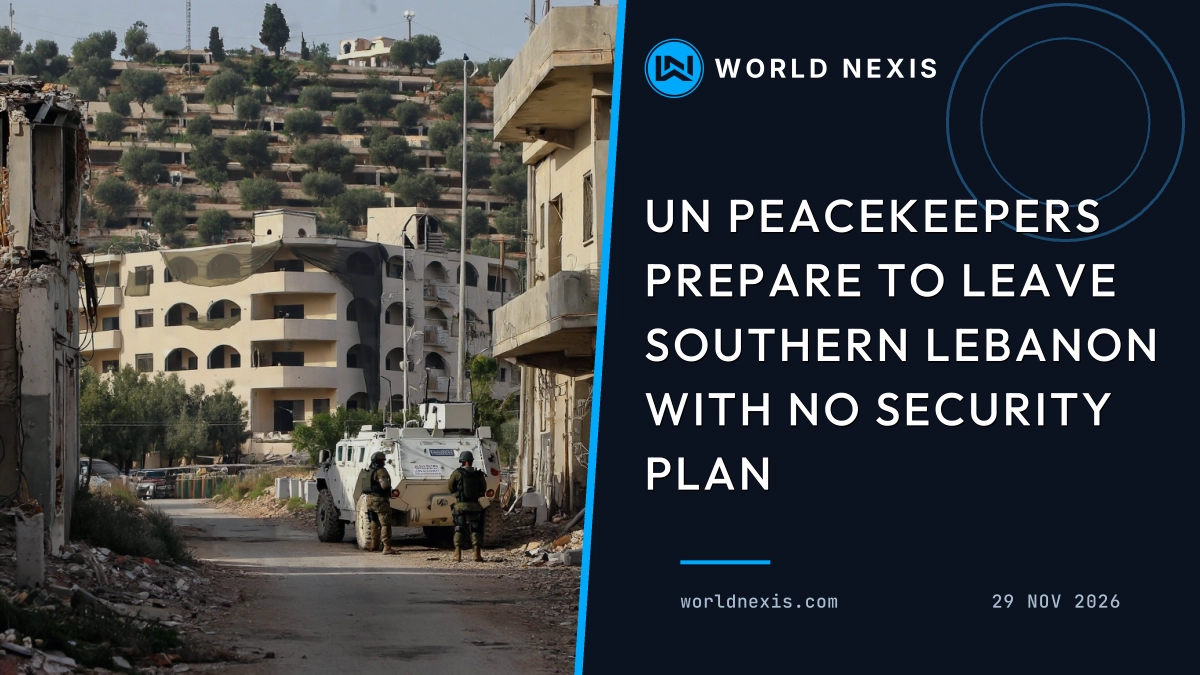
In the border town of Naqoura, few buildings are still standing. An abandoned hotel occupied by Israeli soldiers, its walls draped in anti-drone netting, and the compound housing the force’s headquarters are among the few structures left intact.
The roads are largely surrounded by rubble and mostly empty. The only regular movement comes from military patrols and convoys escorting civilians or delivering supplies.
The UNIFIL withdrawal would remove the most visible international presence along a frontier that has seen two wars in less than two decades.
What the commander and residents say
Major General Diodato Abagnara, the force commander, said UNIFIL was not responsible for disarming Hezbollah. Its main role was to support the Lebanese Armed Forces and help them take full control of security in the south, he said, warning that avoiding a security vacuum after the withdrawal would be extremely important.
Israel has described the mission as a failure, pointing to Hezbollah’s military buildup over the years. The force says it helped maintain relative calm for 17 years before the October 2023 Hamas attack on southern Israel triggered a wider regional conflict.
For people living under the drones, the argument is more concrete. Mohammed Aoun, a farmer from the village of Halta near the Israeli-occupied area, delayed harvesting his olive groves this year after losing the previous two years’ harvests to the fighting. On the first day of picking this month, a patrol stopped at his orchard while an Israeli drone flew overhead and an airstrike sounded in the distance. Aoun said he was worried about working in those conditions, and about what comes after the peacekeepers leave.
How the UNIFIL withdrawal was decided
The mission was created in 1978, after Israel invaded southern Lebanon to fight Palestinian militants. Israel invaded again in 1982 and held its occupation until 2000, years in which Hezbollah emerged as a guerrilla force backed by Iran.
After the month-long war of 2006, the force was given the job of monitoring violations of UN Security Council Resolution 1701, which ended that fighting. When another war between Israel and Hezbollah ended with a ceasefire in 2024, the peacekeepers also became part of the mechanism overseeing that deal.
The vote that set the UNIFIL withdrawal in motion came last year, when the Security Council decided the mission should finish in December 2026. Under the arrangements, the Lebanese army is expected to take responsibility for security in southern Lebanon. Whether it can maintain stability without the international force is the question nobody in the region has answered.
Why it matters
For families in the south, the UNIFIL withdrawal changes the arithmetic of daily life: whether it is safe to farm, to rebuild or to travel near the frontier. For Lebanon, it hands the army a security job in the south that no one has yet shown it can carry alone.
For the wider region, the exit removes a force that, whatever its flaws, sat between the Israeli army and Hezbollah along a live front line. Fighting on that line has escalated into full wars twice in the past two decades.
Analysis
Covering the end of peacekeeping missions is part of my beat at World Nexis News, and the question I always ask is not whether a force succeeded, but what fills the space it leaves. On that test, the UNIFIL withdrawal looks like a gamble taken in the right direction at the wrong speed. The case for ending the mandate is genuinely strong: a mission that watched Hezbollah build a rocket arsenal and could not stop either side from fighting twice was never the guarantee its name implied.
Yet the facts in front of us support Abagnara’s warning more than Israel’s confidence. The Lebanese army is expected to take over a job it has not yet demonstrated it can do, the ceasefire mechanism loses a component, and the timetable is fixed while the political conditions are not. I think Washington and Israel won the argument about the mandate and have not answered the argument about the morning after.
The strongest counterpoint is real, and I will not dodge it: peacekeepers who cannot disarm Hezbollah or stop Israeli airstrikes provide deterrence mostly on paper, and a country is entitled to stop paying for a mission that does not deliver. But that is an argument for changing the mission or its UNIFIL mandate, not for leaving a populated border with nothing in place.
What happens next
Under the current timetable, the UNIFIL withdrawal starts on January 1 and the mandate expires in December 2026, with the force leaving in stages. The Lebanese Armed Forces are expected to assume responsibility for security in the south as the peacekeepers hand over.
What we don’t know yet
Three questions remain open. It is not clear whether the Lebanese army can hold the south without international cover, whether the withdrawal will run to schedule, or who monitors violations of the ceasefire terms once the force’s role ends. Until those answers arrive, the towns along the border are planning around a mission that will soon be gone.
Related coverage
- Macy’s parade: 100th edition draws major crowds after delay
- United Fidelity Bank failure triggers major $1.83bn hit
- Assault weapons ban faces major Supreme Court test
Further reading
About the author: Marcus Ellington is the International Correspondent at World Nexis News (WNN), covering world affairs. The analysis section reflects the writer’s view.

Marcus Ellington
Marcus Ellington is International Correspondent at World Nexis News, reporting on diplomacy, conflict and the political forces reshaping Europe, the Middle East, Asia and the Americas. Based in London, he focuses on explaining why events unfold as they do, using official statements, diplomatic documents and…