Peterhead power station: 900MW gas plant sparks warning
Peterhead power station approval locks Scottish households into volatile gas bills for decades, campaigners warn after ministers backed SSE's 900MW plant.
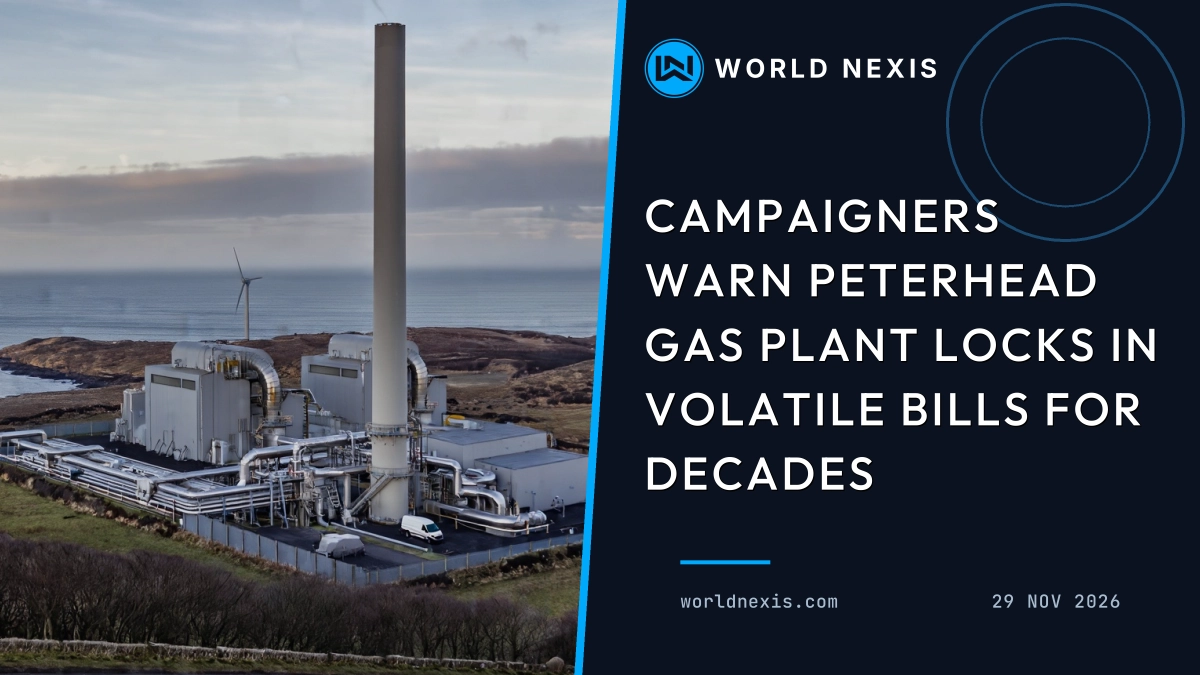
Approval for a new Peterhead power station has triggered a warning that every household in Scotland will be tied to costly, volatile gas for decades. Scottish ministers gave energy company SSE the go-ahead last month to build a 900-megawatt gas-fired plant at Peterhead, Aberdeenshire. The station is initially slated to burn gas until 2059.
Key points
- Scottish ministers approved SSE’s 900MW gas-fired Peterhead power station last month.
- Campaigners say the plant locks Scottish households into volatile bills for three decades.
- Friends of the Earth Scotland links the decision to last week’s 26% rise in the energy price cap.
- The Scottish Government says it remains committed to net zero by 2045.
Campaigners say Peterhead power station locks in volatile gas bills
Friends of the Earth Scotland said the decision leaves households and businesses facing three decades of dependence on volatile fossil fuels. The group pointed to last week’s 26% hike in the energy price cap, which it says was driven by fluctuations in international gas prices. Electricity from the new plant will be exposed to the same global market swings and geopolitical events, including the wars in Iran and Ukraine, it added.
Kate Whitaker, of Friends of the Earth Scotland, said the cap rise had exposed the flaws in what she called a disastrous decision. “Locking every household in Scotland into dependence on costly, volatile gas for decades to come is a complete failure of leadership,” she said.
“The Scottish Government wants to blame Westminster for rising energy bills but the blame for this decision is 100% at its door.”
Whitaker laid responsibility for the approval directly on John Swinney. She argued that ministers had put the interests of energy companies above those of households struggling to pay, and warned that more fossil fuel burning would worsen climate change, bringing more extreme weather, wildfires and supercharged storms. She called for urgent support with bills alongside a sustained programme to insulate homes and to power heating and transport with renewables.
Simon Francis, co-ordinator of the End Fuel Poverty coalition, said people suffering in cold, damp homes this winter need short-term help and a long-term plan to bring bills down. “Gas-fired power stations are unable to provide the solution,” he said. Francis argued that with 90% of the North Sea’s gas reserves already extracted, the fuel for the Peterhead gas plant will increasingly have to be imported.
He called instead for a plan to move the grid away from gas, built on renewables backed by batteries, pumped hydro and smart systems that store and share cheap clean power.
Why SSE says gas backup is still needed
A website for the project argues that “flexible and efficient gas-fired generation will continue to play a critical role in the transition to a net-zero future”. It describes the plant as “reliable backup power” that will “complement renewable energy”. That framing casts the station in a supporting role behind wind and solar, rather than as a primary source of electricity.
The Peterhead power station dispute lands at an awkward political moment. The energy price cap rise of 26% was announced last week, and Scotland’s net zero target year of 2045 falls fourteen years before the plant’s initial gas-burning life is due to end.
Scottish Government defends its climate record
A Scottish Government spokesperson said ministers have taken world-leading action to lower greenhouse gas emissions, which have more than halved since 1990. “We remain unwavering in our commitment to tackle climate change, delivering positive climate action to achieve net zero by 2045,” the spokesperson said.
The spokesperson added that in an energy-rich nation like Scotland nobody should be struggling to afford to heat their homes. The UK Government, the spokesperson said, must take decisive action to substantially lower energy bills.
Why it matters
For households, this argument is about the shape of every bill for a generation. Campaigners say electricity from a gas plant carries the same exposure to international fuel prices that drove last week’s cap rise, so any further market shock would be felt in Scottish bills.
For climate policy, the Peterhead power station decision is a test of how a 2045 net zero target works in practice. A plant burning gas until 2059 would still be running well past the deadline ministers have set, even in a supporting role.
Analysis
Having covered the energy transition for World Nexis News, I look first at what a plant like this does to the price households pay, not at what it does to the sky. On that measure the campaigners have the stronger case. A station buying its fuel on the global market cannot insulate anyone from the swings that pushed the cap up 26% last week, and building it makes the gas system larger rather than smaller.
I also think the sequencing is hard to defend. Approving new gas generation within weeks of a gas-driven price shock, with a 2045 target on the books, tells billpayers that the cheapest short-term answer will always win. Whitaker is right that this decision rests with ministers in Edinburgh, not with Westminster alone, however convenient blame-sharing has become.
The strongest counter-argument is real, though: wind and solar cannot guarantee supply on a still, cold evening, and something has to fill that gap. In my view backup is a legitimate need, but 2059 is a very long time to accept it, and every year of gas purchases should carry a clear, published plan for replacing it.
What happens next
The approval allows SSE to take the Peterhead power station project forward, with the plant initially expected to run on gas until 2059. Campaigners are pressing for emergency support with bills this winter and for a national programme of insulation and clean heating.
What we don’t know yet
It is not clear how quickly construction will move, what the plant will cost billpayers, or what conditions, if any, ministers attached to the consent. Campaigners also argue that no credible plan exists yet to move the grid off gas before 2059.
Related coverage
- NYC delivery bill: Mamdani takes on Amazon over $5 warning
- Tirana clashes: tear gas at 114th independence day protest
- NBC anti-Israel ad pulled as $400 Gaza spot sparks backlash
Further reading
- New power station ‘will increase dependence on volatile gas’
- New power station ‘will increase dependence on volatile gas’
About the author: Hannah Lindqvist is the Climate & Environment Reporter at World Nexis News (WNN), covering climate & environment. The analysis section reflects the writer’s view.

Hannah Lindqvist
Hannah Lindqvist is Climate & Environment Reporter at World Nexis News, based in London. She covers climate policy, extreme weather, the energy transition, conservation and climate finance, grounding stories in scientific research, official data and documented commitments rather than slogans. She is interested in how…