Hotel Chocolat recall: Christmas boxes in salmonella warning
Hotel Chocolat recall: Christmas boxes bought between 2 and 8 October are affected by a pistachio salmonella warning. The FSA says do not eat them.
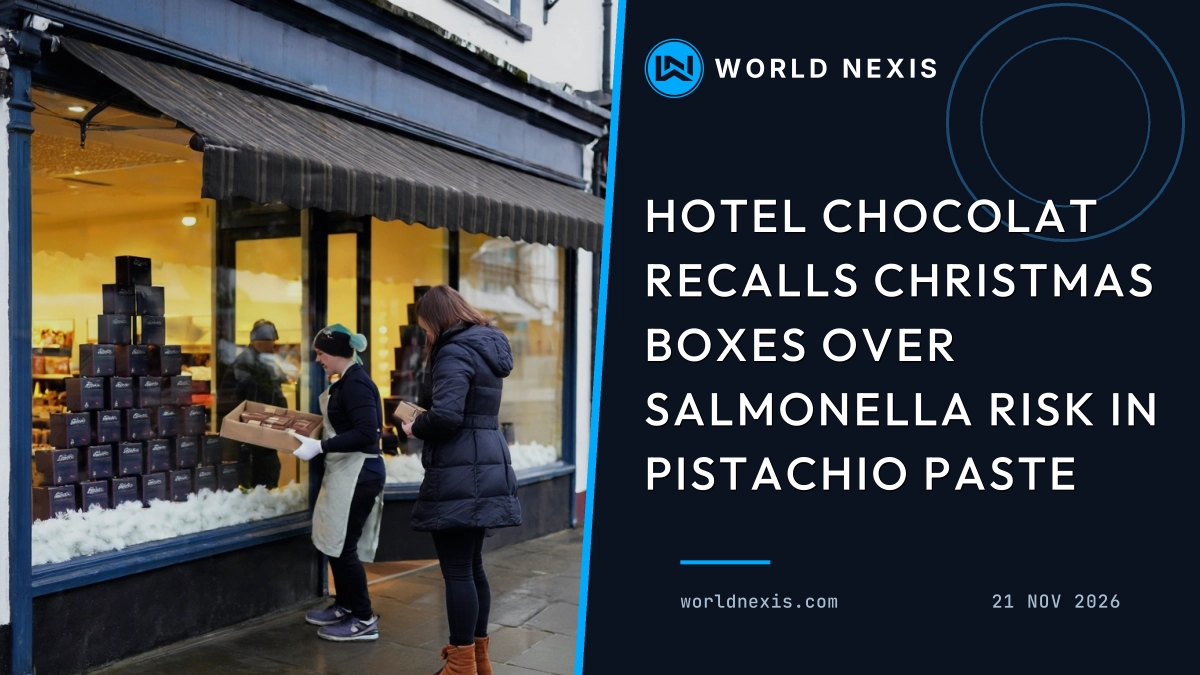
The Hotel Chocolat recall is under way after the British chocolate maker called back a small number of its Christmas boxes as a precaution, following a salmonella warning linked to a pistachio paste ingredient. The Food Standards Agency published its food alert on Saturday 21 November. Christmas chocolate boxes bought between 2 October and 8 October are among the products affected.
Key points
- The Hotel Chocolat recall covers a small number of Christmas products, pulled as a precaution over a possible salmonella risk.
- The company links the risk to pistachio paste and says salmonella has not been detected in any finished product.
- The Food Standards Agency has told shoppers not to eat affected items and to check lot codes against the recall notice.
- Customers can return affected products to the store where they bought them for a replacement or refund.
What the Hotel Chocolat recall covers
In its recall notice, the manufacturer said the decision followed a notification from inside its ingredient supply chain. Raw pistachios used to make the pistachio paste may be linked to a salmonella contamination incident, which is why the affected batches were pulled.
The company was explicit that the problem has not been found in the chocolate itself. “Salmonella has not been detected in any finished Hotel Chocolat products,” the notice states.
A supply chain trigger, not a failed product test
The sequence matters. This recall began with information about an ingredient upstream, not with a test that found salmonella in a finished box. That is why the company describes the action as precautionary.
The Hotel Chocolat recall notice names Christmas chocolate boxes bought between 2 October and 8 October. The agency’s test is whether a product matches the specific lot codes set out in the notice, not simply the date on a receipt.
Salmonella symptoms and the agency’s advice
Salmonella usually causes fever, diarrhoea and abdominal cramps. The Food Standards Agency said people with these symptoms should stay away from work, school or nursery until they have stopped having symptoms for at least 48 hours, so they do not pass the illness on.
Its instruction on the products caught up in the Hotel Chocolat salmonella warning is direct: do not eat them. Shoppers should take them back to the store where they were purchased, where they will be given a replacement or refund. Hotel Chocolat Customer Care can be reached on 03444 932323 or at help@hotelchocolat.com.
The alert behind the Hotel Chocolat recall arrives in the middle of the Christmas shopping season, when gift boxes are being bought, stored and sometimes handed over weeks before the day itself. That timing raises the chance that an affected box is already in a cupboard or has changed hands.
Why it matters
For anyone caught up in the Christmas chocolate box recall, the practical step is to check the packaging against the lot codes before the box is opened and shared. A replacement or refund is available, and the company says no salmonella has been found in the finished products.
The bigger issue is how food safety warnings travel. The Hotel Chocolat recall only works if the shopper sees the alert, finds the box, reads the code and acts. Gifts bought in early October are exactly the kind of purchase that slips through that chain.
Analysis
Having covered public health and food safety for World Nexis News, I look first at what triggered the Hotel Chocolat recall rather than at what was found in the chocolate. The answer is a warning about raw pistachios upstream, the point at which a manufacturer has the least information and the most reason to move fast. On the evidence in the notice, I think the company and the Food Standards Agency have made the right call.
The strongest counter-argument is that a precautionary recall of products that have tested clean looks like an overreaction. It costs money, it wastes food, and it can make shoppers cynical about the next alert. Those costs are real, but they are recoverable in a way that an illness in a household at Christmas is not, and the agency’s 48-hour exclusion advice shows how easily an infection spreads within a family.
Where I part company with the handling is the burden placed on the shopper. Matching lot codes on a box bought in early October asks a lot of someone who may have received it as a gift. A customer care line and a web notice are the minimum; the retailers who sold the boxes are better placed to reach the people who actually hold them.
What happens next
The Hotel Chocolat recall remains open. Anyone who thinks they have an affected box should stop eating from it, check the lot code against the notice, and return it to the store where they bought it. Replacements and refunds are being offered, and Customer Care is handling enquiries on 03444 932323 and at help@hotelchocolat.com.
What we don’t know yet
The company has described the recall as involving a small number of products but has not put a figure on how many boxes are affected. It has also not set out how widely the pistachio paste was used across its Christmas range. Both details would help a shopper judge quickly whether the box in front of them is one to worry about.
Related coverage
- Strait of Hormuz swim: Briton’s 15km warning on war’s cost
- Parliament Christmas tree: 40ft Sitka felled at Kielder
- Rahul Gandhi Israel remarks spark ‘complicity’ warning
Further reading
- Hotel Chocolat recalls some Christmas boxes over salmonella risk
- Hotel Chocolat recalls some Christmas boxes over salmonella risk
About the author: Sofia Alvarez is the Health & Medicine Reporter at World Nexis News (WNN), covering health & medicine. The analysis section reflects the writer’s view.

Sofia Alvarez
Sofia Alvarez is Health & Medicine Reporter at World Nexis News, covering public health, clinical research, mental health and the policy decisions that shape care. Based in Manchester, she prioritises evidence over anecdote, checks claims against peer-reviewed research and official guidance, and explains uncertainty plainly…