Parliament Christmas tree: 40ft Sitka felled at Kielder
Parliament Christmas tree: A 40ft Sitka spruce has been felled in Kielder Forest for Parliament's Christmas tree, as Sir Lindsay Hoyle watched the…
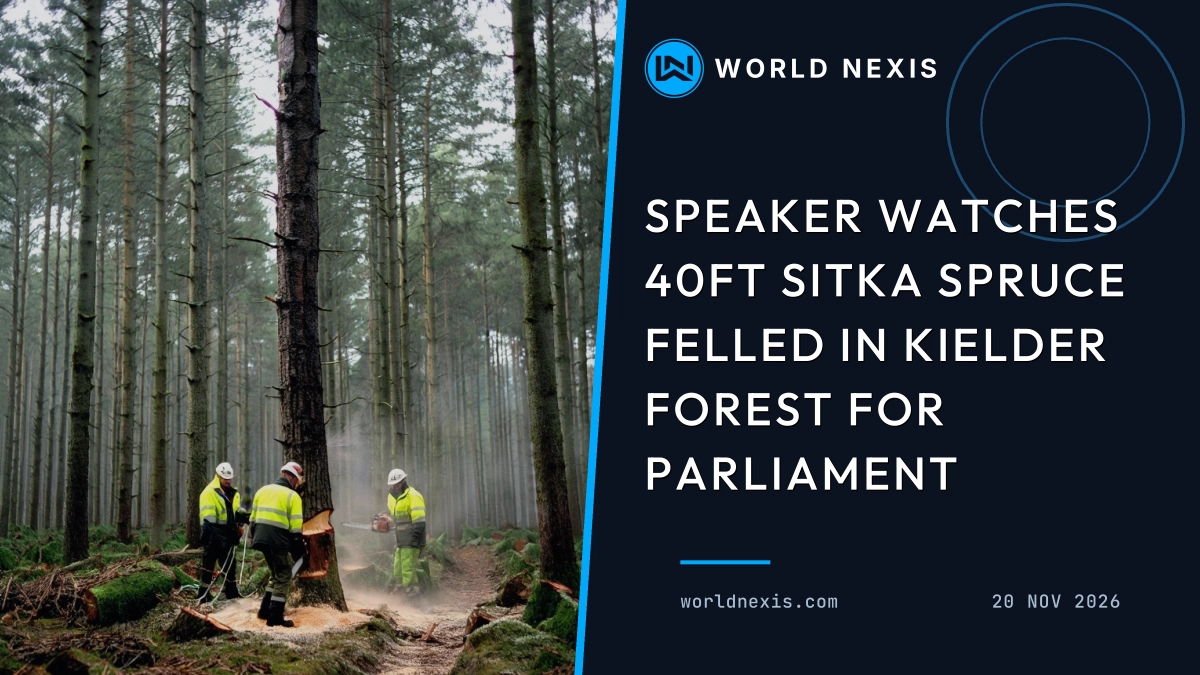
Parliament’s Christmas tree has been felled in Kielder Forest, after the Speaker of the House of Commons travelled to Northumberland to watch the 40ft Sitka spruce come down. Sir Lindsay Hoyle saw the tree cut on site before it begins a 300-mile journey south to London, where it will form the centrepiece of the New Palace Yard display.
The spruce was selected from 150 million specimens growing in England’s largest forest. It is an annual gift from Forestry England, which this year marks the 100th anniversary of Kielder’s creation.
Key points
- Sir Lindsay Hoyle watched a 40ft Sitka spruce being felled in Kielder Forest, Northumberland, for Parliament’s Christmas tree.
- The specimen was chosen from 150 million trees in England’s largest forest.
- It will be wrapped and transported 300 miles to London for the New Palace Yard display.
- Forestry England donates the tree every year and is celebrating Kielder’s centenary.
Why the Parliament Christmas tree comes from Kielder
Kielder Forest lies in Northumberland and is the largest woodland in England. That scale is what makes the annual gift possible. Instead of choosing from a small commercial crop, Forestry England can select from a standing population of 150 million trees.
The Parliament Christmas tree is chosen for how it will look in a courtyard rather than a living room. Richard Cooper, the Forestry England figure who picked this year’s specimen, said the anniversary added pressure to get the choice right.
“It’s a big responsibility to pick the right tree, and with this year being Kielder’s 100th anniversary, it felt more important than ever to choose the right one.”
Why Sitka spruce suits a civic display
Cooper described Sitka spruce as the obvious choice for a tree of this kind. He noted that most households buy Norway spruce or Nordmann fir, but said Sitka is sturdier and bushier, which makes it ideal for a large outdoor display.
Those qualities matter once the tree leaves the forest. A 40ft specimen must survive wrapping, a long road journey and weeks standing outside in winter weather before the lights go on.
A century of Kielder
Forestry England is marking 100 years since Kielder’s creation, and the centenary frames this year’s donation. The annual gift has become a fixture of the parliamentary calendar. The spruce cut on this visit will stand in for that wider landscape in London.
From Kielder to New Palace Yard
Jack MacNeil carried out the felling as the Speaker watched. The Parliament Christmas tree will then be wrapped for transport and driven 300 miles south, a route that takes a piece of the North East into the heart of Westminster.
As Speaker, Sir Lindsay is the Commons’ presiding officer. His presence at the felling gave the annual donation a higher profile than a routine delivery would have had.
Sir Lindsay said the arrival of the tree, its decoration and the carol service always herald the festive period. He described the visit to the forest as a privilege.
“When the tree arrives, when it gets its lights on and we have a carol service, we know Christmas is upon us.”
He added: “It is always wonderful to receive a piece of the North in Westminster each year – and we are so thankful for the annual donation of Parliament’s tree.”
Why it matters
For most people this is a seasonal marker rather than a political event. Yet the Parliament Christmas tree is a public object in a public place, standing in New Palace Yard where MPs, staff and visitors pass through the parliamentary estate all winter.
The donation also links the Commons to a working forest in one of England’s most remote counties. Kielder’s centenary gives that connection a sharper edge, because the landscape being celebrated is a managed woodland with a hundred-year history rather than a decorative backdrop.
Analysis
Having covered devolution and public services for World Nexis News, I look first at what a Westminster institution borrows from the regions, and what it gives back. The Speaker’s trip is easy to file as a photo opportunity. I think it reads better as a small piece of constitutional theatre with a practical core: the Commons takes its most visible seasonal symbol from a publicly managed forest in the North East rather than from a supplier on London’s doorstep.
The evidence supports the visit. Sir Lindsay did not wait for a courier; he travelled to a remote site, watched the felling and thanked the foresters in public. The centenary supplied a real news hook rather than a manufactured one. Regional identity is usually discussed in Westminster in the abstract language of funding formulas, yet here it arrived as a 40ft tree and a man with a chainsaw.
The strongest counter-argument is that a Speaker’s time is scarce and that any official travel invites accusations of a jolly. I would answer that the cost is small next to the benefit of a national institution publicly acknowledging where its materials come from. A tree standing in New Palace Yard will be seen by more people, over more weeks, than most parliamentary announcements.
What happens next
Parliament’s Christmas tree will be wrapped and moved 300 miles to London, then installed as the centrepiece of the New Palace Yard Christmas display. The lights will go on and a carol service will follow, the two moments Sir Lindsay identified as the real start of the season.
What we don’t know yet
The material released so far does not confirm the date the tree reaches Westminster, or the date of the carol service. Nor is it clear how much of the display the public will be able to see in person.
Related coverage
- Burnham EU deal struck, but fee row risks 100,000 places
- Irish Sea border breakthrough as food checks set to end
- Brexit reset deal: what Burnham’s Brussels summit changes
Further reading
- Timber! Speaker attends felling of Parliament’s Christmas tree in Kielder Forest
- Timber! Speaker attends felling of Parliament’s Christmas tree in Kielder Forest
About the author: Liam O’Connor is the UK Politics Reporter at World Nexis News (WNN), covering uk politics. The analysis section reflects the writer’s view.

Liam O'Connor
Liam O'Connor is UK Politics Reporter at World Nexis News, covering Westminster, devolved politics and the issues that matter to voters across England, Scotland, Wales and Northern Ireland. Based in London, he reports from primary sources — Hansard, official statements, published data — and explains…



