Burnham EU deal struck, but fee row risks 100,000 places
The Burnham EU deal on food, emissions and youth mobility is done, but a row over EU tuition fees could delay it. Here is what it means for the UK.
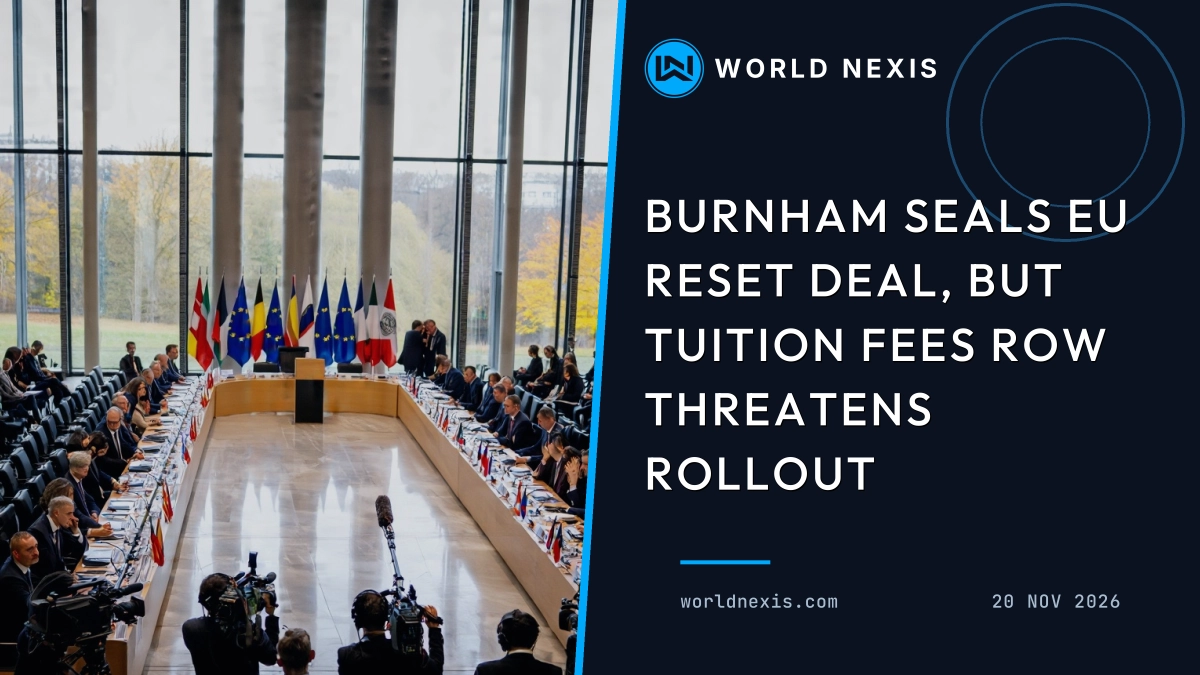
The Burnham EU deal was concluded in Brussels on Friday, covering food and farm trade, linked carbon markets and a youth mobility scheme for up to 100,000 young adults each way. The prime minister met European Commission president Ursula von der Leyen and European Council president António Costa at a UK EU summit that is only the second since Britain became the first country to leave the bloc. One item is missing, however: the tuition fees paid by EU students at British universities, which Brussels has tied to parts of the agreement taking effect.
Key points
- Downing Street declared the Burnham EU deal done, with a spokesperson saying: “The deal is done – negotiations have concluded.”
- The youth mobility scheme would let up to 100,000 young adults from each side live and work temporarily in the other.
- Brussels wants EU students charged the £9,970 domestic fee rather than up to £38,000 a year, and has set a six-month deadline for talks.
- Reform UK leader Nigel Farage called the package a “betrayal” and said the Brexit argument had restarted.
What is in the Burnham EU deal
The central element is the sanitary and phytosanitary agreement on food and farm produce. It removes export health certificates and border checks on goods crossing between Britain and the EU. Government officials claim it will add up to £5.1bn a year to the economy.
A second strand links the UK and EU emissions trading schemes, shielding British exporters from a carbon tax when they sell into Europe. Officials value that at £3.8bn a year. The third piece is the youth mobility scheme, which Burnham presents as an opportunity for young people rather than a migration measure.
Burnham framed the summit around household budgets. “The test for this summit is simple: does it make life better for people in Britain?” he said before the talks. “That is what I will deliver in Brussels today – cutting costs, keeping prices down in the supermarkets and creating opportunities for young people.”
Von der Leyen said she wanted “a summit of ambition and concrete results. More opportunities for young people. Easier agrifood trade. And a stronger cooperation on economic security.” Costa said: “Our security and prosperity are closely intertwined, making a strong partnership between us essential.”
The overall economic gain is modest. Burnham has cited an uplift in gross domestic product, with figures varying between 0.4% and 0.5% depending on which side is counting.
The EU tuition fees row holding up implementation
The unresolved element of the Burnham EU deal concerns money for universities. Brussels wants students from member states to pay the same £9,970 a year as domestic undergraduates. Universities can currently charge them up to £38,000, and UK ministers have resisted a cut because of the damage it would do to institutional finances.
An EU official said the agreements would have to “come into force in a balanced way”, adding: “I think this is an important element, so let’s hope that everything can go ahead.” A six-month deadline has been attached to the fee talks, with the prospect that parts of the package are not implemented until a solution is found.
Downing Street rejected the idea that the deal could stall. A spokesperson said both sides had agreed when the elements would come into force, that the dates are set out in a joint statement to be published in due course, and that “talks will continue on some areas”.
Farage says the Brexit debate has restarted
Reform UK leader Nigel Farage described the agreement as a “betrayal”. Because Britain must accept some EU rules and standards it has no role in setting, supporters of Brexit argue the Burnham EU deal erodes the independence they voted for. “I’m afraid that the great Brexit debate has just started again,” Farage said, predicting it would soon become a question of “do we rejoin or do we stay out”.
Burnham has made no secret of his view of the 2016 decision, saying this week: “The Brexit we were given has not worked. We have lost more than we gained.” He has said all options should be on the table for the future relationship, including rejoining, while stressing that reversal is only one possible outcome and far from imminent.
Why it matters
For shoppers and small exporters, the food provisions in the Burnham EU deal are the part that reaches daily life: fewer certificates, fewer checks and, the government argues, lower prices on the shelves. For young people, the mobility scheme is the difference between a placement abroad and a visa wall.
For universities the stakes are larger and more immediate. A cut in EU fees without new money would land on institutions already under pressure. It is students from outside the EU, who pay full rates, who would most likely end up covering the gap.
Analysis
Having covered Westminster’s relations with Brussels for World Nexis News, I look first at what is enforceable rather than at what is announced. On that test, the Burnham EU deal is real: the food and carbon market texts are substantial, and they were signed by leaders who rarely give a British prime minister a second UK EU summit so soon after the last one.
I side with the government on the substance of the fee dispute. Cutting EU students to £9,970 overnight, with no funding settlement for the universities that lose the income, would simply move a problem from Brussels to British campuses. The strongest counter-argument is that the EU’s demand is basic fairness, and that a system charging some students £38,000 is a domestic funding failure rather than a European imposition. That is fair, but it argues for a funding review, not a rushed concession.
Where I part company with Downing Street is the framing. A deal whose implementation Brussels has publicly linked to an unanswered question is not fully done. Calling it so invites the charge of spin once the six-month clock starts to matter.
What happens next
Implementation of the Burnham EU deal now moves into the legal processes required in each country, and a joint statement setting out the dates is due to be published. Talks on EU tuition fees continue under a six-month deadline.
What we don’t know yet
The exact implementation dates have not been made public. Nor is it clear whether Brussels will treat the whole package as contingent on a fee settlement, or how the gap between £9,970 and £38,000 would be bridged.
Related coverage
- Brexit reset deal: what Burnham’s Brussels summit changes
- Badenoch welfare row: leader defiant over amputee remark
- Kemi Badenoch EU warning: Burnham dragging UK backwards
Further reading
- Andy Burnham and EU leaders speak after reaching agreement on reset deal – live
- The U.K. and EU hold a rare summit to strengthen ties
About the author: Liam O’Connor is the UK Politics Reporter at World Nexis News (WNN), covering uk politics. The analysis section reflects the writer’s view.

Liam O'Connor
Liam O'Connor is UK Politics Reporter at World Nexis News, covering Westminster, devolved politics and the issues that matter to voters across England, Scotland, Wales and Northern Ireland. Based in London, he reports from primary sources — Hansard, official statements, published data — and explains…



