Badenoch welfare row: leader defiant over amputee remark
Badenoch welfare row: Kemi Badenoch stands by her welfare row remark that double amputees run marathons, after Andy Burnham called the comments crass and…
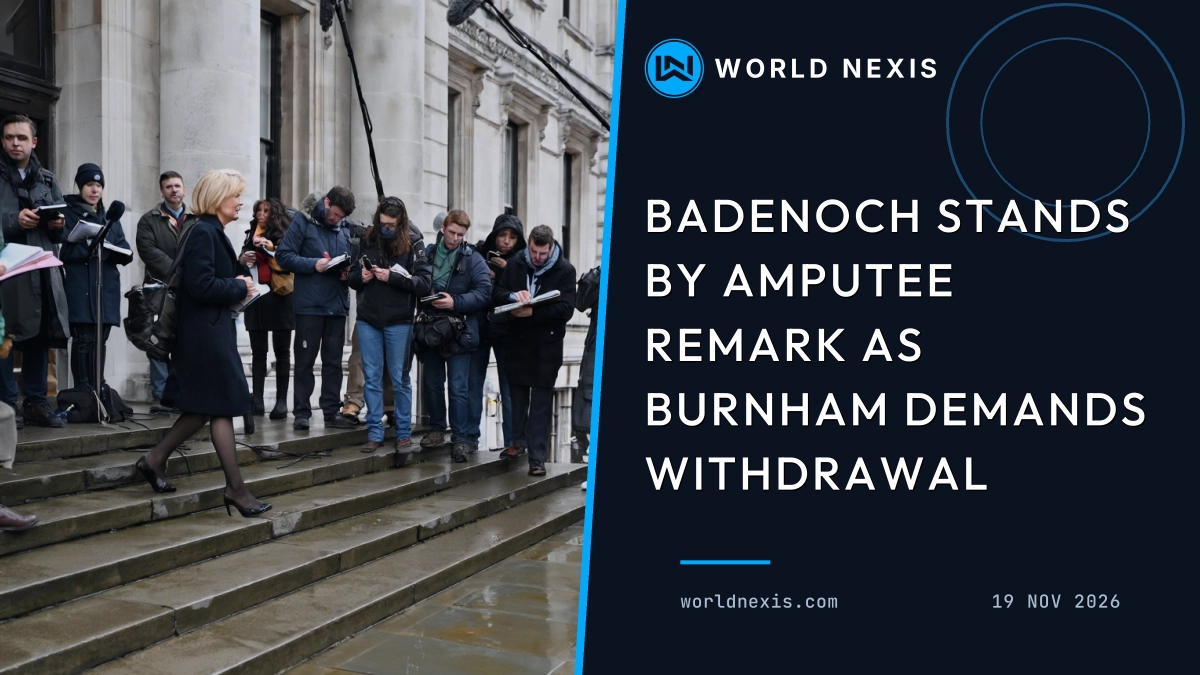
Kemi Badenoch is refusing to back down in the Badenoch welfare row, telling a morning broadcast interview on Thursday that she will not withdraw her claim that because double amputees can run marathons, more disabled people should work. The Conservative leader said she had used “extreme examples to illustrate things” but defended the argument as “a message of hope”. Her remarks, first made in a speech last week, sit at the front of a party plan to cut welfare spending by £36bn a year.
Key points
- Kemi Badenoch has stood by her claim that the achievements of double amputees show more disabled people can work.
- Paralympian Richard Whitehead accused her of “weaponising” his sporting success.
- Prime Minister Andy Burnham called the remarks “crass and insensitive” and urged her to withdraw them at Prime Minister’s Questions on Wednesday.
- The comments accompanied Conservative plans to cut welfare spending by £36bn a year.
Badenoch welfare row: what she said under questioning
Asked whether she accepted that her words were insensitive, Badenoch replied: “No, no, no. I do not accept it. I will speak the truth, and I will say what I believe is common sense.”
She continued: “What I know is that if people can work, then we should encourage them to work. What I’m saying is actually a message of hope that if people even with significant problems can work, then those who have ADHD and mild anxiety should go to work.”
The Conservative leader acknowledged that she had used “extreme examples to illustrate things”. She added: “But if someone can do that, then yes, your condition of ADHD or anxiety is mild.”
Badenoch also rejected the suggestion that she should soften her language. “I will say things as they are,” she said. “People may disagree with things that I say, and that’s fine, this is a free country, people are free to disagree, but they know where I’m coming from.”
She ended with the line her party intends to keep repeating: “I start from first principles: If you can work, you should work, and the Conservative Party is going to help you get a job.”
Where the Badenoch welfare row started
In a speech last week setting out the case for her party’s plans, Badenoch argued that millions of people contribute to the economy, to their families and to their communities while facing serious challenges. “Double amputees run marathons,” she said. “People who are housebound do wonderful creative work from home. People with autism run some of the biggest tech companies in the world.”
Those examples introduced a package the Conservatives say would cut welfare spending by £36bn a year. The party says the proposals would stop people claiming disability benefits for milder mental health issues and neurodiversity conditions, including anxiety, depression and ADHD, and puts the saving from its sickness and disability overhaul at £13.7bn a year. It also promises £1bn for health support, so that people who lose eligibility for cash benefits can access treatment instead.
Whitehead: “weaponised”
The Badenoch welfare row intensified when Richard Whitehead, a double amputee marathon runner with four Paralympic medals, responded on social media. He said he was “gobsmacked that somebody’s sporting success would be weaponised in this way”.
He added: “Disability should never be judged through isolated examples of individual achievement, but through an understanding of the barriers people and families face every day. The fact that some double-leg amputees can run marathons does not mean that disability support is unnecessary. Equally, the fact that some people with ADHD thrive despite limited support does not mean that others do not need meaningful assistance.”
Burnham: “crass and insensitive”
The Badenoch welfare row reached the Commons on Wednesday, when Labour MP Charlotte Nichols asked Andy Burnham whether he agreed that the achievements of disabled sportsmen and women should never be weaponised against others. The Prime Minister said the comments were “crass and insensitive” and that she should withdraw them.
Why it matters
For anyone who claims disability benefits, the Badenoch welfare row is not a debate about tone. The Conservative welfare cuts at its centre would remove eligibility for some of the conditions people currently rely on, and the party’s answer is treatment funded through a £1bn support pot rather than cash.
The argument also sets the terms of the next election. A Prime Minister and an Opposition leader are now disputing in public who deserves support, and both will be judged on whether the system they propose is fairer or simply cheaper.
Analysis
Having covered public services and Westminster for World Nexis News, I look first at how a claim like this would work in practice, and the Badenoch welfare row fails that test. Eligibility for disability benefits is decided case by case, on evidence about a person’s impairment and its effect on daily life. An athlete completing a marathon tells you about one body, with one set of adaptations, resources and years of training. It tells you nothing about a stranger with a different condition, a different employer, or no adapted transport to get to work.
That is why I side with Whitehead. He is not claiming the system is perfect; he says himself that it needs a shake-up. His point is that support should follow a person’s actual needs, and that isolated examples are the weakest possible basis for rules that affect millions. Badenoch’s suggestion that someone else’s achievement exposes a “mild” condition reverses the logic of assessment.
The strongest counter-argument is that her £36bn welfare cuts promise a serious sum, and a party proposing savings of that size owes voters a real explanation of where the money would come from. She is entitled to make that case loudly. But it has to be built on how assessments work, not on the most extraordinary bodies in the country.
What happens next
The next stage of the Badenoch welfare row will be fought over detail rather than anecdote. Ministers and shadow ministers will be pressed to say which conditions would lose eligibility and how the £13.7bn saving would be delivered.
For now the standoff is unresolved: Badenoch says she will not withdraw, and the Prime Minister says she should. That disagreement is likely to shape the next exchanges between the two leaders in the Commons.
What we don’t know yet
- How the party would define a “mild” mental health or neurodiversity condition in eligibility rules.
- Whether the £13.7bn saving has been independently costed.
- Whether the government will bring forward changes of its own to the benefits system.
Related coverage
- Kemi Badenoch EU warning: Burnham dragging UK backwards
- Neet welfare reforms could extend to over-25s, Burnham says
- Van Gogh auction: record $190.4m sale ends Nazi-era row
Further reading
- Kemi Badenoch defends amputee marathon runners claim in benefits cut row
- Badenoch stands by comment linking amputee’s marathon success to ability to work
About the author: Liam O’Connor is the UK Politics Reporter at World Nexis News (WNN), covering uk politics. The analysis section reflects the writer’s view.

Liam O'Connor
Liam O'Connor is UK Politics Reporter at World Nexis News, covering Westminster, devolved politics and the issues that matter to voters across England, Scotland, Wales and Northern Ireland. Based in London, he reports from primary sources — Hansard, official statements, published data — and explains…



