Van Gogh auction: record $190.4m sale ends Nazi-era row
The Van Gogh auction at Sotheby's New York ended with Châtaigniers en fleurs selling for a record $190.4m, after Fischer heirs settled a Nazi-era claim.
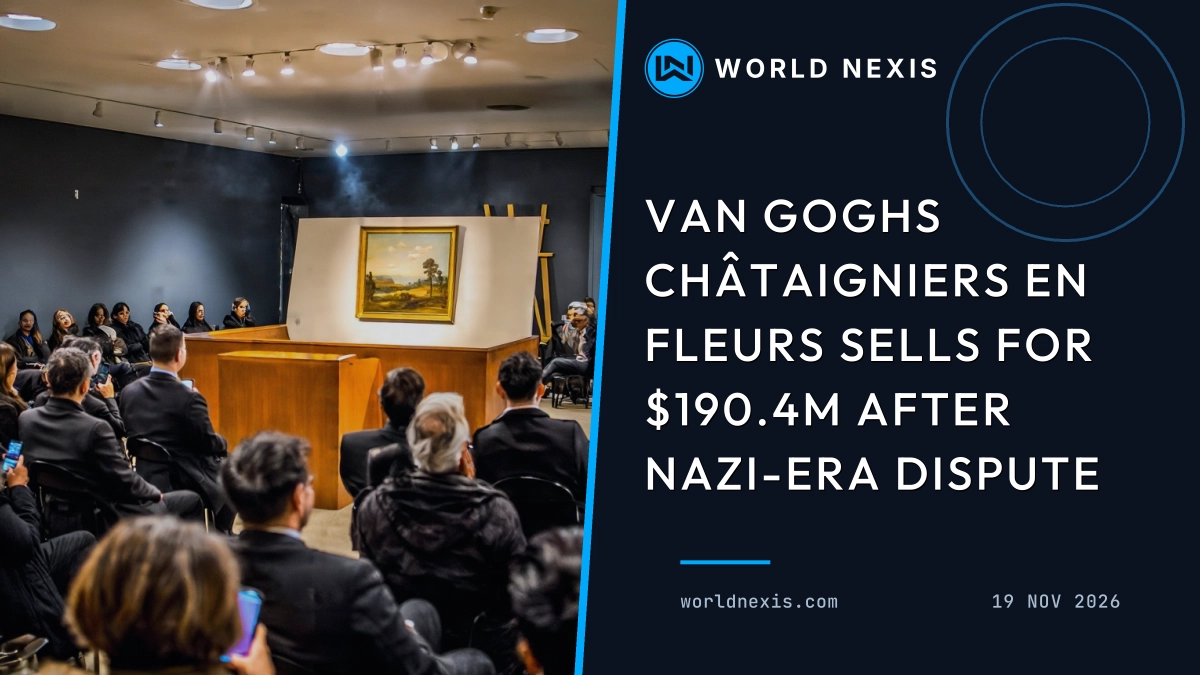
The Van Gogh auction the art market had circled for a week ended in New York on Wednesday with a record. Châtaigniers en fleurs sold for $190.4m, the highest price ever paid for the artist, hours after the families fighting over its Nazi-era history settled their dispute.
Sotheby’s said the 1890 canvas, known in English as Chestnut Trees in Blossom, went under the hammer once an agreement was reached. The deal covered the Blaquier-Arrieta family and all of the legal descendants of Hedwig and Samuel Fischer. It is the most expensive work auctioned so far this season.
Key points
- Châtaigniers en fleurs sold at Sotheby’s in New York on Wednesday for $190.4m, just under £145m.
- The Van Gogh auction record stood at $117.2m, paid in November 2022 for Orchard with Cypresses.
- The sale went ahead only after a settlement between the sellers and the heirs of Samuel Fischer, who said the family sold the work under Nazi-era pressure.
- The buyer has not been identified, and the terms of the settlement have not been published.
The Van Gogh auction record, in numbers
Vincent van Gogh painted the work in 1890 at Auvers-sur-Oise in France. The Van Gogh auction record it replaces stood at $117.2m, paid in New York in November 2022 for Orchard with Cypresses. Wednesday’s price is $73.2m higher, a rise of almost 62% in four years.
Until Tuesday, the Châtaigniers en fleurs sale was in doubt. Representatives acting for the Fischer heirs had argued the family parted with the painting only because of financial losses suffered under the Nazis. Once that objection was resolved, the route to the block was clear.
How a 1936 sale became the obstacle
Samuel Fischer, an influential German publisher, acquired the painting in Paris in 1909. His family sold it in 1936. The heirs argued the family parted with the work only because of financial losses its publishing business suffered under the Nazis.
Their Berlin-based lawyer, Gunnar Schnabel, had called on Sotheby’s to prove the painting sold at its market value. He also asked the auction house to show the family would have sold it regardless of the political context. The Blaquier-Arrieta family bought the work in 1975 and held it for more than half a century, according to Sotheby’s.
On Tuesday, Sotheby’s said “an agreement has been reached between the Blaquier-Arrieta family and all of the legal descendants of Hedwig and Samuel Fischer regarding the sale”. The auction house did not say what either side had agreed to.
The claim had put Wednesday’s sale at risk, leaving the auction house one night to reassure bidders that the title was clean. Sotheby’s announced the deal a day before the auction. The heirs said they were:
“grateful for the trusting and fair negotiation and collaboration with Sotheby’s and the Blaquier-Arrieta family, which make it possible to acknowledge the suffering of the Fischer family during the Nazi era and honor Gisela Berman Fischer’s history of seeking justice for her family.”
Sotheby’s released the statement on the heirs’ behalf. The wording now forms part of the documented history of a painting that has just changed hands for a nine-figure sum.
Why it matters
The Van Gogh auction matters beyond one canvas. Provenance disputes like this one now surface in the days before a major sale, when publicity is loudest and the seller’s options are thinnest. For museums, insurers and collectors, the paperwork behind a work is watched as closely as the work itself.
For families seeking restitution, the Van Gogh auction is a template and a warning. A negotiated settlement can deliver an acknowledgment within days, but it delivers no ruling that anyone else can use. The case is already a marker in Nazi-era art restitution, even without a judgment.
For buyers, the lesson is about cost. Legal review, insurance and the risk of a late claim now sit on top of the hammer price for any work that changed hands in the 1930s, and bidders increasingly weigh them before raising a paddle.
Analysis
Having covered market structure and record prices for World Nexis News for five years, I read the Van Gogh auction result less as a verdict on the artist than as a verdict on paperwork. Once the agreement landed, the bidding was never really in doubt. What buyers were pricing was a clean title, and the premium for that ran to tens of millions.
On the substance, I side with the Fischer heirs. A 1936 sale by a Jewish publishing family under Nazi pressure should not be treated as an arm’s-length transaction unless the seller can show the price matched the market. Schnabel’s demand that Sotheby’s prove exactly that was the right test, and settling before the gavel beats settling after a trial.
The strongest counter-argument is fairness to the sellers. The Blaquier-Arrieta family bought in 1975 and held the painting for half a century; they did not conduct the 1936 sale. That grievance is real, and it is probably why the deal is private. What worries me is that a private deal leaves no rule behind: if the heirs took a share of the $190.4m, nobody outside the room will know the figure.
I would rather see auction houses disclose the shape of these settlements, even when both parties want silence. I accept that confidentiality gets deals done faster, which is why this one closed in days rather than years. But a market that resolves restitution privately keeps renegotiating the same questions.
What happens next
The Van Gogh auction is complete, so the painting passes to a buyer Sotheby’s has not named. The auction house said the work would be sold pursuant to the families’ agreement, which now governs the transaction instead of a court order.
Neither family has said whether the settlement involved anything beyond the sale itself. Sotheby’s has not promised to publish the terms.
What we don’t know yet
Who bought the painting, whether the Fischer heirs will receive part of the proceeds, and what each family agreed to say in public. Those answers may never be made public, and no deadline has been set for any of them.
Related coverage
- UK inflation rate hits 3.6% on record diesel prices
- UK inflation hits 3.6% as record diesel prices drive rise
- CMA Awards 2026: Ella Langley ties record as Swift returns
Further reading
- Van Gogh painting sells for $190.4m after row over Nazi history
- Vincent van Gogh painting auctioned for record $190.4m after dispute over Nazi era sale
About the author: Daniel Whitmore is the Business & Markets Editor at World Nexis News (WNN), covering business & markets. The analysis section reflects the writer’s view.

Daniel Whitmore
Daniel Whitmore is Business & Markets Editor at World Nexis News, based in New York. He leads coverage of companies, economies, markets and the forces that move them, from central bank decisions to corporate earnings and the cost-of-living pressures facing households on both sides of…



