UK inflation rate hits 3.6% on record diesel prices
UK inflation rate hits 3.6%, a 12-month high, as petrol and diesel prices surge and energy bills are forecast to jump £443 a year from January.
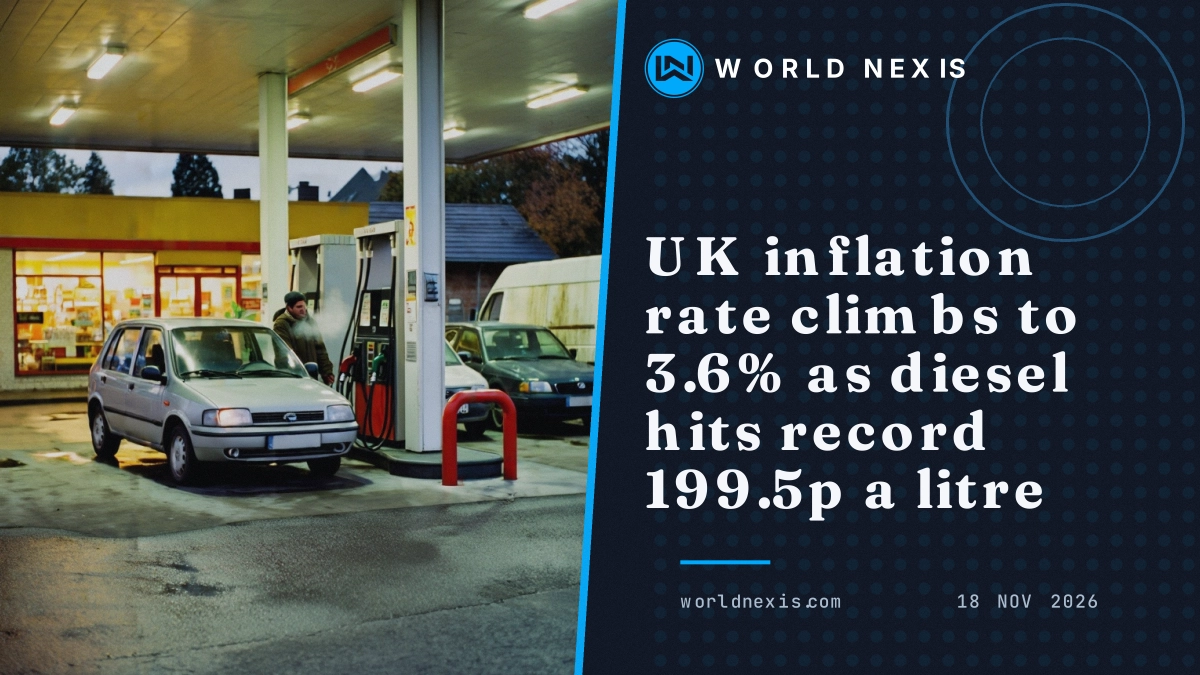
The UK inflation rate climbed to 3.6% in the year to October, the highest reading in 12 months, as petrol and diesel costs rose again. The Office for National Statistics said the Consumer Prices Index increased from 3.5% in September, in line with economists’ forecasts. It was the fourth consecutive monthly rise.
Key points
- The UK inflation rate rose to 3.6% in October, the highest in a year, according to the ONS.
- Petrol averaged 174.7p a litre after a 5.2p monthly rise; diesel hit a record 199.5p.
- Food inflation slowed to 0.9%, the weakest since September 2021, as chocolate prices fell 2.9%.
- Cornwall Insight expects the Ofgem price cap to rise 26% in January, adding £443 a year to bills.
Why the UK inflation rate rose again
The ONS said transport, particularly motor fuels, was the main driver behind the higher UK inflation rate. Transport prices rose 7.5% year on year, up from 6.6% in September. Restaurants and hotels made the largest downward contribution, offsetting part of the fuel effect.
Grant Fitzner, chief economist at the ONS, said fuel prices were “once again a major contributor” to the increase. He added that annual costs of both raw materials and goods leaving factories “continue to climb, driven by higher crude oil and petrol prices, respectively”.
A duty rise at the start of October pushed tobacco prices up 5.2% on the month and 12.4% on the year, the highest rate for almost two years. HMRC data show the change added about £1.21 to an average pack of 20 cigarettes.
There was relief elsewhere. Food price inflation eased to 0.9% from 1.3%, helped by a 2.9% fall in chocolate prices after the cocoa crisis of 2024. Factory gate prices, however, rose 5.1% annually, up from a revised 4.7%.
Energy bills and the UK inflation rate outlook
Researchers at Cornwall Insight expect the Ofgem cap on gas and electricity to rise 26% in January, taking a typical annual bill to £2,166. That is about £443 more than households pay now. Ofgem announces the new cap on Wednesday 25 November.
The cap already rose 4% in October, and the ONS said changes to how it is calculated added to household gas costs. Oil prices driven higher by the US-Israel war with Iran sit behind much of the pressure. Craig Lowrey, Cornwall Insight’s retail markets principal, said support “can only chip away at the edges of a bill that continues to be pushed up by events in the Middle East”.
Forecasts like that matter for the UK inflation rate because energy feeds through into other prices. Firms that absorb costs today may pass them on later. The Bank of England said earlier this month it had seen “limited evidence” of such pass-through so far.
Households are already adapting. Sophie, who manages a cafe at the Old Boat Corner community centre in Brighton, told the BBC she watches her smart meter “like a hawk”.
“I try to cook using the oven a lot less than I used to. We haven’t got the heating on yet in our household. We’re just like ‘wear more layers’.”
What it means for mortgages, loans and savings
The UK inflation rate is now well above the Bank’s 2% target, and rate-setters responded earlier this month by raising Bank Rate from 3.75% to 4%. It was the first increase in three years. The Bank said it wanted to “limit how much higher energy costs affect other prices”.
Higher rates lift borrowing costs on some mortgages, loans and credit cards, while improving returns on savings. Core inflation, which strips out energy and food, and services inflation were little changed in October. The Bank watches both closely when setting policy.
Ministers point to support already in place. VAT on electricity is zero until next July, and £100 will be paid to 20 million homes in January. Emma Reynolds, chief secretary to the Treasury, said the government was providing help with households’ energy costs. Shadow chancellor Andrew Griffith blamed “soaring energy costs” and Labour’s decision to “hike taxes and employment costs”.
Analysis
I have covered markets and central banking for five years at WNN. In a month like this, I look first at what remains once fuel is stripped out. The answer is reassuring. Food inflation is the slowest in five years, hotel prices fell, and core and services inflation barely moved. That points to a supply shock passing through forecourts, not demand running hot at home.
In my view, the facts support holding in December rather than hiking again, a possibility the BBC’s coverage also flags. Petrol and diesel have already eased back in November as oil fell after the US midterm elections. A rate rise cannot reopen a shipping route, but it will raise repayments for households remortgaging next year.
The strongest counter-argument is credibility. With the Bank warning of a peak near 5% and no return to 2% until 2028, inaction could let expectations drift. I would answer that with clearer communication, not a hike aimed at a problem the Middle East owns.
What happens next
Ofgem publishes the new price cap on 25 November, when the January forecast will be tested against the final figure. The Bank of England’s rate-setters meet in December, and the flat core reading may persuade them to pause. The Bank has said inflation could peak around 4.9% in the middle of next year and not return to 2% until 2028. In an adverse scenario, where the conflict escalates and oil climbs further, it has suggested inflation could reach 6.2% in 2027.
Related coverage
- UK inflation hits 3.6% as record diesel prices drive rise
- UK inflation confirmed at 3.6% as energy bills drive highest rate in a year
- UK unemployment rate falls to 4.6% as vacancies plunge
Sources
- Energy bills forecast to go up by £443 a year from January as UK inflation rate rises again (bbc.co.uk)
- UK inflation rises to highest level in a year on back of higher petrol and diesel prices – business live (theguardian.com)
- Inflation hits 12-month high after further rise in petrol prices (witneygazette.co.uk)
- Inflation hits 12-month high after further rise in petrol prices (oxfordmail.co.uk)
- Inflation hits 12-month high after further rise in petrol prices (harwichandmanningtreestandard.co.uk)
About the author: Daniel Whitmore is World Nexis News’s Business & Markets Editor, covering business & markets. The analysis section reflects the writer’s view.

Daniel Whitmore
Daniel Whitmore is Business & Markets Editor at World Nexis News, based in New York. He leads coverage of companies, economies, markets and the forces that move them, from central bank decisions to corporate earnings and the cost-of-living pressures facing households on both sides of…



