Irish Sea border breakthrough as food checks set to end
The Irish Sea border is set to shrink as Andy Burnham and Ursula von der Leyen confirm an agri-food deal in Brussels, ending port checks on GB food.
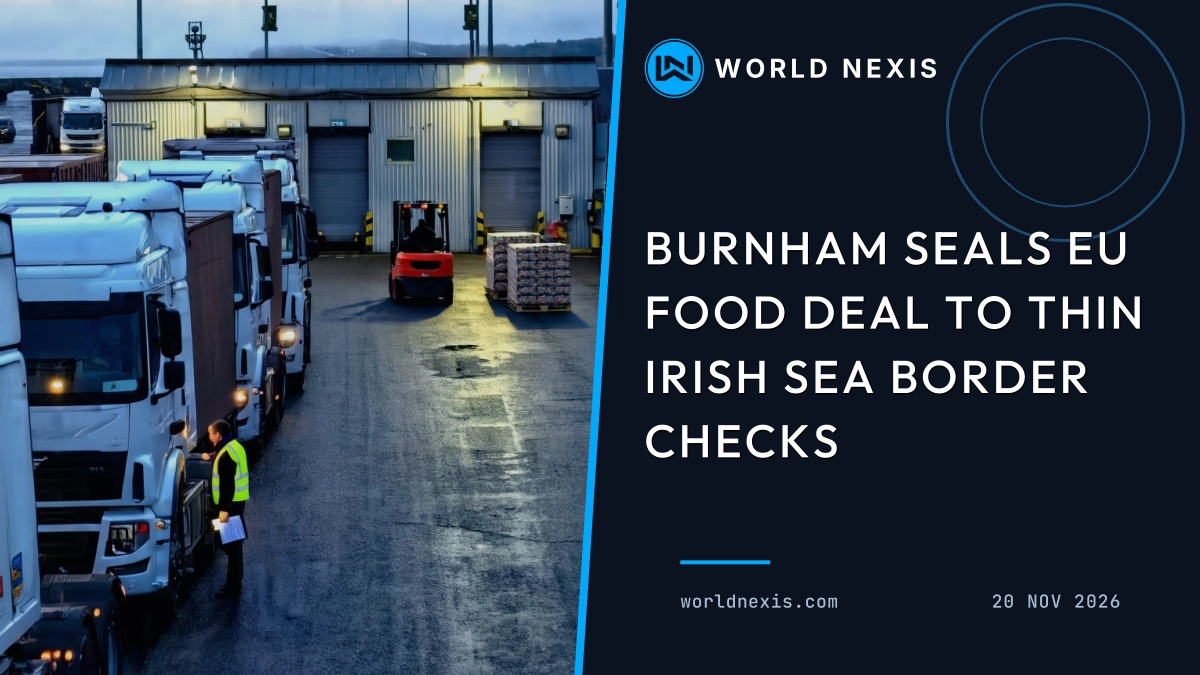
The Irish Sea border is set to shrink sharply this week, with Andy Burnham and Ursula von der Leyen expected to confirm a deal in Brussels that aligns the whole UK with EU agri-food rules and removes the need to check food and plants arriving in Northern Ireland from Great Britain.
The agreement would end port inspections on GB agri-food goods, cut but not remove the paperwork attached to them, and retire the “Not for EU” labels that GB food sold in Northern Ireland currently has to carry. The customs side of the Irish Sea border would stay in place.
Key points
- Goods sent from Great Britain to Northern Ireland would no longer be checked at Northern Ireland’s ports.
- Paperwork for agri-food movements is reduced, not eliminated.
- Businesses in Great Britain would still file customs declarations for goods going to Northern Ireland.
- Border control posts on the Irish Sea border would become largely redundant, though pre-Brexit livestock checks continue.
What the Irish Sea border deal changes for shoppers and retailers
The Irish Sea border dates back to the 2019 Brexit deal, revised in 2023 and now known as the Windsor Framework. Because Northern Ireland kept following EU rules on goods while the rest of the UK did not, controls were pushed onto the sea crossing rather than the land border with the Republic of Ireland.
That kept the island’s border open, but it left supermarkets, wholesalers and plant importers absorbing checks and forms on every pallet of food arriving from Great Britain. Food products and plants carry the heaviest bureaucracy of all, and retailers have complained about the Windsor Framework since it took effect.
A Swiss-style arrangement
Switzerland shows what the new model looks like. It sits outside the EU, yet there are no regulatory border controls on agri-food trade with the bloc, because it follows EU rules almost to the letter: accepting dynamic alignment, adjusting its laws when Brussels legislates, and submitting to oversight from the European Court of Justice.
The UK and EU are now on the verge of something similar. Under such an EU-UK deal, checks on GB food entering Northern Ireland could effectively end, and the inspection posts built at the ports would be largely redundant.
‘Stronger together’: the politics behind the Irish Sea border
Burnham has said the UK and EU are “stronger together” ahead of the summit. The Brussels agenda stretches beyond food, covering energy and youth mobility as well as the agri-food package.
Caoimhe Archibald, Northern Ireland’s Economy Minister, said what has been suggested so far “seems to be positive” in terms of cooperation and the removal of “some of the barriers that had been erected by Brexit”. She added: “Anything that reduces friction for our businesses in terms of trade is a positive thing in that regard.”
She went further on the wider Brexit settlement, describing it as “an act of economic self-harm for Britain and particularly from an economic perspective”.
Unionist parties have issued a joint statement on the agreement. For many unionists, the sea border is a constitutional affront that undermines Northern Ireland’s place in the UK, and the Democratic Unionist Party blocked power-sharing between 2022 and 2024 in protest at it. Nationalists have long treated the controls as the least bad way to soften Brexit’s impact on the island.
Why it matters
For households in Northern Ireland, this is a shelf-price story. Fewer checks means fewer delays and lower handling costs on the food that crosses the Irish Sea every day, and it should widen the range of GB products stocked by local shops. For GB exporters, it removes the inspection queue but not the customs declaration.
The timing is pointed. Cornwall Insight forecasts that energy bills in Great Britain will rise 26% from January, adding £443 to a typical household’s annual bill, driven by gas prices amid the Middle East conflict. Energy is on the summit agenda, so the deal is being sold to voters as cost-of-living relief as much as constitutional repair.
Politically, the stakes are Stormont. A settlement unionists can live with protects power-sharing; one they cannot may reopen the argument that shut the institutions down for two years.
Analysis
Having covered devolution and Northern Ireland for World Nexis News, I look first at what a deal does to the ground beneath Stormont rather than to the headline. On the evidence in front of us, the economic case is far stronger than the constitutional objection. The checks being removed exist because the UK chose a hard Brexit and then chose not to follow EU agri-food rules. Aligning again costs influence over rule-making but returns something concrete: food on shelves without inspection, labels removed, lorries moving.
Archibald’s framing is blunt to the point of partisan, but the underlying point holds. The barriers now being dismantled were erected by a UK decision, not imposed out of spite in Brussels. My view is that the deal is worth having, and that unionist parties weaken their own argument when they treat every reduction in friction as a further surrender.
The strongest counter-argument is not sentiment but democracy. Under dynamic alignment the UK accepts rules it does not vote on and courts it does not appoint, and that is a real loss of control which will never appear on a retailer’s invoice. That trade-off deserves to be argued honestly rather than buried under talk of growth.
What happens next
The agreement is expected to be confirmed when Burnham and von der Leyen meet in Brussels. After that, the alignment has to be carried into practice, and because it is dynamic, future changes in EU agri-food law would flow into UK rules, with European Court of Justice oversight as the backstop.
Separate strands on energy and youth mobility are being negotiated alongside food. Customs is not part of this package, so GB businesses will keep filing declarations for goods going to Northern Ireland, and incorrect paperwork will still delay loads.
What we don’t know yet
No implementation timetable has been set out. It is unclear whether unionist parties will accept the package or campaign against it, and equally unclear how far the parallel energy and youth mobility talks will get at this summit.
Related coverage
- Irish border poll: Harris seeks clarity after Bryant refusal
- Food bank donations critically low at 43% of Trussell sites
- Border poll: Bryant holds sole power to call the vote
Further reading
- EU-UK talks: New deal should reduce ‘Irish Sea border’ impact
- UK energy bills are rising. Tell us: are you shopping around for a better deal?
About the author: Liam O’Connor is the UK Politics Reporter at World Nexis News (WNN), covering uk politics. The analysis section reflects the writer’s view.

Liam O'Connor
Liam O'Connor is UK Politics Reporter at World Nexis News, covering Westminster, devolved politics and the issues that matter to voters across England, Scotland, Wales and Northern Ireland. Based in London, he reports from primary sources — Hansard, official statements, published data — and explains…



