Irish border poll: Harris seeks clarity after Bryant refusal
Simon Harris has asked the UK to explain how it would decide to call an Irish border poll, after Chris Bryant declined to set out any criteria.
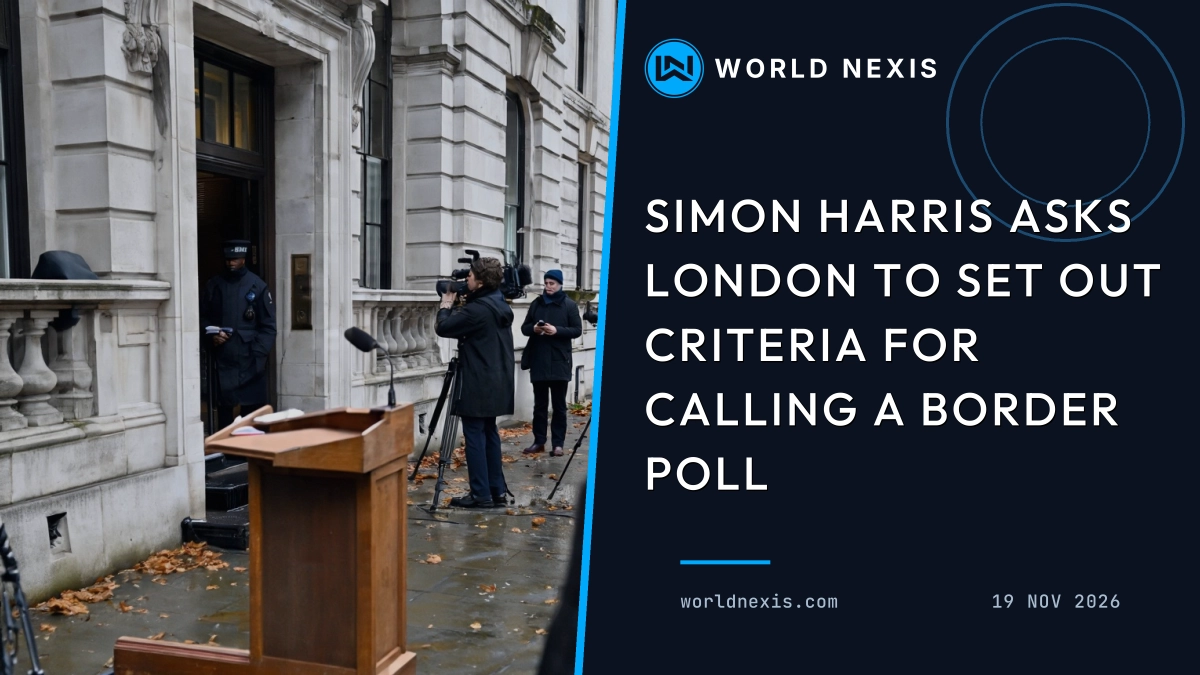
Simon Harris has asked the UK government to explain how it would decide to call an Irish border poll, after the Northern Ireland Secretary refused to say what would prompt one. The Tánaiste said on Thursday that clarity from Sir Chris Bryant on the criteria London would apply would be “useful” for Dublin. Sir Chris had earlier said there is “one single factor” behind the decision and that it is “very clear in the Good Friday Agreement”.
Key points
- Simon Harris wants the UK to set out the criteria it would use before calling an Irish border poll.
- Sir Chris Bryant said the test lies in the Good Friday Agreement and that the judgement is at his discretion.
- The Northern Ireland Secretary said it is not his job to campaign for a united Ireland.
- He said he does not currently detect that a majority in Northern Ireland wants to leave the UK.
Irish border poll: the single factor Bryant cites
Asked on Thursday morning to list the factors behind such a decision, Sir Chris pointed to the agreement’s own wording. It allows the Secretary of State to order a vote on Northern Ireland leaving the UK and forming a united Ireland “at any time it appears likely to him that a majority of those voting would express a wish” for that to happen.
“There’s one single factor and it’s very clear in the Good Friday Agreement,” he said. “You can argue that it’s nuanced, but it’s nuanced and clear.” Pressed on how he would judge when a vote appeared likely, he replied: “When it appears likely.”
In a separate broadcast interview, he described that as the “legal determination” set out in the agreement and added: “It’s at my discretion.”
Harris asks London to explain the criteria
Responding later in the morning, the Tánaiste said the commitment itself was not in dispute. What was missing, he argued, was an understanding of how a British government would apply it before calling an Irish border poll.
“It would be useful at a point in time to understand the criteria that a British Government may consider applying to decide to deciding whether or not to call a border poll,” Simon Harris said.
He added: “The commitment in the Good Friday Agreement is exactly as Chris Bryant read out. There’s no disputing of that, but the application of that is also something that would be good to have a greater understanding.”
Harris also played down any suggestion that Dublin was rushing towards a vote. He said there was “a lot of work to be done” and that the published documents show “very meaty pieces of work that need to be done” in the period ahead.
Stormont rows and the question of who decides
Sir Chris was also asked whether the power-sharing and budget disputes at Stormont showed that the case for Northern Ireland’s current place in the UK was fading. He rejected the premise that trouble in agreeing a budget meant the region “should immediately be part of a united Ireland”.
“My view is that it is for the people of Northern Ireland, to decide their future,” he said, describing that as a core principle of the agreement. He added that he does not detect that a majority would want to join a united Ireland at present.
On preparations for unity by the two parties in the Irish Government, Fine Gael and Fianna Fáil, he said “I don’t think so” when asked whether they were destabilising Stormont. “There are people who’ve obviously been campaigning all of their life and it’s part of their kind of reason for existing in politics to campaign for a United Ireland, that isn’t my job,” he said.
He was equally direct on Dublin’s role in an Irish border poll, saying the decision is “very clear” a matter for the Northern Ireland Secretary, as agreed by the two governments as co-guarantors of the peace deal.
Why it matters
For voters in Northern Ireland, the practical question is not whether an Irish border poll is imminent but who holds the trigger and on what evidence. Under the current wording, a single minister’s reading of opinion in the region is enough to start a constitutional process that would reshape citizenship, public services and the border economy.
For businesses and households on both sides of the border, uncertainty about the test feeds into longer-term planning, from cross-border trade to funding decisions in Belfast and Dublin. A published set of criteria would not settle the constitutional question, but it would tell people what to watch.
Analysis
Having covered devolution and Northern Ireland for World Nexis News, I look first at what a minister is willing to put on paper. Here the answer is nothing beyond the agreement’s own words, and I think Harris has the better of the argument on transparency. The “appears likely” test is a judgement about evidence, from polling to election results to party positions, and a government that will not say which evidence it would weigh leaves room for unionist suspicion and nationalist frustration to grow unchecked.
The strongest counter-argument is Bryant’s, and it is a serious one. The agreement deliberately places the call with the Secretary of State rather than with a formula, so that no side can game a checklist. Publish a set of triggers and every election result becomes a countdown clock, with campaigns organised around clearing a threshold rather than around governing. His reading of the law is correct, and his refusal to campaign for a united Ireland is the right posture for the office.
Even so, discretion is not the same as silence. A minister can keep the decision while explaining the kind of evidence he would consider, and I side with Harris that this would be useful. The risk of saying nothing is that the eventual decision, whenever it comes, looks political rather than principled.
What happens next
No date has been set for any vote, and Sir Chris has made clear he does not believe the conditions for one are met. The immediate next steps are political rather than procedural: continued contact between London and Dublin as co-guarantors, and the work Harris described on the Irish Government’s side.
What we don’t know yet
It is still unclear whether the UK government will publish any criteria for calling an Irish border poll, or whether Sir Chris will expand on his position in the Commons. Nor is there any agreed mechanism for Dublin to challenge a decision either way.
Related coverage
- Border poll: Bryant holds sole power to call the vote
- Stormont budget: Bryant warns of crisis over £1.5bn offer
- Stormont budget impasse: Bryant says no money for £1.5bn ask
Further reading
- Simon Harris seeks clarity on when UK would call an Irish border poll
- Simon Harris seeks clarity on when UK would call an Irish border poll
About the author: Liam O’Connor is the UK Politics Reporter at World Nexis News (WNN), covering uk politics. The analysis section reflects the writer’s view.

Liam O'Connor
Liam O'Connor is UK Politics Reporter at World Nexis News, covering Westminster, devolved politics and the issues that matter to voters across England, Scotland, Wales and Northern Ireland. Based in London, he reports from primary sources — Hansard, official statements, published data — and explains…



