Safe Thanksgiving: 165F rule and why washing is a risk
Food safety experts warn that rinsing raw turkey spreads bacteria across the kitchen. Here is how to plan a safe Thanksgiving and hit the 165F mark.
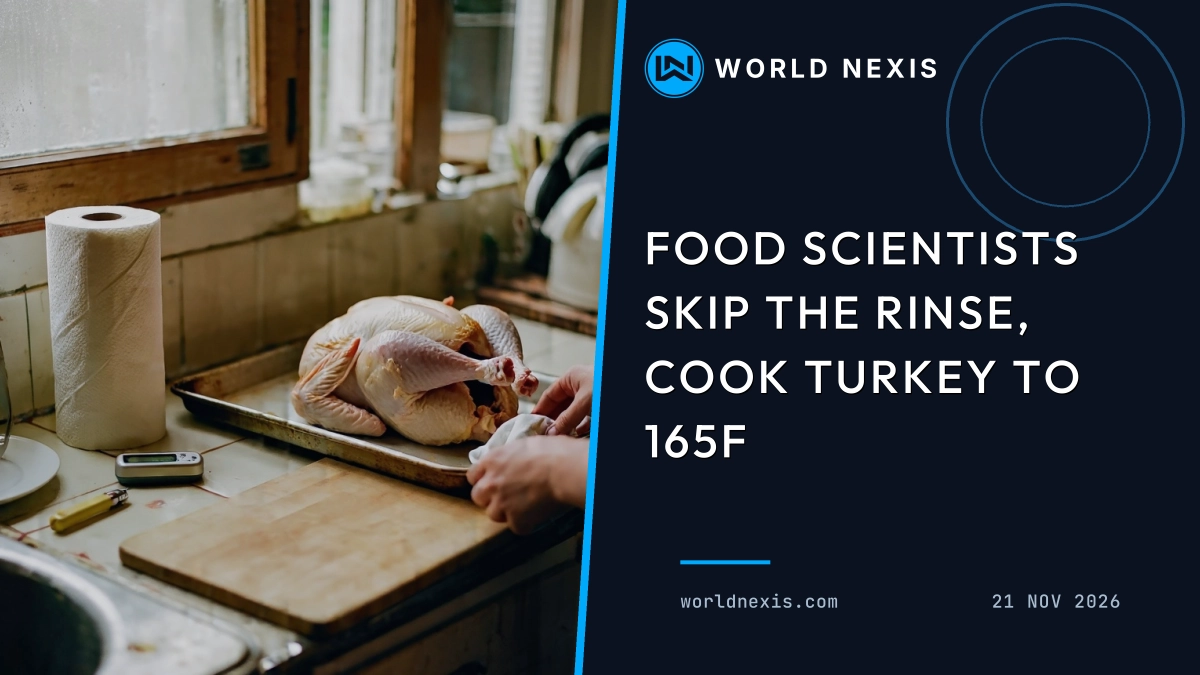
Getting a safe Thanksgiving dinner on the table comes down to a handful of rules that food scientists say home cooks keep breaking, starting with the most stubborn one: stop rinsing the bird. Raw turkey can harbor salmonella, campylobacter and other germs, and washing it in the sink spreads those bugs across counters, taps and nearby food instead of removing them.
Outbreaks of some kinds of food poisoning tend to rise in November and December, according to the US Centers for Disease Control and Prevention. Investigators have linked past illnesses, and even deaths, to tainted turkey, undercooked stuffing and germ-laced gravy left out at holiday buffets.
Key points
- Do not wash raw turkey. Pat it dry with paper towels and throw them away, or use a kitchen towel and disinfect it in the laundry.
- Thaw a frozen bird for about 24 hours for every 4 to 5 pounds of weight in the refrigerator, or use a microwave or cold running water and cook it immediately.
- Turkey must reach 165F (73.8C). Check the innermost thigh with a tip-sensitive digital thermometer, not a pop-up button.
- Keep hot food hot and cold food cold, and get leftovers into the refrigerator within two hours.
Why a safe Thanksgiving starts with a dry bird
Donald Schaffner, a food science expert at Rutgers University, and Benjamin Chapman, a food scientist at North Carolina State University, work through these hazards on their food-safety podcast, “Risky or Not?” Both put the kitchen sink at the top of the trouble list.
“Anything that hits that surface and generates spray is going to basically spread contamination around your kitchen,” Chapman said.
Most cooks rinse out of habit rather than reasoning. The droplets carry bacteria onto worktops, dish racks and anything else within reach, which is why a paper towel and a bin do the job far better.
Surfaces and tools still need cleaning and sanitizing afterwards, and raw poultry should be kept away from anything that will be eaten uncooked. Undercooked stuffing has featured in past outbreaks too, CDC investigators have found.
The 165F target and the thermometer habit
For anyone asking how to thaw a turkey, the refrigerator is the slowest but steadiest route, because the bird stays out of the range where bacteria multiply. According to the US Department of Agriculture, a frozen turkey needs roughly 24 hours for every 4 to 5 pounds of weight. Birds thawed in a microwave or in cold running water must be cooked straight away.
Roasting then has to bring the meat to 165F (73.8C) throughout. The reliable test is a tip-sensitive digital thermometer pushed into the innermost part of the thigh without touching bone.
Chapman’s research has shown that the plastic pop-up buttons fitted to some commercial turkeys can activate well before the meat is done. Other familiar signals are no better: golden-brown skin, meat that is no longer pink and juices that run clear. “None of those are great indicators of temperature,” he said.
Side dishes and the danger zone
Mashed potatoes, gravy, green beans and yams deserve as much attention as the centerpiece of a safe Thanksgiving menu. Bacteria multiply fastest between 40F and 140F (4C and 60C), the so-called danger zone, so hot dishes should stay piping hot and cold dishes should stay cold.
Scale is the real problem for occasional cooks. “Cooking takes longer with big masses of food. Cooling takes longer with big masses of food,” Schaffner said. Leftovers should go into the refrigerator within two hours.
Why it matters
A safe Thanksgiving hinges on small habits rather than elaborate planning. Most people cooking this week are not professionals, and one lapse, such as a bird left on the counter or gravy sitting out through dessert, can put an entire table at risk. Food poisoning is miserable for a healthy adult and far more serious for anyone already vulnerable.
Turkey food safety costs little: a digital thermometer, a roll of paper towels and a bit of refrigerator space. Those three things remove the most common ways a holiday meal goes wrong.
Analysis
Having covered public health for World Nexis News, I look first at whether advice like this actually changes what happens in kitchens, and the honest answer is that it often does not. The rinse-under-the-tap habit survives because it feels like cleanliness, and because nobody can see the bacteria they have just sprayed across the worktop. On the evidence, the food scientists have the stronger case by a wide margin. There is no version of this in which washing raw poultry makes it safer, and a clear mechanism by which it makes the kitchen dirtier.
What I think most coverage misses is where the risk actually sits. It is concentrated among people cooking unfamiliar, oversized meals under time pressure, not among careless cooks. The experts are not demanding perfection either; a thermometer and two hours of refrigeration discipline remove most of the danger.
The strongest counter-argument is that food safety guidance keeps multiplying, and busy households tune out long lists of rules. There is something in that. Even so, the case for a safe Thanksgiving rests on the simplest instruction available: leave the turkey alone until it goes in the oven.
What happens next
With Thanksgiving days away, the practical steps behind a safe Thanksgiving are thawing, shopping and clearing refrigerator space. The CDC will keep tracking foodborne illness through the holiday season, and the USDA’s thawing and cooking calculators remain the reference point for weights and times.
Cooks can weigh a bird now against the 24-hours-per-4-to-5-pounds rule and move shelves to make room. Anyone planning a safe Thanksgiving should trust the thermometer over the clock.
What we don’t know yet
No one can say in advance how many households will fall ill this season; the winter rise is a pattern, not a forecast. There is also no single checklist that covers every family recipe, which is why the temperature target matters more than any one method.
Related coverage
- Las Vegas Grand Prix: Russell accuses Verstappen of breaking unwritten rule
- Anthropic IPO puts $81bn AI risk in pensions and 401(k)s
- Thanksgiving travel fears spike after nationwide ground stop
Further reading
- Stop washing your turkey. If you want a safe Thanksgiving, here
- Stop washing your turkey. If you want a safe Thanksgiving, here’s what to do instead
About the author: Sofia Alvarez is the Health & Medicine Reporter at World Nexis News (WNN), covering health & medicine. The analysis section reflects the writer’s view.

Sofia Alvarez
Sofia Alvarez is Health & Medicine Reporter at World Nexis News, covering public health, clinical research, mental health and the policy decisions that shape care. Based in Manchester, she prioritises evidence over anecdote, checks claims against peer-reviewed research and official guidance, and explains uncertainty plainly…