Anthropic IPO puts $81bn AI risk in pensions and 401(k)s
The record Anthropic IPO puts pensions, 401(k) plans and index funds in the path of AI boom-and-bust risk, with an $81bn valuation at stake for savers.
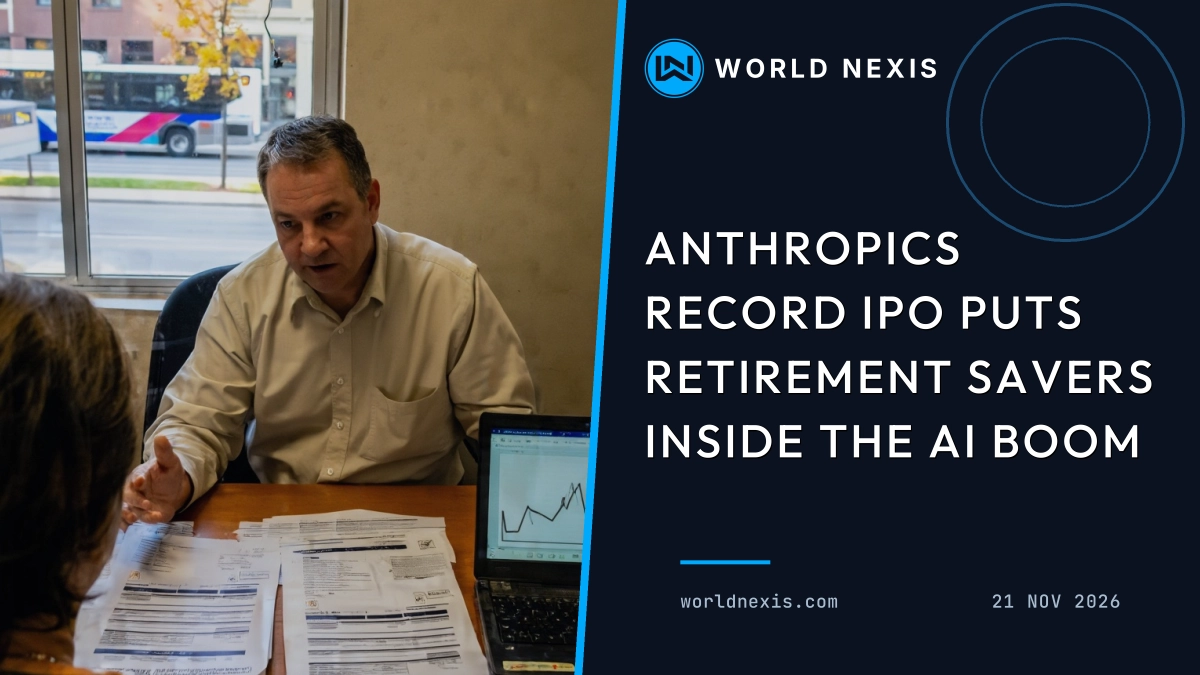
The Anthropic IPO has pulled ordinary Americans’ retirement savings closer to the boom-and-bust cycle of artificial intelligence. Public pensions, 401(k) plans and index funds already hold stakes in the newly listed company, so teachers, firefighters and private-sector workers will share in whatever the AI industry earns or loses next.
Allen Mendenhall, an economic policy analyst and senior adviser at the Heritage Foundation, said the offering was valued at 81 billion dollars and described it as the highest IPO ever. In his reading, the central concern for investors is that AI spending may be running ahead of real-world returns.
Key points
- The Anthropic IPO placed AI exposure inside public pensions, 401(k) plans and index funds that already held the stock.
- Mendenhall said the listing was valued at 81 billion dollars, the highest IPO ever.
- He said technology firms are spending heavily on data centers, servers, electricity and power generation while profits lag.
- Shares rose sharply and then fell back to roughly the offer price within a day of trading.
Where the record Anthropic IPO lands in retirement accounts
The Anthropic IPO’s reach into retirement money is indirect, but it is broad. Index funds buy a small slice of every listed company, which Mendenhall described as buying “a little bit of every company in the market”. A saver who never picked an AI stock can therefore still own part of one through a default fund option.
Public pension funds hold similar positions on behalf of teachers and firefighters, while 401(k) plans hold them for private-sector employees. The money raised in the offering will help fund data centers and jobs in construction and manufacturing, tying the shares to the physical build-out of AI rather than to software alone.
Early trading showed how quickly sentiment can move. Mendenhall said the stock ran “way up” and traded “really high” a day after launch, then fell back sharply and settled at about the same level as the offer price. For a retirement saver, that round trip is a reminder that the value of the stake can change long before any of the promised data centers are built.
The Anthropic IPO’s 81 billion dollar test of AI profits
For Mendenhall, the Anthropic IPO matters less than the spending behind it. He said technology companies are “pouring a ton of money into AI”, buying “data centers and servers and electricity” and paying for “power generation”, while “the profits haven’t caught up with the spending”.
“The issue with AI, the big problem with AI right now is that investment may be running ahead of actual returns,” he said.
He framed the current wave of spending as a bet by companies and their investors that today’s costs will be repaid by profits later. “They’re spending a lot of money now on the assumption that later they’re going to earn profits,” he said. “But right now, we haven’t seen that these AI companies are producing revenue to justify all the money spent on it.”
On Anthropic itself, he said the company “loses tens of billions of dollars”. The Anthropic IPO nonetheless set a new mark for valuation and fundraising, he added, which gives the sector a public price against which every other AI bet will now be measured.
Fewer listed names make AI harder to diversify
Mendenhall stopped short of calling the retirement exposure a hidden danger. “I think it’s probably mostly normal investing. It’s not really a hidden danger,” he said, because index investors spread their money across the whole market by design.
His caveat is concentration. “I guess that the difference is there are just fewer AI companies,” he said, which makes it “harder to diversify within those AI” names. A small number of listed firms carry most of the sector’s weight, so a fund that looks spread across hundreds of holdings can still lean heavily on one theme.
Guardrails and the wider AI retirement risk
The debate over AI rules runs alongside the investment story. Mendenhall said he is wary of regulation that reaches beyond investor protection into broader safety efforts, and he questioned how such rules would be written.
He does expect some form of oversight eventually. “Eventually, I think we’re going to have to see some type of AI guardrails put in place,” he said. “I can’t exactly tell you what those are going to be.”
Why it matters
For anyone with a 401(k) or a public pension, the point is not that AI has suddenly become dangerous. It is that the sector’s fortunes now sit inside portfolios most savers never chose, and that they cannot easily step away without abandoning broad market funds altogether. The Anthropic IPO therefore changes what a default fund option means for millions of workers.
The AI retirement risk also spreads beyond individual accounts. When pension funds and default 401(k) options hold the same handful of technology names, one bad stretch in the AI spending boom shows up in the same place for millions of people at once.
Analysis
Having covered market structure for World Nexis News, I look first at what these funds actually hold rather than at the Anthropic IPO’s headline valuation. On the evidence here, Mendenhall’s more modest conclusion is the better one: owning a loss-making AI company through an index fund is normal investing, not a concealed trap. Most savers hold dozens of companies that lose money, and the fund structure spreads the damage if any single one of them fails.
Where I part company with the reassuring framing is concentration. The counter-argument is that a genuinely diversified fund cannot be badly hurt by one listing, and that is fair as far as it goes. But AI is not one listing; it is a theme running through chipmakers, cloud providers, power suppliers and the data center builders financed by this money, and those bets tend to sour together. That correlation, not the 81 billion dollar figure, is what I think savers should watch.
My view is that the boom-and-bust risk is real but slow-moving, and that the people most exposed are the least likely to notice it. A teacher in a public pension plan has no vote on whether Anthropic sits in the portfolio, and no practical way to find out how much of it does.
What happens next
Mendenhall expects some form of AI guardrails to arrive eventually, without committing to a design, and lawmakers continue to debate tighter rules for the industry. After the Anthropic IPO, the shares will also be watched in the coming sessions to see whether they hold above the offer price following their first swing.
What we don’t know yet
It is not yet clear how large a stake any particular pension fund or index product holds in the company, or how the proceeds will be split between data centers and the construction and manufacturing jobs the offering is meant to support. The shape of future AI regulation also remains open.
Related coverage
- Anthropic IPO raises record $81bn in biggest listing ever
- Anthropic IPO closes up 17% as protests target record debut
- Pensions dashboard to launch summer 2027 for 75m records
Further reading
- Anthropic’s record IPO puts pensions and 401(k) plans closer to AI boom-and-bust risk
- Anthropic’s record IPO puts pensions and 401(k) plans closer to AI boom-and-bust risk
About the author: Daniel Whitmore is the Business & Markets Editor at World Nexis News (WNN), covering business & markets. The analysis section reflects the writer’s view.

Daniel Whitmore
Daniel Whitmore is Business & Markets Editor at World Nexis News, based in New York. He leads coverage of companies, economies, markets and the forces that move them, from central bank decisions to corporate earnings and the cost-of-living pressures facing households on both sides of…



