Anthropic IPO closes up 17% as protests target record debut
Anthropic IPO closes up 17% at $97.17 after a record $81bn listing, as protests hit New York and San Francisco and Wall Street slides further.
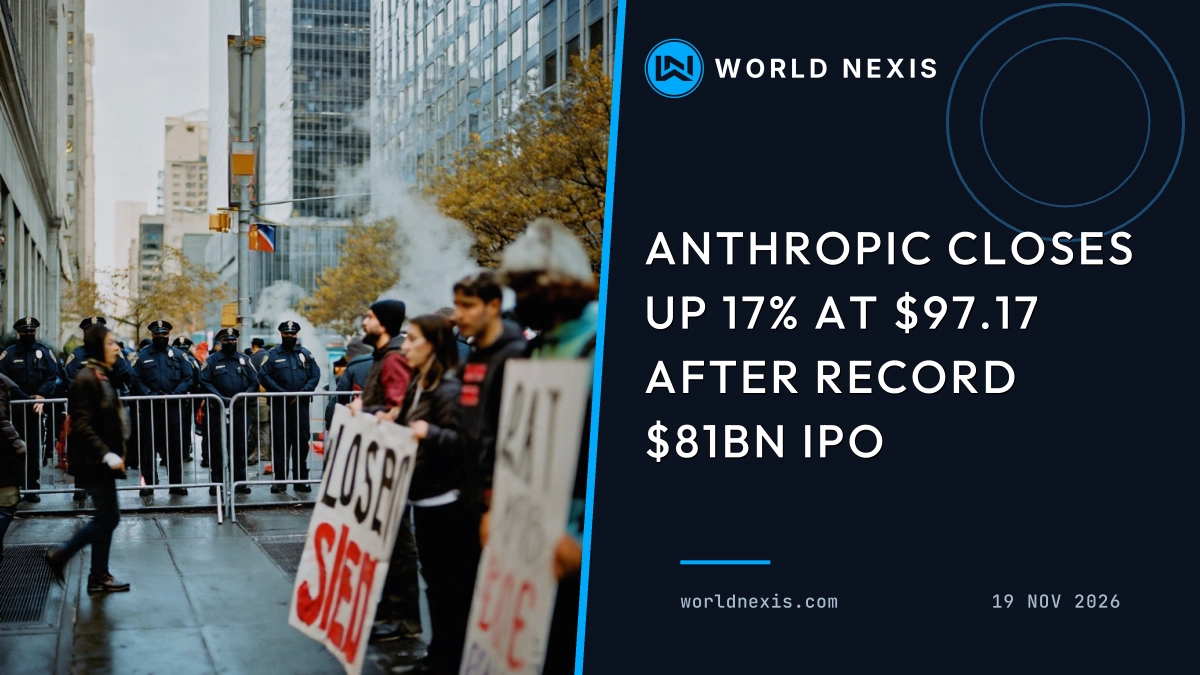
The Anthropic IPO closed 17% higher on its first day of trading, with shares ending at $97.17 after a record $81.3 billion raise. The stock briefly pushed the company’s valuation above $2 trillion. Demonstrators also gathered outside the Nasdaq exchange in Times Square and at Anthropic’s San Francisco headquarters on Thursday, and several people were arrested in New York.
Key points
- Anthropic shares opened at $111.50, touched $114.99, then closed at $97.17, 17% above the $83 offer price.
- The company raised $81.3 billion, the largest initial public offering in history.
- All three major US stock indexes closed sharply lower, with the Nasdaq down more than 2%.
- Protesters in two cities demanded stricter AI rules and an end to self-improving systems.
Anthropic IPO closes 17% higher after record $81.3bn raise
The Anthropic IPO priced 980 million Class A shares at $83 each, above the $70 to $78 range the company had marketed to investors. Anthropic is the first purely AI company to be publicly listed, and its debut is being read as a test of investor appetite for the whole sector.
Anthropic shares opened at $111.50, up 34% on the offer price, and reached $114.99 before giving back much of that gain. The stock settled at $97.17 by the close. The intraday peak briefly valued the company above $2 trillion, while estimates of its value at the closing price vary with how its share classes are counted.
Anthropic was founded in 2021 and develops the Claude family of generative AI models. The company has said it will raise a further $26 billion from AMD, Broadcom, Google, Microsoft and Nvidia, taking total fundraising to about $107 billion.
A wild first session was expected
Jay Ritter, an IPO expert at the University of Florida’s Warrington College of Business, said the swing from offer price to close came as no shock. “Both the jump from the offer price and the high volatility are not surprising, given the enormous potential of the company and the wildly different opinions about how profitable the company will become,” he said.
Dan Ives, a technology analyst and partner at Yorkville Ives & Co., called the listing an “A-plus success” and said it was a vote of confidence for the market relative to the tech trade.
Protests follow the Anthropic IPO in two cities
The Anthropic IPO drew about 30 protesters to the Nasdaq building in Times Square, where demonstrators carried flags reading “STOP TECH OLIGARCHS” and “FREEZE AI: END ICE, END WAR”. Several were arrested at the scene. About three dozen people from two groups gathered before 11am outside Anthropic’s headquarters in San Francisco.
“I think people are starting to get that there’s something wrong,” said Jose Gonzalez, 46, a policy researcher at New York Communities for Change, which helped organize the New York rally. State senator Aber Kawas told the crowd: “Investing in AI also comes at the direct cost of investing in people.”
Environmental safety, national security and the use of AI by police and immigration enforcement were among the crowd’s main concerns. In San Francisco, Sydney Von Arx of the group Ban RSI called for a worldwide ban on recursive self-improvement, in which AI systems train themselves to become more capable. “We should not have AI building AIs,” she said.
Why it matters
You do not need to buy a single share to be exposed to this trade. Retirement accounts across the US are weighted toward a stock market whose largest companies are increasingly priced on AI expectations, so a sharp repricing would reach savers who never opened a brokerage account.
The Anthropic IPO also showed how narrow the rally has become, rising while the broader market sold off. A study by Truist of 32 of the largest IPOs found that more than half fell at least 50% at some point in their first year of trading.
Analysis
Having covered market structure and corporate strategy for World Nexis News, I look past the opening bell to the plumbing underneath a listing like this. A 34% opening pop that fades to a 17% close, on a day when the Nasdaq fell more than 2%, is the signature of a stock priced for a story rather than for earnings. On capital, though, I think the bulls clearly win: $81.3 billion raised, with another $26 billion committed by some of the largest chip and cloud companies in the world.
What the Anthropic IPO tells me, though, is that the price is doing less work than it appears to. Only about 7.4% of shares are available for public trading, according to Renaissance Capital, so the closing print reflects scarcity as much as conviction about the Claude chatbot. The counter-argument is fair, because early investors took the risk and retail buyers are not owed a discount.
My bigger worry is concentration. One debut that can swing a $2 trillion valuation while the rest of the market falls suggests the index funds inside ordinary 401(k) plans are now a bet on a handful of AI names. That is a savings problem dressed as a technology story, and it deserves more scrutiny than the bell-ringing footage received.
What happens next
Anthropic shares will resume trading when markets reopen, and the first test is whether they hold above the $83 offer price once the initial excitement fades. The company must also complete the additional $26 billion raise from AMD, Broadcom, Google, Microsoft and Nvidia, and keep shipping new Claude models into a crowded field.
Protest groups in both cities said they want national rules on AI development before the technology spreads further, and a global halt to systems that improve themselves.
What we don’t know yet
- Whether the shares hold above the $83 offer price in the coming weeks.
- How many people were arrested in New York, and whether charges follow.
- Whether regulators act on calls to restrict recursive self-improvement.
Related coverage
- Anthropic IPO raises record $81bn in biggest listing ever
- Van Gogh auction: record $190.4m sale ends Nazi-era row
- UK inflation rate hits 3.6% on record diesel prices
Further reading
- How did Anthropic’s stock market debut unfold?
- Protesters rally against Anthropic in New York and San Francisco after $2tn stock market debut
About the author: Daniel Whitmore is the Business & Markets Editor at World Nexis News (WNN), covering business & markets. The analysis section reflects the writer’s view.

Daniel Whitmore
Daniel Whitmore is Business & Markets Editor at World Nexis News, based in New York. He leads coverage of companies, economies, markets and the forces that move them, from central bank decisions to corporate earnings and the cost-of-living pressures facing households on both sides of…



