Las Vegas Grand Prix: Verstappen wins as Ferrari clash dominates fallout
Las Vegas Grand Prix: Max Verstappen takes pole after Kimi Antonelli's five-place penalty, with two FIA inquiries still hanging over the grid.
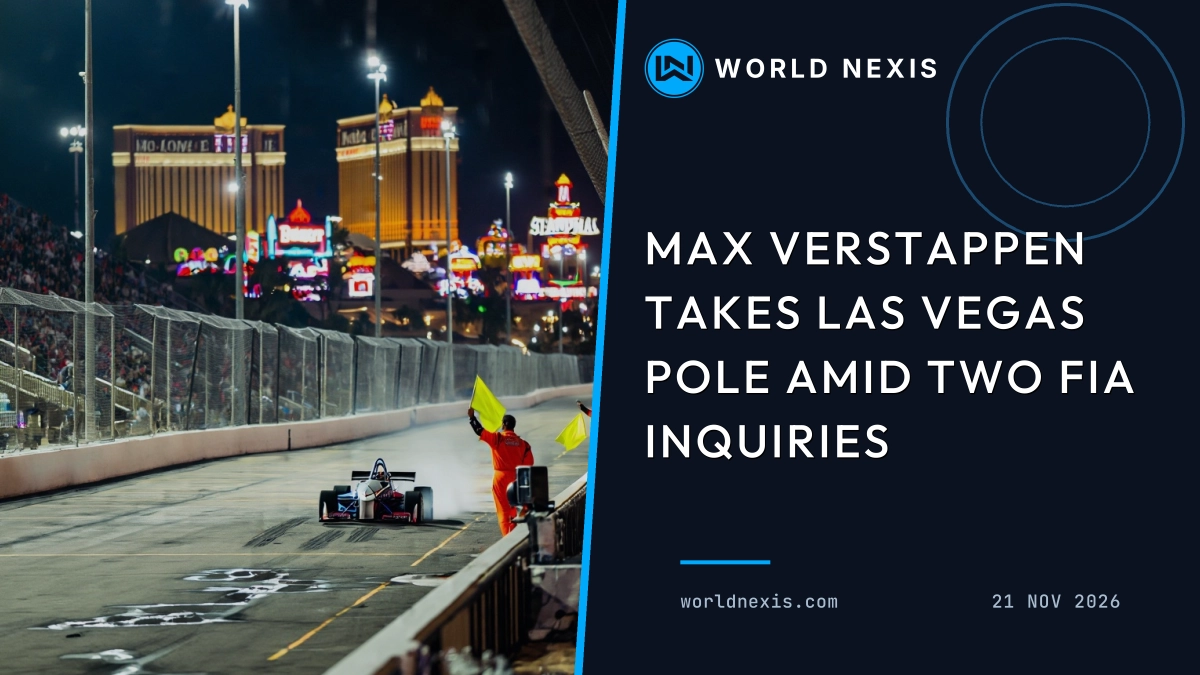
Updated 22 Nov 2026, 15:21 (UK time): Ferrari’s Lewis Hamilton and Charles Leclerc collided again at the Las Vegas Grand Prix, prompting team boss Fred Vasseur to call the clash unacceptable and the relationship unmanageable, while McLaren’s Lando Norris and Oscar Piastri finished second and third.
The Las Vegas Grand Prix produced a fresh flashpoint beyond Max Verstappen’s win: Ferrari’s Lewis Hamilton and Charles Leclerc collided on track, and team boss Fred Vasseur called the clash ‘unacceptable’. Vasseur said the relationship between the drivers has become ‘unmanageable’ and that Leclerc did not follow instructions while behind Hamilton, which he described as a professional mistake.
Leclerc admitted his error and said the situation needs fixing, while Hamilton said he has done all he can and wants the team to sort it out. McLaren’s Lando Norris and Oscar Piastri finished second and third, completing the podium behind Verstappen.
What it changes is the centre of the fallout. Verstappen’s win and his jibe at George Russell still frame the result, but Ferrari’s internal dispute is now the more serious team story, with public criticism from the boss raising the pressure on both drivers.
I think Vasseur’s public rebuke is a pressure move as much as a principle, and it risks deepening the rift rather than fixing it.
Updated 22 Nov 2026, 11:41 (UK time): Max Verstappen won the Las Vegas Grand Prix and mocked George Russell’s late crash, turning their practice-row into an on-track verdict.
Max Verstappen won the Las Vegas Grand Prix, his second consecutive victory in the event, after a race that produced a remarkable number of lead changes. The result gives the pre-race argument a clear on-track answer.
George Russell’s late mistake cost him a podium, and Verstappen did not soften his verdict afterwards. He said Russell is “so far below my level” and described the sight of Russell’s trouble as “karma,” remarks that turn a stewards’ warning into a personal scoreboard.
What it changes is the story’s centre: the Las Vegas Grand Prix is no longer about an unwritten rule in practice but about a race Verstappen controlled when it mattered. I think the win settles the argument on track, but gloating over a rival’s crash is a needless edge; the racing was spectacular enough without it.
Updated 21 Nov 2026, 10:46 (UK time): George Russell publicly accused Max Verstappen of repeatedly ignoring an unwritten rule when rivals begin flying laps, confirming the stewards’ warning closed the matter with no grid penalty and Verstappen keeping pole.
George Russell has publicly challenged Max Verstappen’s conduct at the Las Vegas Grand Prix, saying the pole-sitter repeatedly ignores an unwritten rule when rivals are starting flying laps. The stewards’ warning over the Turn 14 contact in final practice closed the matter with no grid penalty, so Verstappen’s place at the front of the grid is unchanged, and Russell said he accepted the warning itself.
Russell said there is nothing in the regulations stopping a driver from overtaking a car that has begun a lap, but that doing so “screws this person over” and that Verstappen does it week in, week out with many drivers. He added that he was not prepared to accept it and that somebody has to stand up to the Dutchman.
What it changes is where the attention sits. The practice clash is now settled without reshaping the grid, but the Las Vegas Grand Prix has become a personal argument between two drivers who are also fighting over second in the championship, with Verstappen 17 points clear and three rounds remaining.
The warning looks proportionate for a session nobody was hurt in and no car was stopped, and Mercedes still comes away with second and sixth from a qualifying it largely controlled. Racing a rival that hard on an out-lap is a legitimate grievance, but airing it minutes after the session turns a stewards’ matter into theatre — entertaining, yet a distraction from a front row that engine rules already scrambled.
Las Vegas Grand Prix qualifying produced the most scrambled front row of the season, with Kimi Antonelli setting the fastest time and Max Verstappen taking pole without topping the session.
Antonelli’s Mercedes finished 0.258 seconds clear of the field. A five-place grid penalty for using more than the permitted number of engine components then dropped him to sixth and handed the top spot to Verstappen.
The Las Vegas Grand Prix result caps a messy weekend for Verstappen, who also faces two separate inquiries into incidents during final practice.
Key points
- Antonelli was fastest in qualifying but starts sixth after a five-place engine penalty.
- Verstappen inherits pole position, with George Russell second and Lando Norris third.
- Both Ferraris went out in the second session, leaving Charles Leclerc 11th and Lewis Hamilton 12th.
- The FIA issued a warning after Verstappen’s Turn 14 clash with Russell in final practice.
How the Las Vegas Grand Prix grid fell into place
The Strip Circuit rewards a slipstream more than almost any other track, so qualifying became a contest of who dared to run last. Antonelli and Russell became tangled with the Alpines and Racing Bulls as the pack jostled for track position.
Antonelli ended up at the back of the queue and crossed the line a second before the checkered flag. Even so, he vaulted to the front. “That was all the tow,” he said over the radio.
“Starting the lap, I was only one second behind the car in front and I thought I was screwed,” he said. “But the tow is so powerful here.”
Verstappen said he had been managing “some weird issues” that also troubled him in Brazil, and that the session finally clicked. “It was solid in the corners, and you have a bit of dirty air, but it is insane how much you gain on the straights.”
Russell called his own day “very solid” and admitted he had wanted pole. “Kimi did a great job and he probably thought it wasn’t going to work out so well being so close but with the tow it worked out,” he said.
The full Las Vegas Grand Prix starting lineup now reads: Verstappen, Russell, Norris, then Isack Hadjar and rookie Arvid Lindblad, promoted after running sixth fastest. Antonelli starts sixth, with Liam Lawson seventh, Pierre Gasly eighth and Franco Colapinto ninth. Oscar Piastri’s 10-place penalty lifts both Ferraris one place each.
Verstappen’s Las Vegas Grand Prix weekend under scrutiny
Final practice had already given the stewards plenty to examine. Russell set the pace in that session, but attention shifted to a clash between Verstappen and Russell at Turn 14.
The stewards opened an investigation, and the FIA issued a warning over the incident. A second inquiry covers a separate matter involving Colapinto, so the governing body must weigh two cases before the grid forms.
Neither inquiry has produced a sanction so far. Verstappen therefore keeps the Verstappen pole position unless the stewards decide otherwise, while Mercedes must settle for second and sixth from a session it largely controlled.
Why it matters
For the city, the Las Vegas Grand Prix is no longer an experiment. The race is in its fourth year and holds a contract running to 2037, after roughly £500m went into the circuit and its buildings.
Official figures put the economic impact across three years at $3.2bn (£2.4bn) for Southern Nevada, with tax income of $45m and $43m in the past two years. Research in 2024 found the average visitor spent $2,400 before tickets.
That matters more than usual this weekend, because the drivers’ title is already settled. Early local hostility has faded as businesses, county officials and the visitors’ authority saw the returns.
Emily Prazer, F1’s chief commercial officer and president of the Las Vegas Grand Prix, accepts the early missteps. “We have to admit where we perhaps were a little bit bull in a china shop about it,” she said.
Russell goes further, calling the race the sport’s biggest after Monaco. “I guess it’s the biggest one, bar Monaco, from an entertainment perspective for the people who come here and for F1,” he said. “This just feels like the Super Bowl.”
Analysis
Having covered Formula 1 for World Nexis News, I look first at how the stewards handle these two inquiries, because consistency is the only currency they have. A warning for a practice clash at Turn 14 is defensible: nobody was hurt, the session was not stopped and both cars carried on. The harder question is whether the second inquiry is judged on the same scale.
I think the facts support leniency rather than severity here. Practice incidents rarely justify grid drops, and a penalty would distort a Las Vegas Grand Prix that already had its order rewritten by engine rules. The counter-argument is fair, though: when the biggest name in the sport escapes with a warning while a rookie loses six places for an engine change, fans will read it as one rule for one and one for another.
On the race itself, I side with Russell’s reading rather than the purists’. The circuit is a slipstream lottery, but it has produced packed crowds, a settled relationship with local officials and a contract to 2037, and no other round pulls this much spending per visitor. A race can be commercially serious and still be good theatre.
What happens next
The stewards have yet to publish findings on either inquiry, and any grid drop would reshape a front row already rewritten by engine penalties. Verstappen starts on pole with Russell alongside him, Norris third and Hadjar fourth.
Longer term, the Las Vegas Grand Prix stays on the calendar until 2037, and organisers will keep working with Clark County on traffic and disruption. The commercial test is whether this year’s crowds come back next year.
What we don’t know yet
Whether either inquiry brings a penalty, and precisely what the FIA warning covers, has not been disclosed. Antonelli’s raw pace also leaves open how much of his advantage came from the tow rather than from the car.
Related coverage
- Loch Leven glider crash kills two men on training flight
- Patrick Stewart cause of death reveals two brain diseases
- National cyber director fired amid week of major US outages
Further reading
- Las Vegas Grand Prix: Kimi Antonelli fastest but penalty means Max Verstappen will start on pole
- The Super Bowl of F1: how Las Vegas GP has hit the jackpot after turbulent start
About the author: James Okoro is the Sports Correspondent at World Nexis News (WNN), covering sports. The analysis section reflects the writer’s view.

James Okoro
James Okoro is Sports Correspondent at World Nexis News, covering football, cricket, rugby, tennis, Formula 1, golf, boxing and the major American leagues from London. He reports results and the wider story around them — money, governance, athlete welfare and the data behind performance —…