Loch Leven glider crash kills two men on training flight
Two men have died after a Loch Leven glider crash in Perth and Kinross, police say, as investigators examine why the training flight went down.
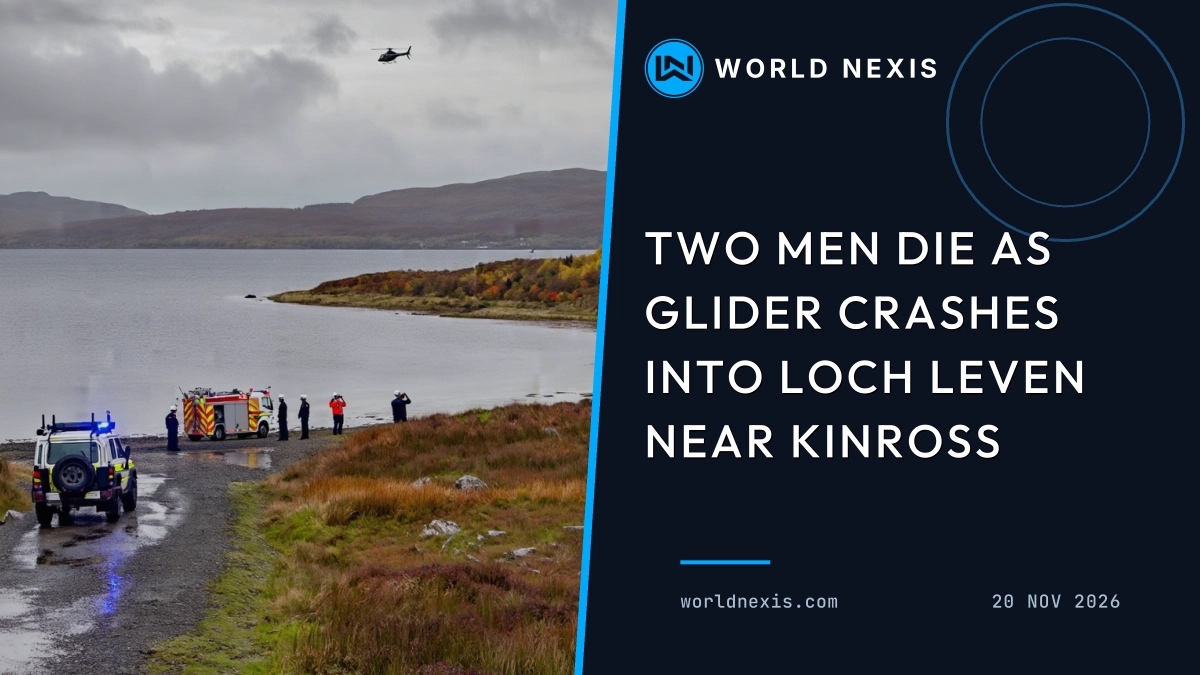
The Loch Leven glider crash killed two men on Friday morning after their aircraft came down in the loch in Perth and Kinross, Police Scotland has said. Emergency crews were called to the water just after 11am and both bodies were later recovered. The force said next of kin have been informed and the deaths are not being treated as suspicious.
Both men had taken off from the Scottish Gliding Centre at Portmoak Airfield, near the loch’s eastern shore, in a two-seater Perkoz sailplane. The club said the aircraft “crashed whilst on a local training flight” and that there was no indication yet as to the cause. The Air Accidents Investigation Branch has opened an inquiry and sent inspectors to the scene.
Key points
- Two men died in the Loch Leven glider crash after a two-seater aircraft went into the water on Friday 20 November.
- Police Scotland recovered both bodies and said the deaths are not suspicious; next of kin have been told.
- The Perkoz had launched from Portmoak Airfield on a local training flight with the Scottish Gliding Centre.
- The Air Accidents Investigation Branch has deployed inspectors with expertise in aircraft operations, engineering and recorded data.
How the Loch Leven glider crash unfolded
A Police Scotland spokesperson said: “Around 11.05am on Friday November 20, we received a report of a microlight glider having crashed into water in Kinross.” Timings logged by other agencies differ by minutes: the Scottish Fire and Rescue Service was alerted at 11.01am.
A Coastguard spokesperson said two HM Coastguard helicopters joined the response, which was reported to the service at about 11.20am. An air ambulance, one fire appliance and specialist resources were also sent to the area.
“Operations control mobilised one fire appliance and specialist resources to the area to assist emergency service partners,” a Scottish Fire and Rescue Service spokesperson said. The service added that its response had come to an end by Friday afternoon.
The response was weighted towards the water. Loch Leven is a large body of open water in Perth and Kinross, which shapes how any crash into it must be handled, with aircraft overhead and crews working from the shoreline.
The aircraft, the club and the flight
The Scottish Gliding Centre is based at Portmoak Airfield, which sits near the eastern shore of the loch. The centre confirmed that the aircraft involved was a two-seater Perkoz and that the flight was a local training sortie.
“The incident is currently under investigation by the Air Accidents Investigation Branch of the Department for Transport and the police in conjunction with the British Gliding Association,” a spokesperson for the centre said. “At the present time, there is no indication as to the cause of the accident.”
The centre said it is co-operating fully with the investigating organisations. It also confirmed that the British Gliding Association is involved in the inquiry alongside the AAIB and police.
Investigation into the Loch Leven glider crash
The Air Accidents Investigation Branch confirmed it had launched an investigation into the Loch Leven glider crash and sent a team of inspectors to the accident site. Its team draws on several specialisms.
“A multi-disciplinary team including inspectors with expertise in aircraft operations, engineering and recorded data have been deployed to gather evidence and make inquiries,” an AAIB spokesperson said.
The branch has not said what recorded data it expects to examine, or how long its work will take. Its findings will be awaited by the club, by the two families and by the wider gliding community.
Why it matters
The Loch Leven glider crash matters first to two families who lost someone on an ordinary Friday morning flight. It matters too to a club and a sport built on training sorties, because every fatal accident raises the question of how quickly help can reach an aircraft that comes down over open water.
For readers who fly, or whose families fly from small airfields, the practical consequence is a waiting period. Until investigators set out what happened, nobody can say whether this crash points to a wider risk or to a single, unrepeatable set of circumstances.
Analysis
Having covered emergency response for World Nexis News, I look first at the timeline rather than the tributes. Three agencies logged three different times, at 11.01am, 11.05am and 11.20am, and that spread shows how an accident over water reaches the emergency services: a club raises the alarm, a control room logs it, and crews are tasked.
In my view the most telling line on Friday came from the AAIB, whose team includes inspectors with expertise in recorded data. That points to an investigation built on evidence rather than recollection, and it supports those arguing that the public should expect a considered preliminary picture rather than instant answers. The counter-argument is fair: a club that flies training sorties from a well-known site owes its own community a fuller account sooner, and quiet looks like evasion. Even so, speculation now would serve nobody, least of all the two families waiting for answers about the Loch Leven glider crash.
What I will be watching is whether the branch flags any operational or training issue before it publishes a final report. If it does not, the lesson is likely to be about water recovery and the limits of what can be done once an aircraft goes in, not about a hazard facing every club in the country.
What happens next
Police inquiries into the Loch Leven glider crash continue, with the force saying it is working to establish the full circumstances. AAIB inspectors remain at the site gathering evidence, and the Scottish Gliding Centre has said it is co-operating with the branch and with police.
The fire service has already stood down from the loch, while the police investigation and the air accident inquiry run in parallel.
What we don’t know yet
Police have not named the two men, and no ages or home details have been released. The cause of the crash remains unknown, and the AAIB has not set out a timetable for its findings or said whether an interim statement will be published.
Related coverage
- RAF Fairford plot: two men face major security charges
- Joanne Young case: four men guilty in landmark abuse trial
- Patrick Stewart cause of death reveals two brain diseases
Further reading
- Two men dead after glider crashes into Loch Leven
- Two men killed after glider crashes into Loch Leven in Scotland
About the author: Tariq Al-Mansoori is the Breaking News Reporter at World Nexis News (WNN), covering breaking news. The analysis section reflects the writer’s view.

Tariq Al-Mansoori
Tariq Al-Mansoori is a Breaking News Reporter at World Nexis News, covering major incidents, official statements and developing stories across the UK, US and internationally. Based in London, he works to confirm details before publication, attributes information to named sources where possible and updates stories…



