RAF Fairford plot: two men face major security charges
Two London men face an Old Bailey hearing over the RAF Fairford plot, charged under the National Security Act with prosecutors citing £70,000 in payments.
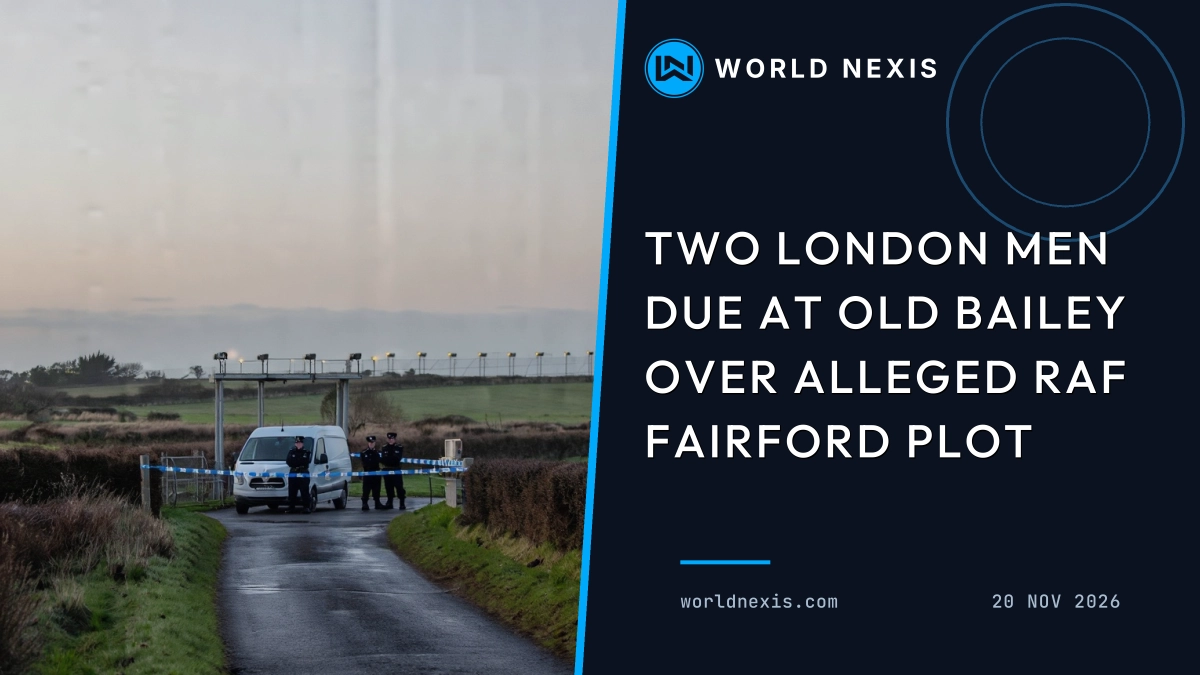
Two London men charged in connection with the RAF Fairford plot are due to appear at the Old Bailey on Friday, in a case that has placed a United States Air Force base in Gloucestershire at the centre of Britain’s national security courts. Mohmed Abdulkarim, 24, and Nouman Essghir, 25, will appear before Mrs Justice Cheema-Grubb charged under the National Security Act 2023. The allegations follow the arrival of vans loaded with petrol at the base on 27 September.
Key points
- Mohmed Abdulkarim, 24, and Nouman Essghir, 25, both of London, are due at the Old Bailey on Friday.
- Both face national security charges, including assisting a foreign intelligence service and entering a prohibited place.
- Prosecutors allege Abdulkarim acted as an intermediary for a handler called Ali and received payments totalling around £70,000.
- Officers found three white vans containing petrol but no explosives after a call in the early hours of 27 September.
What we know about the RAF Fairford plot
Details of the RAF Fairford plot have emerged across several hearings since September. On 27 September, a group of five men was allegedly ordered to drive vans loaded with petrol to RAF Fairford in Gloucestershire. A previous hearing was told that one of the men called police in the early hours after the organiser warned that a bomb was in the vans.
Officers attended and located three white vans. No explosives and no improvised explosive devices were found inside them.
The alleged operation is said to have been directed by a handler named Ali. Prosecutors allege that Abdulkarim, of London, assisted a foreign intelligence service by acting as an “intermediary” for Ali. He is accused of buying equipment for the mission and of receiving multiple payments from Ali totalling around £70,000.
The timeline spans two months: an alleged reconnaissance in August, an alleged convoy in September, and a re-arrest in October. Both men are from London and both are charged under national security legislation rather than ordinary criminal law.
Essghir, also of London, faces a single charge of entering a prohibited place for a purpose prejudicial to the UK. That charge relates to an alleged reconnaissance mission on 22 August, when prosecutors say he filmed the perimeter of RAF Fairford at Ali’s request.
He was among those arrested near the base on 27 September and was re-arrested on 20 October. The charge he now faces, however, concerns the August filming rather than the September convoy.
Both charges sit inside the National Security Act 2023, the law Parliament passed to update Britain’s espionage and sabotage statutes. The case remains at an early stage, and neither man has been convicted of any offence.
The base at the centre of the case
RAF Fairford is used by the United States Air Force, and heavy bombers arrived there in March after permission was granted for “defensive operations” in Iran. That deployment made the airfield a visible part of Western military posture towards Tehran. Armed police were stationed at checkpoints near the base in September.
The site’s dual character, a rural English airfield that also serves American aircraft, explains why an alleged operation against it is treated as a national security matter rather than an ordinary crime. It also explains why the RAF Fairford plot carries consequences for both London and Washington.
Why it matters
For readers, two practical questions follow from the RAF Fairford plot. The first is safety: how well protected are military sites that sit close to ordinary towns, and how quickly are the people who live beside them told when something goes wrong? The second is legal: the charges rest on a statute that is still building a track record in the courts.
The case has also arrived in the same year that American bombers were sent to the base for operations linked to Iran, which makes the airfield’s strategic role unusually visible. A conviction or an acquittal would carry weight well beyond the courtroom, and the outcome will shape how prosecutors use the 2023 powers in future.
Analysis
On a breaking news desk, my first job is to keep two columns apart: what prosecutors allege and what has been established. At this stage, very little sits in the second column. Neither man has been convicted of anything, and Friday is a hearing, not a trial; the labels attached now tend to stick.
That said, I think the allegation worth pressing hardest is the practical one, not the foreign attribution. As alleged, the RAF Fairford plot was not stopped at a barrier: police were called by one of the men involved after the organiser warned that a bomb was in the vans. How that was possible matters more than who ordered it.
I accept the strongest counter-argument, which is that the response worked: officers found the vans, arrests followed and no explosives were present. The charges also show the National Security Act 2023 being used as intended. My reservation is that reassurance resting on a call from inside an alleged operation is thinner than reassurance resting on a base being hard to approach at all.
What happens next
Both men are due before Mrs Justice Cheema-Grubb at the Old Bailey on Friday. That Old Bailey hearing is the next step in the RAF Fairford plot, and the two charges rest on different dates and different alleged conduct: the alleged reconnaissance of 22 August and the alleged convoy of 27 September.
What we don’t know yet
Several questions remain open. The identity and location of the handler referred to as Ali have not been set out in the material placed before the court. It is not yet clear what Friday’s hearing will decide about bail or the timetable, or whether further charges will follow. Although officers found no explosives in the vans, the basis for the warning about a bomb has not been explained in open court.
Related coverage
- Ukraine security guarantee: Europe ready for major talks
- Andrew dossier: major push as Republic sends 80 pages to CPS
- Joanne Young case: four men guilty in landmark abuse trial
Further reading
- Fairford accused due in court on National Security Act charges
- Fairford accused due in court on National Security Act charges
About the author: Tariq Al-Mansoori is the Breaking News Reporter at World Nexis News (WNN), covering breaking news. The analysis section reflects the writer’s view.

Tariq Al-Mansoori
Tariq Al-Mansoori is a Breaking News Reporter at World Nexis News, covering major incidents, official statements and developing stories across the UK, US and internationally. Based in London, he works to confirm details before publication, attributes information to named sources where possible and updates stories…



