Andrew dossier: major push as Republic sends 80 pages to CPS
The campaign group Republic has sent an 80-page Andrew dossier to police and the CPS, calling for a full investigation without fear or favour.
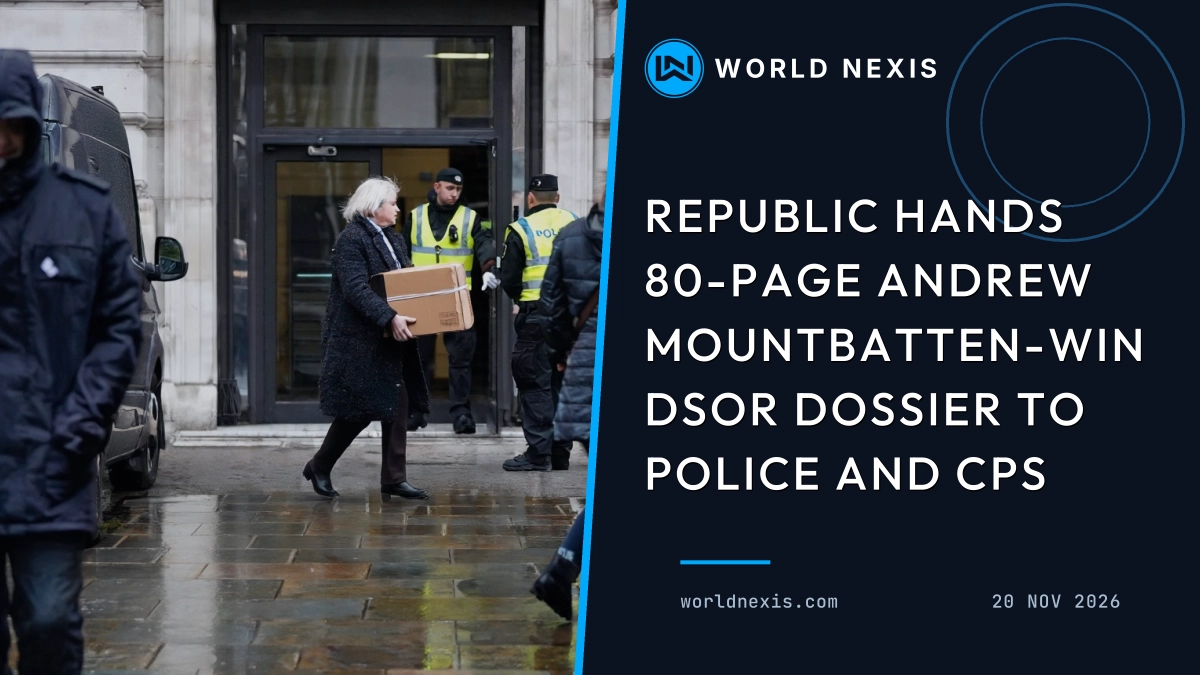
Republic has handed a new Andrew dossier to police and the Crown Prosecution Service, calling for a full investigation into “any and all suspected offences” by Andrew Mountbatten-Windsor. The anti-monarchy campaign group said it had submitted 80 pages of material setting out “a number of areas” where it believes a criminal inquiry is warranted, and wants the claims examined “without fear or favour”.
Key points
- Republic has sent an 80-page Andrew dossier to police and the CPS and asked for a full investigation.
- The group says the papers cover “a number of areas” where investigation is warranted; the contents are being withheld on legal advice.
- Andrew Mountbatten-Windsor was arrested in February on suspicion of misconduct in public office over claims he shared sensitive information with Jeffrey Epstein.
- Thames Valley Police says its misconduct in public office investigation is ongoing and that it is following all reasonable lines of inquiry.
What Republic has put before prosecutors
Republic said the details of the Andrew dossier cannot be published following legal advice. It is understood that the material relates to allegations of misconduct in public office. The group had previously announced it would bring a private prosecution against Andrew, but it changed course after his arrest and said it would trust the police and the CPS to follow the evidence.
Andrew was arrested in February on suspicion of misconduct in public office, following claims that he shared sensitive information with the paedophile Jeffrey Epstein during his time as the UK’s trade envoy.
Graham Smith, chief executive of Republic, said the handover reflected the practical limits of private prosecutions.
“Private prosecutions are usually prohibitively expensive and difficult to pursue. So, we are trusting the police and prosecutors to step up and follow the evidence, wherever that leads.”
Smith said the group made no claim about the guilt or innocence of anyone involved, but argued that “it is vital that evidence is pursued and investigations followed, and that everyone is treated equally in law”. He added: “It is important that all evidence is presented to the police and that police follow all evidence to its natural conclusion.”
Thames Valley Police, which is leading the misconduct in public office inquiry, said the investigation remains live. A force spokesperson said: “Our misconduct in public office investigation is ongoing. We cannot go into specifics of the investigation, but we are following all reasonable lines of inquiry.” The CPS said the matter was for the police.
The Andrew dossier and the wider Epstein inquiries
The Andrew dossier is the latest submission in a much broader wave of investigative activity. The release of millions of pages of Epstein-related material by the US Department of Justice in late 2025 and early 2026 triggered new lines of inquiry. Thames Valley Police, the Metropolitan Police and Surrey Police all have live investigations linked to that release.
In Scotland, Police Scotland is examining the time Andrew, Epstein and Ghislaine Maxwell spent at Balmoral, amid claims that women were trafficked to the estate. Maxwell was convicted of luring young girls for Epstein to sexually abuse.
The allegations that followed the document release ranged widely. One claim was that a second woman was sent to the UK by Epstein for a sexual encounter with Andrew. Another was that Andrew and Epstein asked an exotic dancer for a threesome at the financier’s Florida home. Andrew is also alleged to have shared confidential reports of official visits to Hong Kong, Vietnam and Singapore while he was the UK’s trade envoy.
In 2025 it emerged that Andrew had emailed Epstein in 2011, after the financier had already been jailed, telling him “We’re in this together” — three months after the then-duke insisted he had broken off all contact. It also emerged in May that detectives will consider allegations of sexual misconduct within the misconduct in public office inquiry, widening a case that began with questions about official information.
Why it matters
For readers, the immediate question is not whether a campaign group is satisfied but whether the criminal justice system can reach a conclusion. A live police inquiry into a former royal, several forces working through the same released files and an unresolved decision at the CPS all carry a cost — in police time, in legal fees and in public confidence that the law applies equally.
The wider consequence is institutional. The monarchy’s public standing rests on the claim that nobody is above scrutiny, and every new file handed to detectives tests that claim in the open. If the Andrew dossier sits unanswered for months, the argument that the authorities are dragging their feet will harden, whatever the evidential reality turns out to be.
Analysis
Having covered public services and local democracy for World Nexis News, I look first at who is actually accountable when a file like this changes hands. The answer here is Thames Valley Police and, ultimately, the CPS. Republic has done what a campaign group can do: assembled material, put it in front of the proper authorities and explained its reasoning in public. It has not asked anyone to take its conclusions on trust, and it has explicitly avoided claiming that anyone is guilty.
In my view, the facts support the argument that the burden has now shifted to the prosecutors, not the campaigners. Private prosecutions are expensive and a poor vehicle for complex misconduct claims, so Republic stepping back is proportionate. The counter-argument, and it is a serious one, is that an organisation whose central purpose is abolishing the monarchy cannot be a neutral arbiter of which royal allegations deserve attention. That criticism would land harder if Republic were prosecuting. It is handing over evidence and asking a public body to decide.
What I would watch is pace. Forces rarely announce timetables in live inquiries, but the gap between a dossier arriving and any public decision is where trust is won or lost. The strongest thing the CPS and Thames Valley Police can do now is show, reasonably quickly and in public, that the Andrew dossier has been assessed on its contents rather than on who delivered it.
What happens next
Thames Valley Police will continue its misconduct in public office investigation, which now also covers allegations of sexual misconduct. The CPS has said the matter is for the police, which means any charging decision is unlikely before detectives conclude their work. Police Scotland’s inquiry into the Balmoral claims, and the separate Metropolitan Police and Surrey Police investigations linked to the Epstein files, are continuing in parallel.
What we don’t know yet
Republic has not published the 80 pages, so the strength of the material cannot be independently judged. No timetable has been set for a charging decision, and it is not clear whether the CPS will treat the Andrew dossier as a separate matter or fold it into the existing inquiry.
Related coverage
- Ukraine security guarantee: Europe ready for major talks
- Coalition of the Willing: Martin backs major US-Russia talks
- Trump Xi Putin meeting: first trilateral, major stakes
Further reading
- Republic sends evidence on Andrew to police and CPS and calls for investigation
- Republic sends evidence on Andrew to police and CPS and calls for investigation
About the author: Liam O’Connor is the UK Politics Reporter at World Nexis News (WNN), covering uk politics. The analysis section reflects the writer’s view.

Liam O'Connor
Liam O'Connor is UK Politics Reporter at World Nexis News, covering Westminster, devolved politics and the issues that matter to voters across England, Scotland, Wales and Northern Ireland. Based in London, he reports from primary sources — Hansard, official statements, published data — and explains…



