National cyber director fired amid week of major US outages
National cyber director Sean Cairncross is out after a week of major US tech outages. What his exit means for cyber defense, and who replaces him now.
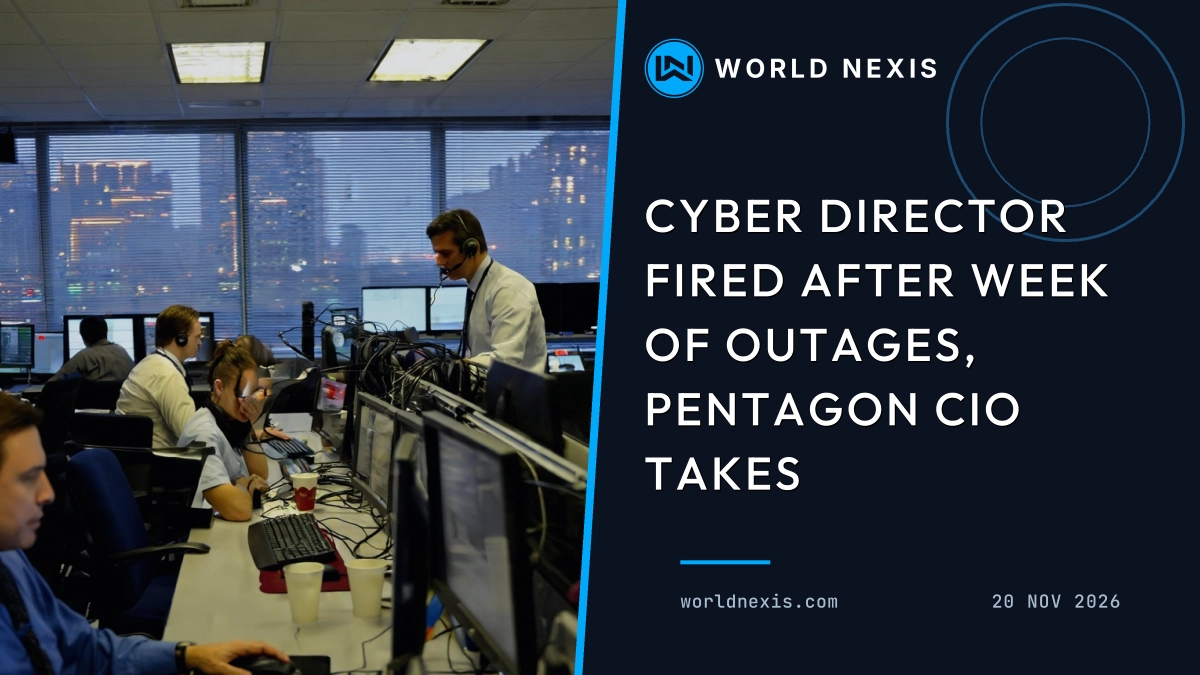
The national cyber director, Sean Cairncross, has been fired after a week of outages that hit air travel, banks, Microsoft services and the National Security Agency’s internal network. Kirsten Davies, the Pentagon’s chief information officer, takes the job in an acting capacity. It is the first senior departure inside the administration since the disruptions began.
Key points
- Sean Cairncross is out as national cyber director. President Donald Trump backed the dismissal, officials said.
- Kirsten Davies, until now the Pentagon’s chief information officer, steps in on a temporary basis.
- Outages over the past week struck Microsoft services, major banks, air traffic control and the NSA’s internal network.
- A permanent director must be confirmed by the Senate, which Democrats control from January.
Why the national cyber director was removed
The Office of the National Cyber Director advises the president on cybersecurity and coordinates strategy across federal agencies. Cairncross, a lawyer by training, had held the post since August 2025. Officials said Trump backed the firing after concerns that Cairncross lacked the cybersecurity credentials the role demands.
People familiar with the decision say the push came from Stephen Miller, a senior White House adviser who had questioned whether Cairncross had the right expertise. One administration official said Cairncross did not want to serve another two years in the job.
Cairncross called the role “the honor of a lifetime”. In a statement, he said he left “incredibly proud of our work to strengthen America’s cybersecurity, protect our critical infrastructure, confront foreign threats”, and credited President Trump’s “extraordinary leadership”.
The cyber outages that triggered the shake-up
The disruptions included a global Microsoft outage that affected hundreds of millions of users and a nationwide halt to air travel that disrupted more than 18,000 flights. Banks and the National Security Agency’s internal network were also hit.
Homeland Security Secretary Markwayne Mullin told lawmakers investigators had “seen nothing that would indicate that they are related”. He said he was “98% confident” the incidents were not malicious foreign activity, while conceding he had “absolutely not” seen so many outages in such a short window.
The country’s top intelligence official said the disruptions were separate service outages linked to maintenance and technical changes, not a coordinated or state-sponsored attack. Secretary of State Marco Rubio said officials had found “zero evidence” tying the incidents to malicious actors.
Cybersecurity specialists point to a rush to patch newly discovered software vulnerabilities in the AI age as a likely common thread. Officials have not confirmed a shared cause. Republican Senator Josh Hawley said the administration should brief lawmakers so they can “share with the American people what’s happening here”.
Kirsten Davies takes the post
Davies arrives from the Pentagon and joins a national security team that spans the intelligence agencies and the State Department. She described the moment as a critical juncture for US technology. “Our opportunity is to dominate the cyber landscape for generations to come … but only if we modernize and drive resilience into the foundations our great nation runs on,” she wrote. She added: “I am honored to continue to serve.”
Why it matters
For anyone who flies, banks or runs a business, the cyber director’s office is the part of government that decides how fast Washington coordinates when systems fail. A leadership change in the middle of an incident slows that coordination, just as lawmakers are demanding answers about a week in which planes stopped and payments stalled.
The timing also collides with politics. Any permanent national cyber director will need Senate confirmation, and Democrats take control of the chamber in January, which changes what kind of nominee can survive a vote.
Analysis
Having covered cybersecurity policy for World Nexis News for four years, I look first at what the evidence actually says. Officials have been unusually clear that they have found no sign of a coordinated attack, and the trail runs toward maintenance work and fast patching of newly found flaws. If that is right, the failure was one of resilience and coordination, not of intruders inside the wires. On that reading, one director’s resume matters far less than the office’s ability to force agencies and companies to fix fragile systems before they break.
I think the White House is right that Cairncross was a poor fit for a technical coordination role, and right that the job needs someone with an engineering and operational background. I side with Josh Hawley’s demand that the administration brief lawmakers: the public deserves a straight account of a week in which flights halted and payments froze. The strongest counter-argument is that removing a Senate-confirmed director mid-incident creates exactly the leadership vacuum the office exists to prevent, and that cost is real.
My expectation is that Davies will be judged on two things during her acting spell: whether she can explain these outages plainly, and whether she can push a resilience agenda through agencies that resist it. If she manages both, the acting label may not last long.
What happens next
Davies starts immediately in an acting capacity. The exact date of Cairncross’s departure has not been announced, and a permanent national cyber director must still be confirmed by the Senate.
Lawmakers including Hawley are pressing for a briefing on the cyber outages, and investigations into what caused them are continuing. Officials have said they have found no evidence of foreign involvement.
What we don’t know yet
Three questions remain open: when Cairncross formally leaves, whether Trump will name a permanent national cyber director before January, and whether the week’s outages share a single technical cause. No nominee has been announced.
Related coverage
- US tech outages: officials insist no cyberattack, 1 week on
- National Book Award 2026: major wins for Assadi and ElGendy
- Cambridge Word of the Year 2026: ‘human’ wins amid AI fears
Further reading
- White House national cyber director leaving his post
- Trump’s National Cyber Director Sean Cairncross fired amid widespread tech outages
About the author: Priya Nair is the Technology Correspondent at World Nexis News (WNN), covering technology. The analysis section reflects the writer’s view.

Priya Nair
Priya Nair is Technology Correspondent at World Nexis News, covering artificial intelligence, cybersecurity, consumer devices and the companies building them. Based in London, she explains how new technology works, who it affects and what the evidence actually shows, with attention to privacy, competition and the…