National Book Award 2026: major wins for Assadi and ElGendy
The National Book Award for fiction went to Hannah Lillith Assadi, while Abdelrahman ElGendy won nonfiction despite being denied a visitor visa.
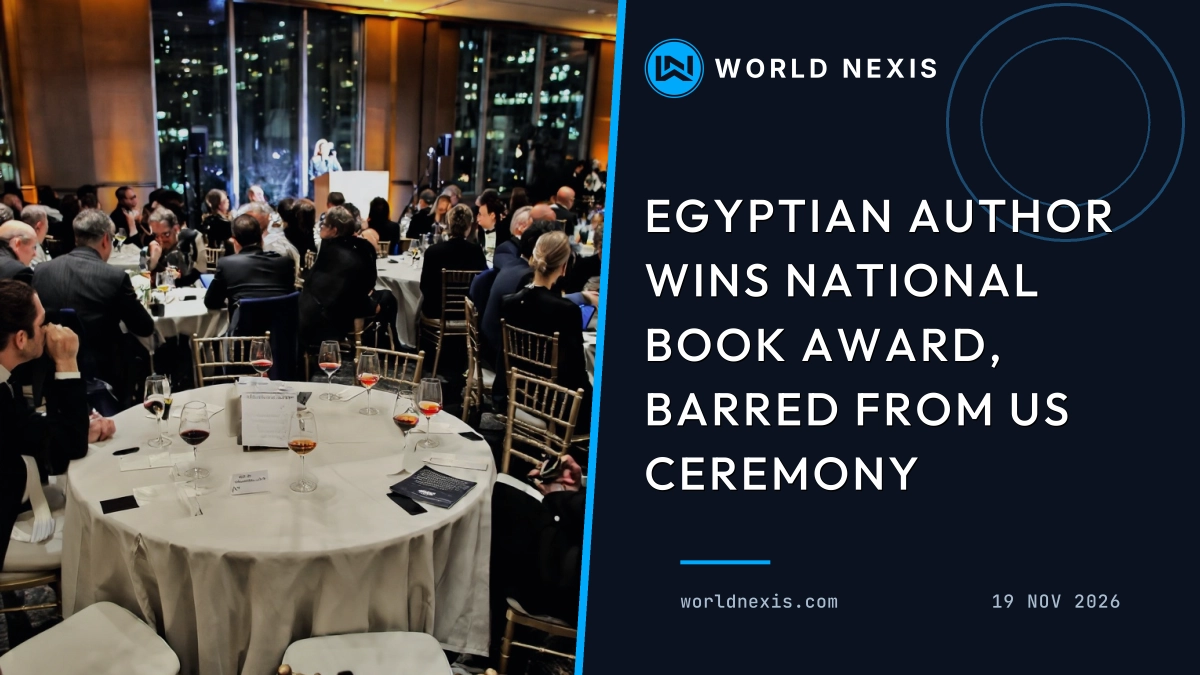
The National Book Award for nonfiction went to Abdelrahman ElGendy on Wednesday night, and the Egyptian author was not in the room to accept it. The United States refused him a visa to travel to New York. Hannah Lillith Assadi took the fiction prize at the same ceremony, the 77th National Book Awards, held at Cipriani Wall Street.
Key points
- Abdelrahman ElGendy won the National Book Award for nonfiction for Huna: A Memoir of Revolution, Prison, and Becoming, his debut book.
- Hannah Lillith Assadi won fiction for Paradiso 17, a novel shaped by her father’s escape from the Nakba in 1948.
- Brenda Hillman won the poetry prize for Still House in the Desert: An eco-contemplation.
- Each winner received $10,000, and 1,912 books were submitted for judging this year.
How the National Book Award night unfolded
The National Book Awards winners were announced at a gala hosted by Kyle MacLachlan. Michelle Zauner opened the evening with a musical performance. MacLachlan used the podium to describe a publishing trade under strain.
“This is not an easy time for the publishing industry,” he said, pointing to “artificial intelligence and content flooding, market consolidation, retailer dominance, supply chain issues, and ink shortages driven by geopolitical disruption.”
Hillman carried her book to the stage to collect the poetry prize. She told the room the collection was about her mother, her childhood and clearing out a house after a parent dies, and she thanked immigrant mothers, including her own Brazilian mother.
By the time the National Book Award for fiction was called, the evening had already turned serious. War, immigration and loss ran through the speeches all night.
A visa refusal and an empty chair
ElGendy spent more than six years as a political prisoner in Egypt. He left the United States in April 2025, fearing deportation back to Egypt, and now lives in the United Kingdom. A US consular office then refused him a visitor visa for the ceremony.
His editor at Hogarth, Helen Thomaides, collected the National Book Award on his behalf and read the speech he had written. In it he dedicated the prize to Palestinians, to political prisoners and to “the 10s of 1000s of souls disappeared into ICE concentration camps”.
“If you’re listening to this, then a years-long dream of mine has come true, and I’m not there to live it with you,” he wrote.
He described once rehearsing acceptance speeches under his duvet in a prison cell, and said the memoir began as a way of putting distance between himself and the abuse he endured. “Today, that dream should have come full circle, but like so many of the circles ruptured in my life, it will remain unfinished,” he wrote, blaming an “oppressive regime with a fascist ideology”.
He was one of two finalists refused entry to the United States over visa problems. The National Book Foundation, which administers the prizes, called both decisions “unjust”. It also said it had no concerns about the eligibility of ElGendy’s title.
The State Department declined to comment on individual cases. In a statement, it said the administration is “fully enforcing US immigration laws”, and repeated Secretary of State Marco Rubio’s line that “a visa is a privilege, not a right”.
Assadi’s father, the Nakba and a third novel
Assadi’s Paradiso 17 follows Sufien, a Palestinian man displaced during the Nakba in 1948, when more than 700,000 Palestinians fled or were expelled from their homes. The story draws on her father, Sami Abdul-Fattah Al-Assadi, who escaped as a child with his family, studied in Italy and later settled in New York.
She began writing at his deathbed. Judges praised her “elegant lyricism” and her “ambitious bending of time and space”, calling the novel “a visionary, finely wrought portrait of rupture and endurance”.
“I’ve watched cancer ravage my father’s body, and genocide ravage his people and their children,” she said. “And perhaps this is the Palestinian story on this earth, so beautiful, so painful, and isn’t that story all of ours?”
She won against a shortlist that included Edwidge Danticat and Valeria Luiselli. Accepting the fiction National Book Award, she said: “What a beautiful story this has been, from its origins at my father’s deathbed until now, ending here and accepting this award. And so full of pain.”
Why it matters
The National Book Award list is the closest thing American publishing has to a shopping list. A win pushes a debut out of a small print run and into high-street shops, and this year it also puts a memoir about Egyptian detention and American immigration enforcement in front of readers who might never have picked it up.
For exiled writers, the result carries a second message: a book can win the country’s biggest literary prize from outside the country. Whether the author can then enter it is a separate question, and one the prize itself cannot answer.
Analysis
Having covered publishing for World Nexis News, I look first at what a prize jury is willing to risk. This one risked a great deal, and the judges deserve credit for reading past the paperwork that kept one of their winners away from the table.
I side with the National Book Foundation, which called the visa refusals unjust. A prize exists to judge a book, not a passport, and the foundation was right to hold its ground when questions were raised about ElGendy’s eligibility. The strongest counter-argument is real: a visa is a privilege granted by a state, as the State Department says, and no literary prize can override immigration law. But that argument explains the rule; it does not explain why a ceremony honoring a memoir about imprisonment had to be emptied of its author. When the National Book Award goes to a writer who cannot enter the country, the award still means something. It simply means something colder than it should.
The pairing matters too. One evening honored a novel about a Palestinian family’s displacement and a memoir about a prison cell, then could not seat one of those authors. I think readers will remember that far longer than any speech.
What happens next
Both National Book Award winners now carry the prize seal into the winter sales season, and each receives $10,000. ElGendy remains in the United Kingdom, where he has lived since leaving the United States.
The foundation has said only that it had no concerns about the eligibility of his title. The State Department has declined to discuss any individual visa case.
What we don’t know yet
It is unclear whether ElGendy will be able to travel to the United States for future readings or ceremonies, or whether the foundation will press officials over the two refusals. The reasoning behind the visa decision has not been made public.
Related coverage
- Cambridge Word of the Year 2026: ‘human’ wins amid AI fears
- CMA Awards 2026: Ella Langley ties record as Swift returns
- Jeffries speaker nomination triggers major Trump probes
Further reading
- Hannah Lillith Assadi wins National book award for ‘visionary’ novel Paradiso 17
- Abdelrahman ElGendy wins National Book Award after U.S. denies his visa to attend ceremony
About the author: Emily Carver is the Culture & Entertainment Writer at World Nexis News (WNN), covering culture & entertainment. The analysis section reflects the writer’s view.

Emily Carver
Emily Carver is Culture & Entertainment Writer at World Nexis News, covering film, television, music, gaming, books and the creative industries from Los Angeles. She writes about the business and craft behind the work — streaming economics, production decisions, criticism and the way culture travels…