Cambridge Word of the Year 2026: ‘human’ wins amid AI fears
Cambridge Word of the Year 2026 is 'human', the dictionary has announced, citing AI's growing influence on how we talk about ourselves and our work.
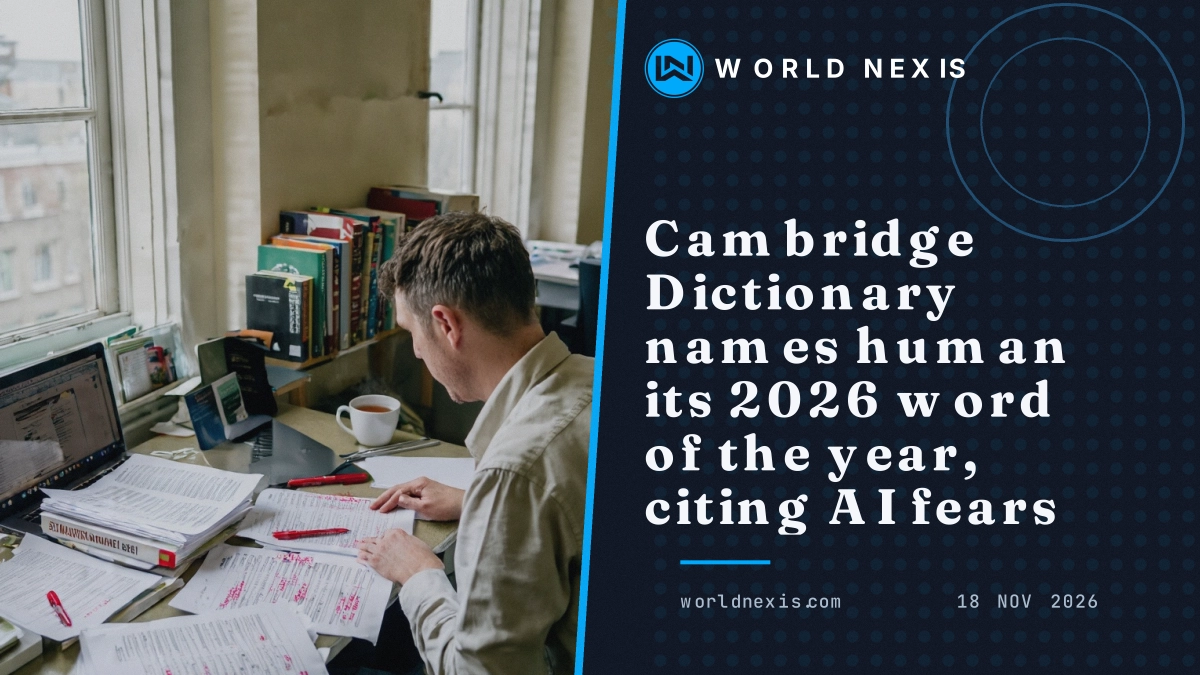
Cambridge Word of the Year 2026 is “human”, the dictionary announced on 18 November, choosing a term in use since the 1450s to capture a year reshaped by artificial intelligence. Cambridge defined the adjective as “having the qualities, faults, and feelings that people have, as opposed to gods, animals, or machines”. It beat a shortlist crowded with technology terms.
Key points
- Cambridge Word of the Year for 2026 is “human”, announced on 18 November.
- Editor Colin McIntosh said AI is changing the way people talk about being human.
- The word beat “agent”, “analogues” and “wholesome” to the title.
- Collins named “mogging” its word of the year earlier this month.
Cambridge Word of the Year: “human” chosen to draw a line against AI
The dictionary said the meaning and use of “human” had become more important in the age of the chatbot. Colin McIntosh, an editor of the dictionary, said AI was “changing the way we talk about being human” and had led to the word being deployed to separate our work from that of advanced computer systems.
“Fears about what humans may lose when we outsource our thinking has made us reconsider the extent to which we rely on AI: from top mathematicians to teachers of young children,” McIntosh said.
He also pointed to a recent increase in compounds such as “human-made”. In his view, those formations show how the word now distinguishes the work or qualities of people from AI. Cambridge said the term derives from the Latin “humanus” and has been in use since the 1450s.
Dictionaries usually pick either a fresh word, often slang that has crossed into the mainstream, or an older word that has taken on a new sense. This year’s Cambridge Word of the Year went the second route, reviving an adjective that long predates computing to describe a divide technology has made sharper.
Rachel Adams, a professor at the University of Cambridge who studies AI governance and human rights, said the question behind the pick is an old one. “AI brings us back to questions that we’ve asked for millennia: who are we, what does it mean to be human?” she said. “The answer to these questions has never been fixed or stable, but the act of asking it is something we have in common.”
AI terms dominate the shortlist as dictionaries track the same shift
The runners-up in the Cambridge Word of the Year shortlist show how far machine intelligence has moved into everyday speech. “Agent”, the term for an AI system that can make decisions and operate without human control, appeared alongside “analogues”, which covers non-digital activities and objects.
“Wholesome” was the only non-tech contender, used to describe something likely to improve your life physically, morally or emotionally.
The backdrop is the rapid spread of generative AI since ChatGPT arrived three years ago. That has pushed questions about authorship, originality and machine-made content into ordinary conversation, and onto the vocabulary lists dictionaries now track.
Word of the Year selections have leaned on AI for several years. Collins picked an AI word of the year in 2023 with “AI” itself, the same year Cambridge chose “hallucinate” for a system’s tendency to invent information. Merriam-Webster named “slop” its word last year for low-quality AI-generated content, and Collins went with “vibe coding” for AI-assisted software development.
Looksmaxxing and aura farming join the dictionary
Cambridge has also added tech-adjacent terms to its listings. They include “looksmaxxing”, the pursuit of maximum physical attractiveness that has been linked to the online manosphere, and “aura farming”, the practice of doing things to project a personality that others find appealing.
The Guardian noted that social media users asked last year why former UK prime minister Keir Starmer was “aura farming” in his TikToks.
Bill Gates, the Microsoft co-founder who has promoted the careful use of AI, welcomed the choice. “AI is making us think harder about what it means to be human,” he said. “The measure of AI’s success should be how much it improves human lives.”
Analysis
Having covered AI policy for WNN, I look first at the usage evidence rather than the announcement itself. The most useful detail in the Cambridge Word of the Year pick is not the headline but McIntosh’s observation about “human-made” compounds. That is a measurable change in how people label work, and it is the kind of shift lexicographers are better placed to spot than any regulator.
I side with those who read this as a genuine linguistic event rather than a publicity stunt. The evidence points one way: dictionaries have now recorded AI-adjacent vocabulary across several successive years, and the human word of the year arrives alongside offline counter-terms such as “analogue”. The strongest counter-argument is that a dictionary can guarantee coverage simply by choosing an AI-adjacent word, and that “human” is vague enough to mean almost anything. That criticism has force, but it does not explain the compound data.
For readers, the practical question is narrower than the philosophical one. When you hand a task to a chatbot, the Gates framing is a reasonable test: does it improve the life of the person on the other end? What I will watch next is whether “human-made” becomes a routine label on products and services, the way other origin claims did before it. If it does, the Cambridge Word of the Year will have anticipated a real shift rather than merely described one.
What happens next
The Cambridge Word of the Year 2026 has now been confirmed, and the new tech-adjacent entries, including “looksmaxxing” and “aura farming”, are already in the dictionary’s listings. Collins named “mogging” its word of the year earlier this month. Cambridge has not set out further plans beyond the announcement.
Related coverage
- GTA VI release: 13-year wait ends with biggest 2026 launch
- Freezer murder trial: 65-year-old denies murdering friend
- Bathgate crash: tributes to four-year-old Tiger Munthali
Sources
- ‘Human’ wins Cambridge dictionary’s word of the year (theguardian.com)
- Cambridge Dictionary chooses ‘human’ as word of the year in response to AI fears (abcnews.com)
- Cambridge Dictionary chooses ‘human’ as word of the year in response to AI fears (wral.com)
About the author: Priya Nair is World Nexis News’s Technology Correspondent, covering technology. The analysis section reflects the writer’s view.

Priya Nair
Priya Nair is Technology Correspondent at World Nexis News, covering artificial intelligence, cybersecurity, consumer devices and the companies building them. Based in London, she explains how new technology works, who it affects and what the evidence actually shows, with attention to privacy, competition and the…